Self-inflating ghosts
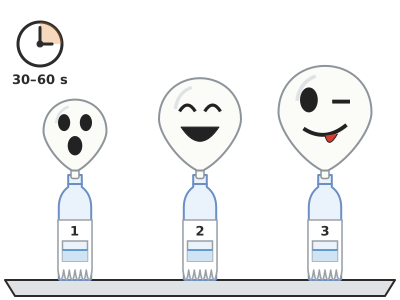
Three 500 ml bottles of vinegar turn into ghosts: when you lift the white balloon fitted over the neck, the bicarbonate of soda inside drops into the vinegar and the gas produced inflates the balloon with its painted face. In the «ghost race», each balloon holds 1, 2 or 3 teaspoons of bicarbonate of soda and the one that grows most wins.
What they will learn
- That when an acid (vinegar) meets a base (bicarbonate of soda), a new substance forms that wasn't there before: an invisible gas, carbon dioxide.
- That this gas takes up far more space than the powder it comes from: 1 teaspoon of bicarbonate of soda (about 5 g, enough to fill a pen cap) gives more than 1 litre of gas.
- That more bicarbonate gives more gas only while there is vinegar left: when one ingredient runs out, the reaction stops (limiting reactant).
- How to run a fair test: three identical bottles, the same vinegar and just one thing different (the amount of bicarbonate).
- How to measure something soft and round with a tape (the balloon's «belly») and estimate its volume from a table.
Prepare beforehand
- Print the template sheet at 100 %: funnel A and faces C on one sheet, sheets B on card, tape D-E-F on an A4 sheet. Check the red 50 mm ruler in the header.
- Gather three 500 ml bottles of the same model. Wash them, remove the labels and leave them to drain upside down: the inside can stay damp, but the outside of the neck must be dry so the balloon doesn't slip.
- Check that the bicarbonate of soda is dry and loose. If it has lumps, crush them with a spoon on a plate.
- Set up the table: tray, measuring jug, kitchen funnel, teaspoon, knife for levelling, kitchen roll and a pair of goggles per child. Keep the vinegar bottle to hand but off the tray.
- If any children are allergic to latex, buy latex-free balloons (nitrile or «latex free») or do the experiment with a 1 litre freezer bag taped around the neck.
Materials and tools
- 500 ml plastic bottles — 3 identical (same model)
water or fizzy drink bottles, clean, label removed and no cap; standard neck Ø 27–28 mm on the outside - White latex balloons — 3 + 3 spare buy
round, 30 cm (12"), ordinary party balloons - White vinegar — 200 ml per bottle (600 ml for the race; 1 litre with the experiments)
spirit or white wine vinegar, 5–6 % acidity (it says on the label) - Bicarbonate of soda — 6 level teaspoons (≈ 30 g) for the race; a 100–200 g tub for everything
baking bicarbonate of soda (NaHCO₃), dry and lump-free - Black permanent marker — 1
medium tip (CD-marker type), for drawing the faces on the latex - White card — 2 A4 sheets
160–200 gsm, for funnel A and the three sheets B - A4 sheet — 2 A4 sheets
80 gsm, for faces C and measuring tape D-E-F - Clear sticky tape — ≈ 50 cm
to close the funnel, join the sections of the tape and the sheets - Balloon pump — 1 (optional) buy
manual, piston type
Tools
- Scissors — cut out the funnel, the sheets, the faces and the tape
- Teaspoon — measure the bicarbonate of soda (always level: level it off with the back of a knife)
- Measuring jug — measure 200 ml of vinegar per bottle
- Kitchen funnel — pour the vinegar into the bottles without wetting the neck
- Safety goggles (or swimming goggles) — one pair per child during the race
- Baking tray or washing-up bowl — stand the three bottles on it in case they tip over
- Blunt table knife — level off the teaspoons
- Kitchen scales (optional) — weigh the bicarbonate of soda: 5, 10 and 15 g
- Stopwatch (phone) — time how long each ghost takes to inflate
Pieces and templates
- A · Funnel for loading the balloon ×1 — card 160–200 gsm
- B · Ghost sheet ×3 — card 160–200 gsm (white)
- C · Ghost faces ×1 — paper
- D · Measuring tape, section 0–25 cm ×1 — paper
- E · Measuring tape, section 25–50 cm ×1 — paper
- F · Measuring tape, section 50–75 cm ×1 — paper
Step by step
Dress the bottles
Cut out the three sheets B along the wavy line and the window. Wrap each one round a bottle, with the wavy edge touching the table and the window at the front, and close it with tape, overlapping whatever is left over. Write 1, 2 and 3 in the gap on each sheet.
1 Cut out the three sheets B along the waves and the window 2 Wrap it round the bottle with the waves at the bottom and tape it closed 3 Write 1, 2 and 3: three dressed bottles Check: The three bottles are standing up, with their number at the front and the window level with the lower part.Tip: The window lets you see the vinegar bubbling. If you don't want to decorate, just write the number on the bottle with the marker.Make the measuring tape
Cut out sections D, E and F. Stick the 0 of E right on top of the blue zone at the end of D, and the 0 of F on top of the blue zone of E, with a glue stick or tape. You end up with a 75 cm tape with the numbers 0 to 75 in a row.
1 Cut out sections D, E and F 2 Stick the 0 of E on top of the blue zone of D (and F on E) 3 A 75 cm tape, with the numbers in a row and no jumps Check: After the 25 of D comes the 30 of E, and after the 50 of E comes the 55 of F, with no gaps or jumps.Make the funnel
Cut out semicircle A along the large arc and the small one. Roll it into a cone until the two straight edges overlap by about 10 mm and close it with tape on the outside. The tip is left with a hole of about 13 mm, which fits into the neck of the balloon.
1 Cut out semicircle A along the large arc and the small one 2 Roll it into a cone with a 10 mm overlap and tape it closed 3 The tip goes 1–2 cm into the neck of the balloon Check: Looking inside you can see light through the tip, and the tip goes 1–2 cm into the neck of a balloon without tearing it.Stretch the balloons adult
Inflate each balloon with the pump until it is about 20 cm wide and let it down; do this 2 times. A stretched balloon inflates with much less force, and the gentle push of the gas from the bottle is enough to blow it up.
1 The adult inflates the balloon with the pump to about 20 cm 2 Let it down and repeat 2 times 3 The stretched balloon is soft and a little bigger Check: The deflated balloon is softer and a little bigger than a new one.Tip: With no pump, an adult blows it up by mouth, each person their own balloon. Under 8, an adult always handles the balloon.Paint the faces
Inflate a balloon to about 10 cm wide (like a grapefruit) and have an adult hold it by pinching the neck. Copy a face from template C with the permanent marker, on the side opposite the neck, leave it to dry for 1 minute and let it down. Do the same with the other two.
1 Inflate to about 10 cm; the adult pinches the neck 2 Copy the face with permanent marker 3 Leave to dry for 1 minute, let it down and mark its dots Check: When you let it down the face shrinks but doesn't rub off when you touch it.Tip: Draw 1, 2 or 3 small dots under the face: that way you'll know which balloon goes on which bottle.Load the bicarbonate of soda
Put the tip of funnel A into the neck of balloon 1 and pour in 1 level teaspoon of bicarbonate of soda (about 5 g); tap the funnel until it has all gone in. In balloon 2 put 2 level teaspoons (10 g) and in balloon 3, 3 level teaspoons (15 g).
1 With funnel A, put 1 level teaspoon into balloon 1 2 Balloon 1: 1 teaspoon; balloon 2: 2; balloon 3: 3 3 If the powder gets stuck, push it with a skewer without piercing the balloon Check: When you squeeze the balloon with your fingers you can feel the powder inside; number 3 clearly holds more than number 1.Tip: If the powder gets stuck in the tip, push it with a wooden skewer without piercing the balloon. The balloon and the funnel must be dry.Add the vinegar
Put your goggles on. Using the measuring jug and the kitchen funnel, pour 200 ml of vinegar into each bottle: the same amount in all three. Stand the three bottles on the tray, about 25 cm apart.
1 Put your goggles on and measure 200 ml of vinegar 2 Pour it into the bottle with the kitchen funnel 3 All three at the same level, on the tray and 25 cm apart Check: The vinegar reaches the same level in all three bottles, about 6 cm from the bottom.Tip: Dry the outside of the bottle neck with kitchen roll if it got wet: the balloon grips better.Fit the balloons
Stretch the neck of balloon 1 with both thumbs and pull it over the neck of bottle 1 until it goes 1 cm down, with the balloon hanging to one side so the powder doesn't fall in. Do the same with balloons 2 and 3 on their bottles.
1 Stretch the balloon's neck with your thumbs and pull it over the bottle 2 Leave the balloon hanging to one side, with the powder inside 3 Don't stand it upright: the powder would fall in too soon Check: The three balloons hang folded over one side of the bottle and no bicarbonate of soda has fallen into the vinegar yet.Tip: If you find it hard, have one child hold the bottle and another stretch the balloon. Under 8, the adult does it.Ghost race!
Each child stands behind a bottle and holds their balloon by the end. On the count of «3, 2, 1, ghosts!», lift all three balloons at once and shake them a little so all the powder falls in. Hold the bottle at the bottom, without squeezing it, and watch them grow.
1 Everyone behind their bottle: countdown 2 Lift the balloons at once and shake them 3 In under a minute they stand up: number 3 grows most Check: The vinegar bubbles straight away and within 30–60 seconds the balloons stand up; number 3 grows more than 2 and 2 more than 1.Tip: Atmosphere: switch off the main light and light the bottles from below with a torch, like a ghost story.Measure the ghosts
Wait 2 minutes for the bubbles to stop. Wrap the measuring tape round the widest part of each balloon, without pulling tight, and read the centimetres where it meets the 0. Under the numbers on E and F you have the approximate litres of gas.
1 Wrap the tape round the widest part of the balloon, without pulling tight 2 Read the number where it meets the 0: here, 52 cm 3 Note down the three measurements and the litres from the tape (estimate) Check: Rough values (estimate): balloon 1 about 40 cm (≈ 1 litre), balloon 2 about 52 cm (≈ 2.5 litres), balloon 3 about 60 cm (≈ 3.5 litres).Tip: Measure gently: if you squeeze, the balloon changes shape and the reading comes out smaller.Tidy up and clean
Pinch the neck of each balloon, take it off the bottle and let the gas out, pointing it away from your face. Pour the liquid down the sink with the tap running and rinse the bottles. The balloon goes in the general waste bin; the rinsed bottle, in the recycling.
1 Pinch the neck, take the balloon off and let the gas out away from your face 2 Pour the liquid down the sink with the tap running 3 Rinsed bottle in the recycling; balloon in general waste Check: There is no liquid left in the bottles and no bits of balloon on the table or the floor.Tip: If you want to keep a ghost, tie a knot in it before letting go: you'll see it goes down within a few hours, much sooner than one blown up with air.
Does it work? The test
Three identical 500 ml bottles with 200 ml of vinegar each; stretched balloons with 1, 2 and 3 level teaspoons of bicarbonate of soda (5, 10 and 15 g). They are lifted at the same time, you wait 2 minutes and measure each balloon's belly with tape D-E-F at the widest part.
What should happen: Estimate: all three balloons start to swell within 2–3 seconds and stand up in under 1 minute. At the end, balloon 1 measures about 38–44 cm round the belly (≈ 1–1.4 litres of gas), balloon 2 about 50–55 cm (≈ 2.3–2.8 litres) and balloon 3 about 56–62 cm (≈ 3.3–4 litres). Number 3 grows a little less than it «should» because it almost runs out of vinegar. If a balloon doesn't inflate, check the troubleshooting table.
If something goes wrong
- The balloon hardly inflates even though the vinegar is bubbling — Gas is escaping at the neck: the balloon isn't far enough on or the bottle neck was wet. Solution: Pull the balloon at least 1 cm down the neck and wrap a turn of sticky tape round the join. Always dry the outside of the neck before fitting it.
- The balloon stays wrinkled and small — New balloon not stretched: latex needs an initial push that the gas from the bottle can barely give. Solution: Inflate and deflate the balloon 2–3 times with the pump before loading it (step 4).
- The bicarbonate of soda sticks inside the balloon — The balloon or the funnel was damp, or a paste has formed in the tip. Solution: Shake the balloon downwards and tap it with your finger. Next time, load the powder with everything dry and don't blow into the balloon after stretching it.
- The powder falls in too soon while fitting the balloon — The balloon was put on upright instead of hanging to one side. Solution: That bottle has already started: leave it and prepare another one the same. When fitting the balloon, fold it at the neck and hold it hanging down until the countdown.
- The balloon pops off the bottle — Balloon neck too loose or a wide-necked bottle. Solution: Use water bottles with a standard neck (Ø 27–28 mm) and secure the balloon's neck with tape or a rubber band wound twice.
- Balloons 2 and 3 end up almost the same — Lower-acidity vinegar (4–5 %) or less than 200 ml: the vinegar runs out before the bicarbonate of soda. Solution: Check the acidity on the label and measure the 200 ml. If it's still the same, you've discovered the limiting reactant! Add 50 ml more vinegar to bottle 3 at the side of the balloon (taking it off for a moment) and you'll see it grow more.
- The ghosts go down after a while — Carbon dioxide passes through latex much faster than air and also slowly dissolves in the liquid. Solution: That's normal: measure after 2 minutes. To keep them, tie a knot, but expect them to be soft within a few hours.
Safety
- Goggles on during the race and when taking the balloons off: vinegar splashed in the eyes stings. If it gets in, rinse with plenty of water for 10 minutes.
- Balloons: under 8, an adult inflates, fits and removes them. A deflated balloon or a piece of burst balloon can cause choking if put in the mouth: pick up the pieces straight away and don't leave loose balloons within reach of little ones.
- Don't close the bottle with the cap or with anything that doesn't give while there is vinegar and bicarbonate of soda inside: the gas raises the pressure and the cap can shoot off. The balloon is fine because it stretches.
- Latex allergy: ask beforehand. For those children, use latex-free balloons or a 1 litre freezer bag held on with tape.
- Each child only blows up their own balloon by mouth, or better still, use the pump. Nobody drinks or tastes the liquid in the bottles.
- Use plastic bottles, never glass, and work on a tray: spilt liquid makes the floor slippery.
The science behind it
For children
Vinegar is a little bit acidic, which is why it stings your tongue, and bicarbonate of soda is the opposite of an acid. When they meet, they turn into new things, and one of them is an invisible gas: the same one that makes the bubbles in fizzy drinks. The gas needs loads of space, more than a thousand times what the powder took up, and as the bottle is already full, it pushes towards the only place that gives way: the balloon. That's why the ghost grows by itself. If you add more bicarbonate, more gas comes out, but only until the vinegar runs out.
For the adult
Acid-base reaction with gas release: NaHCO₃ + CH₃COOH → CH₃COONa + H₂O + CO₂. A 5 % vinegar contains about 50 g/L of acetic acid (M = 60 g/mol): ≈ 0.83 mol/L, so 200 ml provides ≈ 0.17 mol (≈ 0.20 mol if it is 6 %). A level teaspoon of bicarbonate of soda weighs about 5 g (it varies between 4 and 6 g depending on how it is filled; scales remove the error): 5 g / 84 g/mol ≈ 0.06 mol. Each mole of bicarbonate that reacts releases 1 mol of CO₂, which at 20 °C and ambient pressure takes up ≈ 24 L. Estimates for the race: balloon 1 (5 g, 0.06 mol, bicarbonate limiting) ≈ 1.4 L; balloon 2 (10 g, 0.12 mol, bicarbonate still limiting) ≈ 2.9 L; balloon 3 (15 g, 0.18 mol) with 5 % vinegar is acid-limited (0.17 mol) ≈ 4.0 L, and with 6 % ≈ 4.3 L. You have to subtract the CO₂ that stays dissolved in the 200 ml of liquid (solubility ≈ 1.7 g/L at 20 °C: ≈ 0.3 g, about 0.2 L) and the little that the latex pressure compresses (3–5 kPa in a stretched balloon, 3–5 %), so ≈ 1.2, 2.7 and 3.8 L are expected. The air in the bottle doesn't count: the 300 ml headspace stays occupied, and the balloon's volume is practically that of the added CO₂. To measure it without water or measuring cylinders, the circumference of the balloon's equator is used: if it were a sphere, V = C³ / (6π²); 40 cm → 1.1 L, 52 cm → 2.4 L, 60 cm → 3.6 L. The balloon on the bottle is more elongated than a sphere, so the tape gives a volume somewhat lower than the real one: it is an approximate lower bound. The excess vinegar in bottles 1 and 2 is confirmed because no powder is left; in bottle 3, with 5 % vinegar, a little unreacted bicarbonate may remain at the bottom (reactant in excess). Stretching the balloon first matters: a new latex balloon shows a pressure peak when it starts to inflate that the gas from the reaction struggles to overcome. The reaction is slightly endothermic (the bottle cools by 1–2 °C) and the products, sodium acetate and water with some leftover acetic acid, can be poured down the drain with water without any problem. CO₂ is denser than air (1.8 versus 1.2 g/L), which is why a balloon inflated this way falls when released, and it also diffuses through latex much faster than air, hence it goes down within hours.
- acid: a sour-tasting substance, like vinegar or lemon, that reacts with bases
- base: the opposite of an acid; bicarbonate of soda is a mild base
- carbon dioxide (CO₂): an invisible gas formed in the reaction; it's the one in the bubbles of fizzy drinks
- limiting reactant: the ingredient that runs out first and makes the reaction stop
- circumference: the distance all the way round something round, like the balloon's belly
By age
- 5–7 years: The adult stretches, fits and removes the balloons and paints the faces with the child (the child chooses the face and draws the dots). The child measures the teaspoons, pours the vinegar with the funnel and lifts their balloon at the countdown. Focus on «they mix and a gas comes out that inflates the balloon» and on putting the ghosts in order from small to big.
- 8–10 years: They do everything themselves wearing goggles, except blowing up by mouth. Have them write down their prediction before the race, fill in the record table and compare it with what happened. Add the water ghost experiment to talk about the control test.
- 11–12 years: Have them weigh the bicarbonate of soda on the scales, write the reaction and calculate the moles of bicarbonate and acetic acid in each bottle to predict the volume of gas and which is the limiting reactant. Then have them compare their prediction with the tape and explain why the measurement comes out a little lower (dissolved gas, non-spherical balloon).
In a group or in class
Teams of 3 children, one three-bottle race per team (in a class of 24, eight teams). Before the session: print a funnel, a measuring tape and three sheets per team, stretch all the balloons (with a pump) and prepare a 1 litre bottle of vinegar and 30 g of bicarbonate of soda per team, in a cup. 50-minute session: 15 min to cut out and assemble the tape, funnel and sheets; 10 min to paint the faces; 10 min to load and fit; a simultaneous race for the whole class with a shared countdown; 10 min to measure and note results in a table on the board; 5 min to tidy up. A pouring table with a tray, kitchen funnel and measuring jug run by the adult, and a bin bag for burst balloons.
Challenges
- Giant ghost: get the biggest balloon possible with a 500 ml bottle (hint: you need more vinegar and more bicarbonate in just the right proportion; work out how much before trying).
- Exact ghost: get a balloon with a 50 cm belly, no more, no less, choosing the amount of bicarbonate yourself.
- Haunted house scene: make a house with cut-out windows from a shoebox and hide the three bottles behind it, so that the ghosts «peep out» over the roof as they inflate.
- Halloween monster family: an orange balloon with a pumpkin face, a black balloon with card wings stuck to the neck (bat) and a white one; which inflates first?
- Slow-motion ghost: film the race on a phone and count the frames until each balloon stands up to time it to a tenth of a second.
More free projects
- Bouncy egg without a shell
- Coloured carnations
- Fizzy drink and sweets fountain
- Foaming volcano
- Giant yeast foam
- Hidden colours in ink
- Homemade stretchy slime
- Moving colours in milk
- Oil bubble lamp
- Raisins that rise and sink
- Red cabbage acid indicator
- Secret messages with lemon juice
- Cubic salt crystals
- Rock candy on a string