Secret messages with lemon juice
Messages written in lemon juice that can't be seen once dry; when the paper is heated with an iron (or an incandescent bulb), the juice darkens before the paper does and the message appears in brown. Includes a cipher wheel for writing doubly secret messages.
What they will learn
- That heat can cause an irreversible chemical change: the juice darkens (caramelises and oxidises) and never becomes invisible again.
- That some substances darken at a lower temperature than others, and that this lets you «reveal» only what has been written.
- To compare several liquids against a control (water) and to time how long they take to appear.
- What a shift cipher (Caesar cipher) is and how a key is used.
Prepare beforehand
- Print the cipher wheel (A and B) on card and the test card (C) on ordinary 80 gsm paper, at 100 %.
- Empty the iron's water tank (no steam: it would wet and wrinkle the paper) and check where the 2-dot setting is.
- Check which lamp you have: an LED one won't reveal anything; use the iron.
- Set up an ironing area separate from the writing area, with a folded towel on the table and the iron out of children's reach.
- Do a test yourself first: write one letter, let it dry and iron it for 30 s to find the right setting for your iron.
Materials and tools
- Lemon — half (≈ 15–20 ml of juice)
fresh; bottled juice works too - Water — 5 ml (1 teaspoon)
to thin the juice a little so it flows better from the brush (optional) - Cotton buds or a fine paintbrush — 2–3 cotton buds or 1 size 2–4 brush
the brush gives finer letters; the cotton bud gives thick strokes for younger children - White paper — 3–4 sheets
matt 80 gsm printer paper; not glossy or photo paper - Small cup — 1 per liquid
a yoghurt pot or shot glass - Clothes iron — 1
on 2 dots (wool/silk, ≈ 150 °C) and WITHOUT steam (empty water tank) - Old towel or cotton cloth — 1
to iron on top of the table without damaging it - Card and split pin — 1 A4 sheet of 200 gsm card + 1 split pin
for the cipher wheel
Tools
- Lemon squeezer — squeezing the juice out of the lemon
- Scissors — cutting out the cipher wheel and the test card
- Iron — revealing the message adult
- Stopwatch (phone) — timing how long each ink takes to appear
Pieces and templates
- A · Cipher wheel: outer disc ×1 — 200 gsm card
- B · Cipher wheel: inner disc ×1 — 200 gsm card
- C · Ink test card ×1 — white 80 gsm paper
Step by step
Squeeze the lemon
Squeeze half a lemon into a small cup (≈ 15–20 ml). If there is pulp or pips, strain it through a tea strainer. Add 1 teaspoon of water (5 ml) and stir.
1 Squeeze half a lemon into a small cup 2 Strain it through a tea strainer to remove pulp and pips 3 Add 1 teaspoon of water (5 ml) and stir Tip: Without pulp, the brush won't leave lumps that show up later when held to the light.Prepare the paper
Lay a sheet of matt printer paper on the table. Mark where you'll write with a very light pencil (or don't mark anything); leave a 2 cm margin all round.
1 Leave a 2 cm margin; if you mark anything, use a very light pencil 2 Use matt printer paper, not glossy or photo paper Load the brush
Dip the cotton bud or brush in the juice and wipe it on the rim of the cup until it stops dripping. If it's soaking wet, the letters run and leave blotches.
1 Dip the cotton bud in the juice 2 Wipe it on the rim of the cup until it stops dripping 3 Damp stroke but no puddle: that's right Check: When it touches the paper, the stroke stays damp but leaves no puddle.Write the message
Write in big letters (at least 2 cm tall) with a continuous stroke. Dip the brush again every 2–3 letters. Tilt the sheet against the light to see where you've got to.
1 Write in big letters, at least 2 cm tall 2 Dip the brush again every 2–3 letters 3 Tilt the sheet against the light to see where you've got to Tip: With a cotton bud: short words or simple drawings (an X, an arrow). With a fine brush: sentences.Let it dry completely
Leave the sheet flat for 10–15 minutes until there is no damp shine left. Meanwhile, you can prepare test card C with other liquids.
1 Leave the sheet flat for 10–15 minutes 2 Meanwhile, paint an X with each liquid on card C 3 Dry: the sheet looks blank and doesn't shine Check: Seen straight on, the sheet looks blank. Against the light and tilted a lot, you might just make something out: that's normal.Heat the iron adult
The adult sets the iron to 2 dots (≈ 150 °C), with no water or steam, and waits 2 minutes for the light to come on. Put a folded towel on the table.
1 Set the iron to 2 dots, empty and with no steam 2 Wait 2 minutes and put a folded towel on the table Reveal the message adult
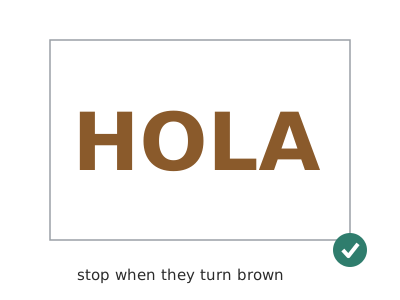
Place the dry sheet on the towel, writing side up. The adult runs the iron over it without stopping, in circles, for 20–60 seconds. Lift it every 10 s to look.
1 Place the dry sheet on the towel, writing side up 2 The adult moves the iron in circles, without stopping 3 It appears in brown: stop before the paper scorches Check: The letters appear first in pale yellow and then in brown. Stop as soon as they are brown: if you carry on, the paper scorches too.Tip: With an incandescent bulb: hold the sheet with pegs 1–2 cm from the glass, without touching it, moving it for 1–3 minutes.Compare the inks adult
Iron card C the same way as the message, timing it. In each box, write down how many seconds the X takes to appear and how dark it ends up.
1 Iron card C and time when each X appears 2 Note the seconds for each X: the water (control) doesn't appear Check: The water (control) never appears; the lemon and the milk appear before the vinegar.Assemble the cipher wheel
Cut out discs A (Ø 130 mm) and B (Ø 100 mm). Pierce the centre of both with the tip of a pencil, put B on top of A and join them with a split pin, not too tight, so that B turns.
1 Cut out disc A (Ø 130 mm) and disc B (Ø 100 mm) 2 Pierce the centre of both discs with the tip of a pencil 3 Join them with the split pin, not too tight: B must turn Check: Disc B turns smoothly and the letters on both discs line up.Encrypt a message
Choose a key: turn B until the arrow (inner letter A) points, for example, to the outer D. Find each letter of the message on the inner disc and write the outer letter next to it in lemon juice. Write the key in a corner in lemon juice as well.
1 Turn B until the arrow (inner A) points to the outer D 2 Find the letter on disc B and write the one on A next to it 3 Write the encrypted message and the key in a corner, in lemon juice Tip: Example with key D: HOLA → KRÑD.Swap messages
Give the dry message to a friend. They'll have to ask an adult to reveal it, read the key and use their wheel the other way round (find the letter on the outer disc and read the inner one) to decrypt it.
1 Give the dry message to a friend; an adult reveals it 2 Set the key and read backwards: letter on A, read the one on B 3 KRÑD with key D reads HOLA
Does it work? The test
Write a 4–5 letter word 2 cm tall in lemon juice, leave it to dry for 15 min and iron on 2 dots with no steam, timing it.
What should happen: Before heating, the sheet looks blank. With the iron, the letters appear in brown in 20–60 s; with a 60 W incandescent bulb at 1–2 cm, in 1–3 min. The paper around them stays white or slightly cream. The change is permanent.
If something goes wrong
- Nothing appears when you hold it near the lamp — The lamp is LED or low-energy: it barely gets warm. Solution: Use the iron on 2 dots or a 40–60 W incandescent/halogen bulb.
- The letters come out as blurry blotches — The brush was too loaded or the paper is very thin. Solution: Wipe the brush on the rim of the cup and use 80 gsm paper; make the letters bigger and further apart.
- The whole sheet scorches before the message appears — The iron is too hot or kept still in one spot. Solution: Turn it down to 2 dots and keep the iron moving. Take it away as soon as the letters are light brown.
- The paper wrinkles and gets wet — The iron had water in it and let out steam, or the message wasn't dry. Solution: Empty the tank and let the message dry for 15 min before ironing.
- The message can be seen before heating — Juice with pulp, or shiny paper that doesn't absorb it. Solution: Strain the juice and thin it with a little water; use matt paper.
- Only some letters appear — Those letters had too little juice or the iron didn't pass over evenly. Solution: Go over the letters with more juice before they dry and iron the whole sheet with even movements.
Safety
- An iron at 150 °C burns instantly: only an adult handles it, it is stood upright when not in use and unplugged when finished. Children watch from an arm's length away.
- Incandescent and halogen bulbs burn: don't touch the glass and don't leave the paper resting on them (it can catch fire).
- If you use an oven (170 °C, 3–5 min on a tray), watch it without moving away: paper burns at ≈ 230 °C. Never use a flame, candle or toaster.
- Lemon juice stings in eyes and cuts: wash your hands after writing.
- The split pin has pointed legs: bend them right back flat.
The science behind it
For children
Lemon juice has a little sugar and an acid in it, and it soaks in between the fibres of the paper. When it's dry, you can't see it because it's almost see-through. But the juice is like bread: with heat it toasts and turns brown long before the paper does. So when you heat the sheet, only what you wrote gets toasted, and the message appears. It's like making toast in the shape of letters.
For the adult
Lemon juice contains ≈ 5–6 % citric acid and 1–3 % sugars, plus other organic substances. As the water evaporates, a thin, almost colourless film is left inside the cellulose fibres. When heated to 130–170 °C, the sugars caramelise and oxidise, forming coloured compounds (and if there are proteins, as in milk, the Maillard reaction joins in). The acid also catalyses the hydrolysis and dehydration of the surrounding cellulose, which chars at a lower temperature than clean paper (≈ 200–230 °C). That temperature window is what you are aiming for: an iron at ≈ 150 °C or an incandescent bulb (glass at 100–200 °C) gets there; an LED (40–60 °C) or a hairdryer (≈ 60–80 °C) does not. The change is chemical and irreversible. The water control shows that what darkens is the solute, not the moisture. The cipher wheel implements a 27-letter Caesar cipher: each letter is shifted k positions (k = key).
- invisible ink: ink you can't see that appears with heat, light or a chemical.
- oxidation: a reaction with oxygen that changes a substance; here it turns it brown.
- caramelise: what happens to sugar when it gets very hot: it turns brown.
- control: a test done without the substance you are studying (water), for comparison.
- cipher: a way of changing the letters of a message with a key so that only someone who knows it can read it.
By age
- 5–7 years: They write big letters with a cotton bud, their name or simple drawings (a heart, an X, a sun). The adult does the revealing. No cipher wheel: the «magic» of it appearing is enough.
- 8–10 years: They write sentences with a brush, make the test card and time it. They use the wheel with a key given by the teacher.
- 11–12 years: They invent their own key, encrypt and decrypt messages between teams, and design an experiment to find the minimum revealing temperature. They can try to crack a message without the key by trying all 26 possibilities.
In a group or in class
Pairs: each child writes an encrypted message for their partner. Per table: a small cup of juice (1 lemon is enough for 6–8 children), cotton buds and sheets of paper. The iron goes in a single «revealing station» on the teacher's desk, with a towel, where pairs take turns of 1 minute. 50-min session: 10 min to explain and assemble the wheels, 15 min to write and encrypt, 15 min drying time while they do the test card, 10 min revealing and decrypting. If there are lots of pairs, use two irons with two adults.
Challenges
- Write a message on the same sheet with two inks that reveal at different speeds: one part appears after 20 s and the other after 60 s.
- Find an invisible ink that reveals without heat (clue: red cabbage juice or turmeric as developers for bicarbonate of soda).
- Crack this message, encrypted with the wheel, without the key: «KRÑD OXPGR».
- Design a «spy letter» with a normal text in pencil and a secret message between the lines.
More free projects
- Bouncy egg without a shell
- Coloured carnations
- Fizzy drink and sweets fountain
- Foaming volcano
- Giant yeast foam
- Hidden colours in ink
- Homemade stretchy slime
- Moving colours in milk
- Oil bubble lamp
- Raisins that rise and sink
- Red cabbage acid indicator
- Self-inflating ghosts
- Cubic salt crystals
- Rock candy on a string