Cubic salt crystals
A saturated salt solution in a jar, with a thread seeded with tiny crystals hanging inside: as the water evaporates, the extra salt settles on the thread and clear cubes grow, reaching 1–2 cm in 1–3 weeks.
What they will learn
- What dissolving is and what a saturated solution is: water only takes about 36 g of salt per 100 ml.
- That dissolved salt doesn't disappear: it reappears as crystals when the water evaporates.
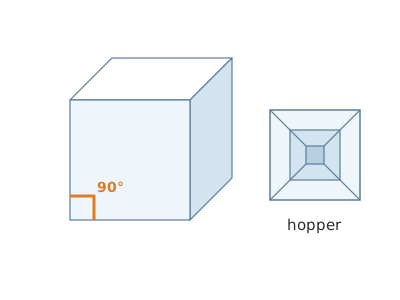
- That salt crystals are cubes because their particles arrange themselves in a cubic lattice.
- That a «seed» (small crystal) makes the salt grow in one particular place instead of everywhere.
- To measure and record a slow process day by day and make a graph.
Prepare beforehand
- Two days before, make the seed crystals: dissolve 1 tablespoon of salt in 3 tablespoons of hot water, pour it onto a dark flat plate and leave it by a window. In 1–2 days, tiny 2–3 mm cubes appear.
- That same day, seed the thread: dip it in the same salty water and leave it hanging to dry; it will end up covered in tiny crystals.
- Wash the jar with hot water and dry it well: grease or soap residue makes the salt crystallise where it shouldn't.
- Find the spot: a mild shelf (20–25 °C), out of draughts, where nobody will move the jar for 2–3 weeks, out of reach of small children.
- Print and cut out clip A and scale B.
Materials and tools
- Additive-free salt — ≈ 150 g (110–120 g for the solution and the rest for seeding)
coarse sea salt or table salt WITHOUT anti-caking agent or iodine (check the label: just «salt») - Tap water — 300 ml
heated to 60–70 °C (steaming but not boiling) - Glass jar — 1 (+1 saucepan or jug for dissolving)
500 ml, wide-mouthed, clean and dry (for example, a jam or pulses jar) - Cotton thread — 30 cm
cotton or rough fine wool (crystals grip it better than polyester sewing thread) - Pencil or stick — 1
longer than the mouth of the jar - Small glass bead — 1
8–10 mm (1–2 g), from a jewellery kit: acts as a weight so the thread hangs straight, sinks in the brine and doesn't rust - Kitchen roll — 1 sheet
to cover the jar: lets water evaporate but keeps dust out - Rubber band — 1
an office one, to hold the kitchen roll around the neck of the jar - Dark flat plate — 1
for making seed crystals by evaporation - Food colouring (optional) — 2–3 drops
for the colour experiment
Tools
- Saucepan and hob, or kettle — heating the water to 60–70 °C adult
- Kitchen scales — weighing the salt
- Measuring jug — measuring 300 ml of water
- Spoon — stirring until saturated
- Magnifying glass — seeing the cubic shape of the crystals
- Ruler or scale B — measuring the crystals every day
Pieces and templates
- A · Thread clip (bridge) ×1 — card (200 gsm) or thin card
- B · Crystal measuring scale ×1 — 80 gsm paper or card
Step by step
Heat the water adult
An adult heats 300 ml of water in a saucepan to 60–70 °C: when it steams and small bubbles form on the bottom, but before it boils. Turn off the heat.
1 Pour 300 ml of water, measured with the jug, into the saucepan 2 The adult heats it to 60–70 °C: it steams and tiny bubbles form 3 Turn off the heat before it boils Tip: If you have a kitchen thermometer, even better: hotter doesn't help with salt.Dissolve the salt adult
Add 100 g of salt and stir for 2 minutes. Then add 5 g at a time (a level teaspoon), stirring for 1 minute each time, until there are grains left on the bottom that won't dissolve. That will be about 110–120 g in total.
1 Weigh 100 g of salt on the scales 2 Tip it into the hot saucepan and stir for 2 minutes 3 Add 5 g at a time until grains are left on the bottom Check: After stirring for 2 minutes, you can still see grains on the bottom: the solution is saturated.Let it settle and pour off adult
Leave it to settle for 5 minutes so the grains sink. Slowly pour only the clear liquid into the 500 ml jar, leaving the grains in the saucepan. If it's cloudy, pour it through a coffee filter or kitchen roll.
1 Wait 5 minutes for the grains to sink to the bottom 2 Slowly pour only the clear liquid into the jar 3 Check there are no grains at the bottom of the jar Check: There isn't a single grain of salt at the bottom of the jar.Prepare the seeded thread
Take the seeded thread (with tiny crystals stuck to it) or tie a 2–3 mm seed crystal from the plate to one end with a double knot. If the thread doesn't hang straight, tie an 8–10 mm glass bead 1 cm below the seed: it weighs just enough, sinks and doesn't rust (an iron paperclip rusts in the brine and stains the crystals).
1 Take a seed crystal from the plate and the cotton thread 2 Tie the seed to the end of the thread with a double knot 3 If it doesn't hang straight, tie a glass bead 1 cm below Tip: If you don't have a seed, dip the thread in the solution, dry it with a hairdryer for 2 minutes and repeat 3 times.Hang the thread
Slip the other end of the thread into the cut in clip A (or tie it to the middle of the pencil) and rest it across the mouth of the jar. Adjust the height so the seed is 2 cm from the bottom and 2 cm from the sides.
1 Slip the free end of the thread into the cut in clip A 2 Rest A on the mouth and raise or lower the thread to adjust 3 The seed is submerged, 2 cm from the bottom and the sides Check: The thread doesn't touch the bottom or the sides; the seed is fully submerged.Cover with paper
Place a sheet of kitchen roll over the mouth of the jar, on top of the clip, and hold it in place with a rubber band. That way the water evaporates but dust doesn't get in.
1 Place a sheet of kitchen roll over the mouth 2 Hold the paper with a rubber band around the neck 3 The water evaporates through the paper but dust doesn't get in Choose a still spot
Carefully carry the jar to a mild shelf (20–25 °C), out of draughts and direct sunlight, where nobody will touch it. Stick the record sheet and scale B next to it.
1 Carry the jar with both hands, slowly and without shaking 2 Put it at 20–25 °C, out of sun and draughts, with the sheet and scale B Observe and measure every day
Every day at the same time, look at the jar without moving it. Measure the side of the biggest crystal with scale B and also note the water level (draw a line on the jar with a felt-tip pen).
1 Measure the side of the biggest crystal with scale B 2 Mark the water level with a felt-tip line 3 After 2–3 days: 2–4 mm cubes and lower water Check: After 2–3 days there are already tiny 2–4 mm cubes on the thread and the water level has dropped a few millimetres.Clean the crust off the rim
Every 3 days, wipe off with damp paper the white crust that creeps up the rim of the jar above the water: it steals salt from your crystal. Do it carefully without moving the thread.
1 Look for the white crust creeping up the rim 2 Wipe it off with damp paper without moving the thread 3 Repeat every 3 days: that way the salt goes to your crystal Remove rival crystals adult
If crystals form on the bottom or on other parts of the thread, after a week take out the thread, remove the small ones, pour the liquid into a clean jar (leaving the ones on the bottom behind) and hang the thread again.
1 Take out the thread and remove the tiny crystals 2 Pour the liquid into a clean jar 3 Hang the thread again; if liquid is low, don't add plain water Tip: If the water level has dropped a lot, top up with new saturated solution, already cool, never plain water: it would dissolve your crystal.Take out and dry the crystal
After a week (or after 3 weeks for big crystals), take out the thread, dry it with kitchen roll without rubbing and leave it hanging to dry for 1 hour. Keep it in a dry box: moisture dissolves it.
1 Take out the thread carefully, pulling upwards 2 Dab it dry with paper and leave it hanging for 1 hour 3 Keep it in a dry box: moisture dissolves it Look at it with a magnifying glass
Look at the crystal with a magnifying glass: look for square faces and 90° edges. Some will be shaped like hollow pyramids («hopper» crystals). Draw what you see in your notebook.
1 Look at the crystal close up with a magnifying glass 2 Look for square faces, 90° edges and hopper crystals 3 Draw what you see in your notebook
Does it work? The test
Every day, at the same time, measure the side of the biggest crystal with scale B and the water level in the jar. Photograph the jar from the same spot.
What should happen: After 2–3 days, tiny 2–4 mm cubes appear on the thread; after 7 days, 5–10 mm cubes; after 2–3 weeks, 1.5–2 cm clusters. The water level drops 1–3 mm a day depending on how humid the house is: it's the water evaporating and leaving the salt behind.
If something goes wrong
- No crystals at all on the thread after 3–4 days — Solution not saturated (too little salt) or thread not seeded. Solution: Add salt until some is left on the bottom, pour off again and seed the thread with tiny crystals.
- The crystals grow on the bottom, not on the thread — Undissolved salt grains were left in the jar. Solution: Pour the liquid into a clean jar without the grains and hang the thread again.
- A white crust forms, not clear cubes — Salt with anti-caking agent or iodine, or evaporation too fast (radiator, sun). Solution: Use additive-free salt and put the jar somewhere mild, not hot.
- The crystal disappeared or got smaller — Plain water was added, or the room suddenly got very warm. Solution: Top up only with cool saturated solution and avoid sudden temperature changes.
- A crust climbs up the sides and spills out of the jar — It's normal: the solution creeps up by capillary action and evaporates at the rim. Solution: Wipe the rim with damp paper every 3 days; smearing the rim with a little oil slows it down.
- Lots of small crystals instead of one big one — Too many growth points on the thread. Solution: Leave a single seed: remove the other tiny crystals and use smooth thread above the seed.
Safety
- Water at 60–70 °C scalds: an adult heats it, mixes it and pours it. Children wait until the jar is at room temperature before handling it.
- Put the hot jar on a cloth, not on a cold surface (the glass can crack).
- The solution is very salty: it is not for drinking. Place the jar out of reach of small children and pets.
- Salt stings eyes and cuts: wash your hands after touching the thread or the solution.
- When you finish, the leftover solution can go down the sink with plenty of tap water; loose crystals go in the bin.
The science behind it
For children
Water can hide salt inside it, like a rucksack that holds things, but the rucksack has a size: when no more salt fits, we say it's saturated. Little by little the water in the jar escapes into the air, the rucksack gets smaller and the salt that no longer fits has to come out. As it comes out, the salt particles line up neatly, one next to another, like building blocks, and form tiny cubes. If we give them a little crystal on the thread, they all go and stick there and make it grow.
For the adult
Sodium chloride dissolves in water by splitting into Na⁺ and Cl⁻ ions surrounded by water molecules. Its solubility is ≈ 35.9 g/100 ml at 20 °C and ≈ 37 g/100 ml at 60 °C: it barely changes with temperature, unlike sugar (≈ 200 g/100 ml at 20 °C and ≈ 290 g at 60 °C) or alum. That's why, with salt, cooling hardly produces any crystals: the supersaturation needed for growth comes from evaporation of the solvent (a typical home evaporates 1–3 mm of water height a day from an open jar). When the solution is slightly supersaturated, the ions are preferentially incorporated onto existing crystal surfaces (heterogeneous nucleation), because creating a new nucleus takes more energy: hence the importance of the seed, of a clean jar and of not leaving grains at the bottom, which would compete for the salt. The NaCl crystal lattice is face-centred cubic, and the macroscopic habit is the cube; with fast growth at the surface, «hopper» crystals (hollow pyramids) appear because the edges grow faster than the centre of the faces. Anti-caking agents such as sodium ferrocyanide (E-535) alter growth and produce dendritic shapes. Slow growth (stable temperature, moderate evaporation, no vibration) gives fewer but larger, clearer crystals.
- dissolve: when a substance spreads through water in bits so tiny you can't see them.
- saturated solution: water that already holds all the salt it can.
- evaporation: water turns into vapour and goes into the air, leaving the salt behind.
- crystal: a solid whose particles are arranged in a repeating order, like tiles.
- seed: a small crystal on which a bigger one grows.
By age
- 5–7 years: The adult prepares the solution and the jar. The child makes the seed crystals on the plate (they love watching them appear), hangs the thread and draws what they see each day instead of measuring.
- 8–10 years: They weigh the salt, count the teaspoons until it's saturated and measure the crystal every day with the scale. They compare salt and sugar.
- 11–12 years: They calculate the concentration (g of salt per 100 ml), record size and water level, make a graph and relate the mass of water evaporated to the salt deposited. Challenge: grow a single well-formed crystal from just one seed.
In a group or in class
Teams of 3–4 with one jar per team, all placed on the same classroom shelf. The teacher prepares the saturated solution for the whole class (1.5 L of water and ≈ 560 g of salt) and hands it out already poured off and lukewarm. Two days before, each team makes its plate of seed crystals. 40-min session: 10 min dissolving and saturating as a demonstration, 20 min seeding and hanging the thread, 10 min preparing the record sheet. After that, 5 min of measuring each day, taking turns, for 2 weeks. Each team can change one variable (spot, colouring, salt or sugar) to compare them at the end.
Challenges
- Grow a single cubic crystal over 1 cm with no others stuck to it.
- Grow crystals on a pipe cleaner bent into a star or your initial.
- Work out how much salt has been deposited: weigh the thread before and after and compare it with the water that has evaporated.
- Try with alum (from a chemist's or hardware shop): it forms large, clear octahedra by cooling.
- Visit (or look up photos of) some salt pans and explain how they get salt from seawater.
More free projects
- Bouncy egg without a shell
- Coloured carnations
- Fizzy drink and sweets fountain
- Foaming volcano
- Giant yeast foam
- Hidden colours in ink
- Homemade stretchy slime
- Moving colours in milk
- Oil bubble lamp
- Raisins that rise and sink
- Red cabbage acid indicator
- Secret messages with lemon juice
- Self-inflating ghosts
- Rock candy on a string