Oil bubble lamp
A bottle of coloured water and oil that, when you drop in a piece of effervescent tablet, fills with coloured bubbles that rise and fall for 1–2 minutes, lit from below by an LED candle inside a card pedestal.
What they will learn
- That two immiscible liquids (water and oil) separate into layers, with the less dense one on top.
- That a chemical reaction (acid + bicarbonate) can produce a gas: carbon dioxide.
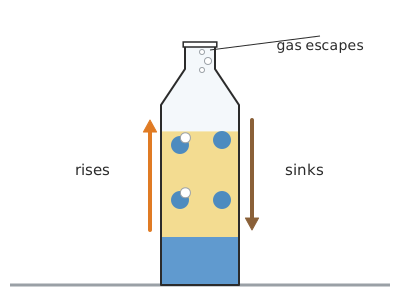
- That an object rises or sinks depending on its average density: a drop of water with bubbles stuck to it weighs less than the oil and floats.
- To observe and time a phenomenon, changing only one variable at a time.
Prepare beforehand
- Wash and dry the bottle and remove the label (hot water and soap).
- Print pieces A, B and C onto the card or stick the printed template on top.
- Check that the LED candle switches on.
- Break the tablets into 4 pieces and keep them in a dry, closed jar: moisture makes them start reacting.
- Have an empty jar with a lid ready to collect the oil at the end.
Materials and tools
- Clear plastic bottle — 1 (2 if you also make the version without a tablet)
500 ml, smooth (no ridges), Ø ≈ 65 mm, label removed - Tap water — 125 ml
at room temperature - Sunflower oil — 300 ml (+ 250 ml for the version without a tablet)
light and clear (olive oil is green and darker) - Liquid food colouring — 8–10 drops
water-based, blue, green or red - Effervescent vitamin C tablets — 1–2 tablets buy
≈ 4 g each; broken into 4 pieces - Bicarbonate of soda and vinegar (version without a tablet) — 5 g (1 teaspoon) of bicarbonate of soda + 30 ml of vinegar
optional, only for step 11; white cooking vinegar - Card — 1 A4 sheet
200 gsm, black or a dark colour - LED candle — 1
the coin-cell type, Ø ≈ 38 mm × 35 mm tall, white or warm light - Funnel — 1
so you don't spill the oil - Sticky tape — ≈ 30 cm
to close the pedestal and stick on the scale - Tray or tea towel — 1
to work on: oil stains
Tools
- Measuring jug — measure 125 ml of water and 300 ml of oil
- Scissors — cut out the pedestal, the ring and the scale
- Stopwatch (phone) — time how long each round of bubbles lasts
- Dessert spoon — add the vinegar in the version without a tablet
Pieces and templates
- A · Pedestal wall ×1 — 200 gsm card
- B · Bottle support ring ×1 — 200 gsm card
- C · Height scale ×1 — paper
Step by step
Build the pedestal
Cut out piece A with its 50 × 30 mm window. Roll it up and stick the end over the 10 mm tab with tape inside and out: you get a tube Ø 73 mm and 60 mm tall.
1 Cut out strip A and its 50 × 30 mm window 2 Roll up the strip and tape the end over the tab 3 You get a Ø 73 × 60 mm tube with the window at the bottom Add the ring
Cut out ring B (Ø 80 mm with a 44 mm hole) and stick it on top of the tube with 4 pieces of tape. Switch on the LED candle, put it on the table and lower the pedestal over it (it has no bottom), with the candle in the middle: it won't fit through the 30 mm window, because it is 35 mm tall.
1 Cut out ring B: Ø 80 mm with a 44 mm hole 2 Stick the ring on top of the tube with 4 pieces of tape 3 Switch on the candle and cover it with the pedestal: light shows through the hole Check: Look from above: you can see light through the hole in the ring.Stick on the scale
Cut out scale C and tape it vertically to the back of the empty bottle, with the 0 level with the bottom.
1 Cut out the 150 mm strip C with its marks 2 Stick it to the back of the empty bottle with the 0 level with the bottom Pour in the water
Measure 125 ml of water in the measuring jug and pour it into the bottle. It should reach roughly the 4 cm mark on the scale (a quarter of the bottle).
1 Measure 125 ml of water in the measuring jug 2 Pour the water slowly into the bottle 3 The water reaches the 4 cm mark: a quarter of the bottle Colour the water
Add 8–10 drops of colouring straight into the water and swirl the bottle gently until the colour is even. This way the colour will be stronger than if you drop it onto the oil.
1 Add 8–10 drops of colouring straight into the water 2 Swirl the bottle gently in circles, don't shake hard 3 Keep going until all the water is the same colour Tip: You can also drop the colouring onto the oil to watch it pass through, but the drops take several minutes to reach the water and some get stuck at the boundary.Add the oil adult
Put the funnel in and slowly pour in 300 ml of sunflower oil: the level reaches about 13 cm on the scale, just below the shoulder, leaving air in the shoulder and neck (about 7 cm). Wait 2–3 minutes without moving the bottle until the oil sits on top, clear, and the water at the bottom.
1 Put the funnel in and slowly pour in 300 ml of oil 2 Wait 2–3 minutes without moving the bottle 3 Two layers with a sharp line about 4 cm from the bottom Check: You can see two layers with a sharp boundary ≈ 4 cm from the bottom.Put the bottle on the pedestal
Stand the bottle on ring B, centred, with the scale facing backwards. Turn off the room light or close the blinds.
1 Lower the bottle onto ring B, centred 2 Turn off the room light: the bottle glows from below Drop in the first piece of tablet
Drop a quarter of an effervescent tablet (≈ 1 g) through the neck. It falls through the oil to the water and starts fizzing as soon as it touches it. Start the stopwatch.
1 Take a quarter of a tablet, about 1 g 2 Drop it through the neck: it sinks through the oil to the water 3 Within 2–3 s coloured drops rise: start the stopwatch Check: Within 2–3 seconds, coloured drops with bubbles attached start to rise.Watch the cycle
Watch each drop rise to the top, release its gas bubble and fall back down. When no more drops are rising (1–2 minutes), stop the stopwatch and write down the time.
1 Watch each drop rise, release its gas and sink again 2 When no drops are rising, stop the stopwatch and write down the time Repeat the rounds
Wait 1 minute for the drops to rejoin the water and drop in another quarter tablet. You can do 6–10 rounds with the same bottle; the water slowly turns cloudy.
1 Wait 1 minute for the drops to return to the water 2 Drop in another quarter tablet: 6–10 rounds per bottle Version without a tablet
In a new bottle, pour 125 ml of coloured water and 1 teaspoon (5 g) of bicarbonate of soda, then only 250 ml of oil: it fills 3/4 of the bottle, about 11 cm on the scale. Add vinegar one spoonful at a time (up to 30 ml): each spoonful passes through the oil and foams when it reaches the water.
1 Add 1 teaspoon of bicarbonate of soda to the water, before the oil 2 Fill only to 3/4 and add the vinegar one spoonful at a time 3 Each spoonful foams when it reaches the water Tip: It makes much more foam than the tablet: that is why less oil goes in here (up to 3/4, ≈ 11 cm). With the 300 ml of the tablet version, the foam would spill out of the neck.Clear up and recycle adult
Wait until it has completely stopped: don't put the cap on the bottle while any bubbles are still rising, because the built-up gas could make the cap pop off. Then put the cap on and keep the bottle for another day, or pour the oil from the top into a jar with a lid to take to the recycling centre or used cooking oil bin. The coloured water can go down the sink.
1 Don't put the cap on until not a single bubble is coming out 2 Pour the oil from the top into a jar with a lid 3 The coloured water can go down the sink
Does it work? The test
Drop a quarter tablet into the bottle in the dark, with the LED candle on, and time it from when it touches the water until no more drops rise.
What should happen: For 60–120 s, coloured drops of 5–15 mm rise, taking 2–5 s to reach the top, and sink in 3–8 s. With half a tablet, the fizzing is stronger but lasts somewhat less than twice as long. With bicarbonate of soda and vinegar, the foam lasts only 15–30 s per spoonful.
If something goes wrong
- The colouring tints the oil — Oil-based or gel colouring. Solution: Use liquid baking colouring (water-based) or washable ink dissolved in water.
- The drops don't rise — Damp, already spent tablet, or too little water. Solution: Use a dry tablet straight from the tube. Check there are at least 3 cm of water.
- Everything goes cloudy — The bottle was shaken or the water and oil emulsified. Solution: Leave it to stand for 10 minutes without moving it: the layers separate again.
- The colours are hard to see — Too little light or not enough colouring. Solution: Darken the room, switch on the LED candle underneath and add 4–5 more drops of colouring to the water.
- The foam overflows — Bottle too full or too much reaction (bicarbonate of soda and vinegar). Solution: Don't fill above the shoulder of the bottle (with bicarbonate of soda, only up to 3/4) and use smaller pieces or add the vinegar one spoonful at a time.
- The cap pops off or the bottle swells — It was closed while it was still producing gas. Solution: Never close the bottle until not a single bubble is coming out.
Safety
- Don't close the bottle while it is fizzing: the build-up of CO₂ can make the cap pop off.
- Effervescent tablets are not sweets: keep them out of children's reach. Antacid ones (such as «Alka-Seltzer») contain acetylsalicylic acid; vitamin C ones are a better choice.
- Don't drink the mixture, even though the ingredients come from the kitchen.
- Spilt oil makes the floor slippery: work on a tray and clean up with paper and soap.
- Used oil must not go down the sink: keep it in a jar and take it to the recycling centre or the used-oil bin.
- If you use a glass jar, an adult should handle it.
The science behind it
For children
Water and oil don't like to mix: the oil is lighter and stays on top, like a lid. When you drop in the tablet, it starts making gas bubbles in the water. The bubbles stick to little drops of coloured water and lift them up, like balloons lifting a child. At the top, the bubble pops, the gas escapes and the drop, with no balloon any more, falls back down. That's why they go up and down again and again!
For the adult
Sunflower oil (density ≈ 0.92 g/cm³) and water (≈ 1.00 g/cm³) are immiscible: water is polar and oil is non-polar, and the forces between like molecules are stronger than between unlike ones, so they separate into two phases, with the less dense one on top. Food colouring is water-soluble and only tints the aqueous phase. The effervescent tablet contains dry citric acid and sodium bicarbonate; when they dissolve they react: C₆H₈O₇ + 3 NaHCO₃ → Na₃C₆H₅O₇ + 3 H₂O + 3 CO₂. The CO₂ forms bubbles that drag drops of coloured water with them; the drop + bubble combination has a lower average density than the oil and rises (Archimedes' principle). At the surface the bubble bursts, the gas escapes into the air and the drop, now denser than the oil, sinks again. The high viscosity of the oil (≈ 50 times that of water) makes them rise and fall slowly and keeps the drops round. With bicarbonate of soda and vinegar the reaction belongs to the same family (NaHCO₃ + CH₃COOH → CH₃COONa + H₂O + CO₂), but is faster because the acid is already dissolved.
- density: how much mass there is in a given volume; less dense things float on denser ones.
- immiscible: that doesn't mix: like water and oil.
- chemical reaction: when some substances turn into new ones, like the gas from the tablet.
- carbon dioxide: the gas in the bubbles: the same as in fizzy drinks.
- viscosity: how «thick» a liquid is; honey is very viscous.
By age
- 5–7 years: The adult pours the oil and prepares the tablet pieces. The child adds the water, the colouring and each piece of tablet, and counts the drops. Focus on «the oil is lighter and floats».
- 8–10 years: They do the whole process, measuring with the jug, and build the pedestal. Have them time the rounds and compare amounts.
- 11–12 years: Have them work out the density of the oil by weighing 100 ml on kitchen scales and design a controlled experiment (a single variable) with their own table and a graph.
In a group or in class
Teams of 3–4, one 500 ml bottle per team (≈ €0.50 of oil and tablet per team). Before the session: measure the oil into 300 ml cups, break the tablets into quarters and hand out trays. 45-min session: 10 min of explanation with the question «what floats?», 10 min of assembly, 20 min of rounds with stopwatch and record-keeping, 5 min of clearing up (each team pours its oil into a shared container). Do the final part with the blinds down.
Challenges
- Get two colours that don't mix: how would you do it? (hint: two rounds with a different colouring in the falling drop).
- Design a 3-layer lamp (honey, coloured water and oil) and explain the order.
- Make the lamp work for 10 minutes with a single tablet (hint: small pieces every so often).
- Make a lid with a straw that lets the gas out but doesn't spill the liquid when you tilt the bottle.
More free projects
- Bouncy egg without a shell
- Coloured carnations
- Fizzy drink and sweets fountain
- Foaming volcano
- Giant yeast foam
- Hidden colours in ink
- Homemade stretchy slime
- Moving colours in milk
- Raisins that rise and sink
- Red cabbage acid indicator
- Secret messages with lemon juice
- Self-inflating ghosts
- Cubic salt crystals
- Rock candy on a string