Raisins that rise and sink
Six raisins dropped into a glass of freshly opened lemonade sink, get covered in CO₂ bubbles, rise to the surface, lose the bubbles and sink again, over and over for 20–40 minutes.
What they will learn
- That an object floats or sinks depending on its density compared with that of the liquid.
- That the gas dissolved in lemonade (CO₂) comes out as bubbles on rough surfaces.
- That bubbles stuck to an object add volume with almost no weight and make it float, like a life jacket.
- How to observe a repeating cycle, count it and see how it slows down as the gas runs out.
Prepare beforehand
- Put the lemonade in the fridge at least 1 hour beforehand and do not shake it.
- Wash the glass and rinse it very well with plain water; leave it to drain.
- Print scale A and tape it to the outside of the glass, with the 0 level with the inside bottom.
- Pick out 6 raisins that are not stuck together.
Materials and tools
- Clear lemonade — 1 unopened 0.5–1.5 L bottle buy
clear lemonade or lemon-lime fizzy drink; cold from the fridge (4–8 °C) - Raisins — 6–10 + a few spares buy
medium raisins (≈ 1–1.5 cm), wrinkly; any kind - Tall clear glass — 1 (or 2 to compare)
smooth glass, 300–350 ml, ≥ 12 cm tall; clean and rinsed with no washing-up liquid - Grains to compare — a teaspoon of each
uncooked rice, 1 cm pieces of thin noodles, shelled peanuts - Tray or deep plate — 1
under the glass in case the foam overflows
Tools
- Stopwatch (mobile phone) — timing how long the dance lasts and counting trips
- Spoon — adding and removing the raisins
- Glass marker pen or masking tape — marking the three-quarter level on the glass
Pieces and templates
- A · Measuring scale for the glass ×1 — paper
Step by step
Prepare the glass
Put the clean glass on a tray. Tape scale A to the outside, with the 0 level with the inside bottom, and mark the three-quarter level (in a 13 cm glass, at about 10 cm).
1 Put the clean glass on the tray and cut out scale A 2 Tape it to the outside: 0 level with the inside bottom 3 Mark three quarters: in a 13 cm glass, at about 10 cm Do the control test
Drop 2 raisins into a glass of still tap water. Watch them for 1 minute: they stay at the bottom. This way you will be able to check later that what moves them is the gas.
1 Drop 2 raisins into a glass of still tap water 2 After a minute they are still at the bottom: no gas, no rising Check: The raisins do not rise in still water.Open and pour the lemonade
Open the cold bottle slowly and pour with the glass tilted, letting the lemonade run down the side, up to the three-quarter mark (about 225–260 ml in a 300–350 ml glass).
1 Open the cold bottle a little at a time, without shaking it 2 Tilt the glass and let the lemonade run down the side 3 Stop when you reach the three-quarter mark Tip: If you pour it straight down from above you lose gas as foam.Wait for the foam to settle
Wait about 20–30 seconds, until the foam on top has almost completely gone. If you add the raisins while there is foam, they get trapped in it.
1 Just poured, it has foam on top: do not add the raisins yet 2 Wait 20–30 s, until there is hardly any foam left Add the raisins
Drop in 6 raisins one at a time, a few seconds apart, letting them fall from 2–3 cm above the surface. Start the stopwatch.
1 Drop the raisins in one at a time from 2–3 cm 2 All 6 sink to the bottom: start the stopwatch Check: All the raisins sink to the bottom within 1–3 seconds.Watch the bubbles
Look closely at the raisins on the bottom, at glass level: within 10–30 seconds they get covered in tiny bubbles, especially in the wrinkles.
1 Crouch down and look closely at the raisins on the bottom 2 Within 10–30 s they are covered in tiny bubbles, mostly in the wrinkles Tip: A torch behind the glass makes the bubbles sparkle.Watch them rise
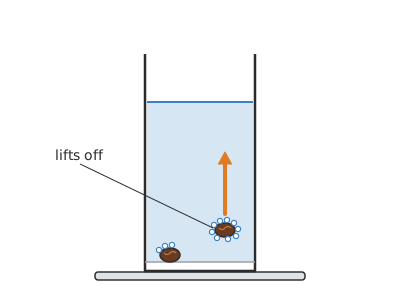
When a raisin has enough bubbles, it lifts off the bottom and rises. Use the scale to see that it climbs the 10 cm to the surface in 1–3 seconds.
1 With enough bubbles, it lifts off the bottom and rises 2 It climbs the 10 cm of the scale in 1–3 seconds Watch them sink again
At the top, the raisin turns, loses bubbles that pop in the air and sinks again. Count one raisin's trips over 5 minutes (one trip = up and down).
1 At the top it turns and its bubbles pop in the air 2 Without bubbles it is heavier than the liquid and sinks again 3 Count one raisin's trips in 5 minutes: up and down is one Check: At first each raisin makes a trip every 10–40 s.Time the dance
Leave the glass still and check it every 5 minutes. Stop the stopwatch when no raisin has risen for 2 minutes in a row. It usually lasts 20–40 minutes.
1 Leave the glass still and check it every 5 minutes 2 If none rises for 2 minutes, stop the stopwatch Tidy up
Scoop out the raisins with the spoon and put them in the food waste bin; the flat lemonade can go down the sink. Rinse the glass.
1 Scoop out the raisins and put them in the food waste 2 Pour the lemonade down the sink and rinse the glass
Does it work? The test
300–350 ml glass with 225–260 ml of cold, freshly opened lemonade and 6 raisins; watch for 30 minutes.
What should happen: The raisins sink when dropped in and within 1 minute start rising and sinking. At first each raisin makes a trip every 10–40 seconds (about 8–30 trips in 5 minutes). The pace slows down little by little and the dance ends after 20–40 minutes, when the lemonade goes flat. In still water they do not move.
If something goes wrong
- The raisins stay at the bottom and do not rise — The lemonade has gone flat (bottle opened or shaken) or it is warm. Solution: Use a new, cold bottle and pour it slowly down the side of the glass.
- The raisins float from the start and do not sink — They have air trapped in their folds or there is a lot of foam on top. Solution: Wait for the foam to settle before adding them; push down any floating ones with the spoon. If they stay at the top, swap them for smaller raisins or soak them in water for 1 minute.
- They rise once and stay stuck at the top — They are big and very wrinkly and hold too many bubbles, or the glass has traces of washing-up liquid. Solution: Use medium raisins and a well-rinsed glass with no soap.
- There are very few bubbles and everything is very slow — Lemonade without much fizz, or a glass that is too wide and low. Solution: Use a tall, narrow glass (the lemonade loses less gas through the surface) and freshly opened lemonade.
- The foam overflows — Poured straight down or glass too full. Solution: Fill only to three quarters and pour with the glass tilted.
Safety
- Raisins, peanuts and grains are small: with children under 4, there is a choking risk; make sure they do not put them in their mouths.
- Nut allergy: if anyone is allergic, do not use peanuts in the experiment.
- Do not drink the lemonade from the experiment or eat the wet raisins that have been through everyone's hands.
- If you use a glass tumbler, put it on a tray and away from the edge of the table.
- If you do the bicarbonate of soda and vinegar experiment: do not keep the mixture in a closed container (the pressure can make the lid pop off).
The science behind it
For children
A raisin weighs a little more than the water that takes up its space, so it goes to the bottom. Lemonade has a hidden gas inside it, the one that makes the bubbles. That gas sticks to the raisin's wrinkles like tiny balloons. With lots of tiny balloons, the raisin becomes lighter than the liquid and goes up as if in a lift. At the top the tiny balloons pop, the raisin is heavier again and goes back down. When the lemonade runs out of gas, the dance is over.
For the adult
A raisin is slightly denser than lemonade (≈ 1.1–1.3 g/cm³ versus ≈ 1.00–1.04 g/cm³), so it sinks. Lemonade is supersaturated with CO₂ (it is bottled at 2–4 atm; once opened, the dissolved gas exceeds equilibrium with 1 atm). The CO₂ escapes as bubbles, but forming a new bubble in the bulk of the liquid takes a lot of energy (surface tension), so bubbles are born at nucleation sites: cracks, fibres and wrinkles on rough, hydrophobic surfaces such as raisin skin. The attached bubbles increase the volume of the whole without adding almost any mass; when the upthrust (weight of liquid displaced by raisin + bubbles) exceeds the weight, the raisin rises. For a 0.4 cm³ raisin with a density of 1.25 g/cm³, ≈ 0.1 cm³ of attached gas is needed, some two hundred 1 mm bubbles (each ≈ 0.5 mm³). At the surface, some of the bubbles are exposed to the air and burst, and the raisin turns over and loses them: it becomes denser than the liquid again and sinks. The cycle lasts as long as the supersaturation allows bubbles to nucleate; when cold, CO₂ is more soluble (Henry's law) and escapes more slowly, so the dance lasts longer even though it starts a little more slowly.
- density: how much mass there is in each bit of volume; denser things sink in less dense ones.
- buoyancy: upward push that a liquid gives to anything placed in it.
- carbon dioxide (CO₂): the gas in the bubbles of lemonade.
- dissolve: mix something into a liquid until you cannot see it, like the gas hidden in lemonade.
- nucleation: the birth of a bubble at a rough spot, such as a wrinkle on the raisin.
By age
- 5–7 years: The adult pours the lemonade. The child drops in the raisins, counts the trips of «their» raisin and says whether it is going up or down. The idea «bubbles are floats» is enough.
- 8–10 years: They do the whole experiment, the control test with still water and the comparison with rice and peanuts, writing down the trips in 5 minutes.
- 11–12 years: Let them design the temperature experiment with a single variable and a graph of trips against time, and work out how many 1 mm bubbles a raisin needs to float.
In a group or in class
Teams of 3–4 children, one glass per team (8 glasses and 2 × 1.5 L bottles for 25 children). Each team tests a different variable (raisins, rice, noodles, cold, lukewarm, still water, bicarbonate of soda and vinegar) and counts trips in 5 minutes. Results are pooled on the board. 30 min in total. Open the bottles just as you start.
Challenges
- Get a single raisin to make more than 30 trips in 10 minutes by changing only the glass or the temperature.
- Find an object in the kitchen that rises faster than the raisin and another that never rises. What is different about them?
- Make a «raisin lift»: two raisins joined with a cocktail stick. Do they still rise?
- Invent a way to make the raisins stay still halfway up the glass.
More free projects
- Bouncy egg without a shell
- Coloured carnations
- Fizzy drink and sweets fountain
- Foaming volcano
- Giant yeast foam
- Hidden colours in ink
- Homemade stretchy slime
- Moving colours in milk
- Oil bubble lamp
- Red cabbage acid indicator
- Secret messages with lemon juice
- Self-inflating ghosts
- Cubic salt crystals
- Rock candy on a string