Fizzy drink and sweets fountain
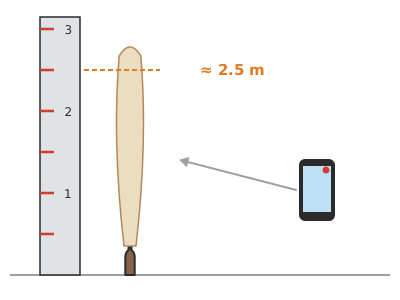
Seven Mentos sweets drop all at once into a 2-litre bottle of diet cola and the dissolved gas escapes in one go: a jet of foam 2–4 metres high shoots out in a couple of seconds.
What they will learn
- That fizzy drinks contain gas (CO₂) dissolved under pressure, and that when you open the bottle that gas wants to get out, but it needs «places» to form bubbles.
- What nucleation is: the rough surface of the sweet offers millions of points where bubbles form at the same time.
- That gas forming suddenly inside the bottle pushes the liquid out through the narrow neck like a nozzle.
- To design a fair test: change only one variable (type of drink, temperature, number of sweets) and measure the height.
- To measure heights indirectly with a marked wall or a slow-motion video.
Prepare beforehand
- Leave the bottle out of the fridge for 2 hours so it is at room temperature, and don't shake it on the way.
- Print tube template A and card B at 100 %. Stick the card onto thick card if your paper is thin.
- Find an outdoor spot with flat, hard ground (playground, patio, dirt pitch), away from cars, windows and passers-by. Bear the wind in mind: it blows the jet sideways.
- Use chalk or string to mark a circle with a 3 m radius around the point where the bottle will go.
- If you are going to measure the height, choose a wall or lamp post to put the bottle next to and mark every 50 cm up to 3 m with masking tape.
Materials and tools
- Diet or zero cola — 1 bottle of 2 litres buy
unopened, at room temperature (20–25 °C), not shaken - Mentos sweets — 7 (half a roll of 14) buy
classic coated mint or fruit Mentos (not the chewing gum or soft ones) - Sheet of paper — 1 (template A)
80 gsm A4 sheet - Stiff card — 1 (template B)
60 × 90 mm, 200–300 gsm card or an old business card - Sticky tape — 2 pieces of 8 cm
to close the tube - Tape measure or chalk — 1
to mark the 3 m safety circle and measure the height - Safety goggles — 1 for whoever drops the sweets
DIY or swimming goggles
Tools
- Scissors — cut out the tube template and the card
- Phone with slow motion (optional) — film the jet to measure the maximum height
- Hose or bucket of water — clean the ground afterwards
Pieces and templates
- A · Sweet-loading tube ×1 — 80 gsm paper
- B · Trapdoor card ×1 — 250 gsm card or business card
Step by step
Make the tube
Cut out template A (90 × 110 mm). Stack 7 Mentos, roll the paper loosely around them along the 110 mm side and stick down the tab with 2 pieces of tape. Take the sweets out.
1 Cut out template A, 90 × 110 mm 2 Stack the 7 Mentos and roll the paper around them loosely 3 Close with 2 pieces of tape: the sweets slide in and out on their own Check: Tilt the tube: all 7 sweets should slide in and out without getting stuck. If they stick, roll it again 1–2 mm wider.Make the card
Cut out card B (90 × 60 mm). If it is thin paper, stick it onto thick card or a business card so it doesn't bend when you pull it.
1 Cut out card B; the circle is only a guide 2 If it is thin paper, stick it onto card or an old business card Mark the safe area adult
Outdoors, on flat, hard ground, use chalk or string to mark a circle with a 3 m radius. Only the person dropping the sweets goes inside the circle, and with goggles on.
1 With 3 m of string and chalk, draw the circle around it 2 Only the launcher goes inside the circle, wearing goggles Check: There are no cars, open windows or people inside the circle; there is little wind.Place the bottle
Stand the 2 l bottle of diet cola upright in the centre, on firm ground, without shaking it. If you want to measure the height, put it 30 cm from the wall marked every 50 cm.
1 Stand the bottle upright in the centre of the circle, without shaking it 2 To measure, leave it 30 cm from the wall marked every 50 cm Tip: If the ground isn't flat, wedge the base with 4 flat stones around it: the bottle must not wobble.Open it carefully
Unscrew the cap slowly, over 2–3 seconds, so the gas comes out little by little. Step out of the circle, leave the cap on the ground outside it and go back to the bottle: the cap is never put back on with the sweets inside.
1 Unscrew the cap slowly, over 2–3 seconds 2 Leave the cap outside the circle: it does not go back on Load the tube
Put card B over the mouth of the bottle, with the guide circle over the mouth. Place the tube on top, right over the circle, and drop the 7 Mentos in from the top one by one.
1 Put the card with the circle right over the mouth 2 Place the tube on the circle and drop the 7 Mentos in from the top 3 Tube upright and centred; the sweets on the card Check: The tube is upright and centred over the mouth; the sweets are resting on the card.Get ready to drop
Hold the tube at the top with one hand and grip the card by the «PULL HERE» end with the other. Stand side-on, with your face not over the bottle. The adult counts: three, two, one.
1 Hold the tube at the top and the card by «PULL HERE» 2 Stand side-on, with goggles; the adult counts three, two, one Drop and step back
Pull the card out horizontally in one go: the sweets all fall together. Let go of the tube and run back out of the 3 m circle (you have 1 second).
1 Pull the card out horizontally: all the sweets drop at once 2 Let go of the tube and run out of the circle Tip: The tube doesn't fit through the mouth (it is ≈ 23 mm inside and the mouth is 21.5 mm): if you let go of it, it rests on top of the mouth or the jet launches it. Don't try to pick it up until the foam stops.Watch and measure
Look at the maximum height of the jet against the marks on the wall or film it in slow motion. Time how long the jet lasts (usually 3–5 s) and note how much drink is left in the bottle.
1 See which mark the jet reaches or film it in slow motion 2 Time the jet and see how much drink is left Clean up
Wait for the foam to stop. Pour away the drink that is left (do not drink it: it contains bits of sweet and dirt), put the bottle in the plastics recycling bin and rinse the ground with a bucket of water or the hose.
1 When the foam stops, pour away the leftover drink: don't drink it 2 Put the empty bottle in the plastics recycling bin 3 Rinse the ground with a bucket of water or the hose
Does it work? The test
2 l bottle of diet cola at 20–25 °C, 7 Mentos dropped all at once, next to a wall marked every 50 cm or filmed in slow motion.
What should happen: The jet comes out in less than 1 s, reaches 2–4 m high and lasts 3–5 s. Only a third or less of the drink is left in the bottle.
If something goes wrong
- Only a little foam comes out and overflows — Drink opened earlier or shaken (it has lost gas), or the sweets fell in one at a time. Solution: Use an unopened bottle and drop all 7 sweets at once by pulling the card out in one go.
- The sweets get stuck in the tube or in the neck — Tube too narrow or sweets slightly damp. Solution: Roll the tube 1–2 mm wider; handle the sweets with dry hands and don't load them too early.
- The foam shoots up too early and wets the card — The tube isn't sitting properly and sweets fall in before you pull. Solution: Check that the card covers the whole mouth and that the tube is centred over the guide circle.
- The bottle tips over — Uneven or soft ground. Solution: Flat, hard ground; wedge it with flat stones or put the bottle inside a plant pot or a low bucket.
- The jet comes out crooked — Wind or a tilted bottle. Solution: Stand with your back to the wind, in a sheltered corner, and check that the bottle is upright.
- Everything is left sticky — Regular drink with sugar. Solution: Use diet or zero cola, or do it on the lawn and water it afterwards.
Safety
- Always outdoors, with a 3 m safety circle clear of people, cars and windows.
- Never put the cap back on with the sweets inside: the pressure can burst the bottle or shoot the cap off.
- Whoever drops the sweets wears goggles and keeps their face away from above the bottle.
- Don't drink the leftover drink, and don't eat large amounts of sweets and fizzy drink together: it isn't dangerous, but it will make you feel unwell and it is not part of the experiment.
- The ground gets slippery: rinse it with water and warn people before running across the wet area.
- The sweets are small: keep the rest away from children under 3.
The science behind it
For children
Inside the fizzy drink there is loads of hidden gas, as if it were asleep and squashed up. To get out and make bubbles, the gas needs somewhere to grab onto, like when you need a ladder to climb up. Mentos have skin full of tiny little holes, and each little hole is a ladder. When they all fall in at once, the gas wakes up in millions of places at the same time, turns into bubbles and doesn't fit in the bottle: it shoots up out of the neck like a fountain.
For the adult
A fizzy drink bottle is filled with CO₂ dissolved at ≈ 3–4 bar; when you open it, the liquid is left supersaturated (it holds about 3–4 times more gas than it could at equilibrium at 1 atm), but forming a new bubble takes energy because of surface tension, so the gas comes out slowly. Mentos have a microscopically rough surface (sugar coating with micropores) that offers millions of heterogeneous nucleation sites; in addition, their gum arabic and gelatine, together with the aspartame and potassium benzoate in diet drinks, lower the surface tension and help the bubbles grow. As the sweets are dense and sink to the bottom, nucleation happens throughout the whole column of liquid at once: the expanding gas forces the liquid out through the ≈ 21.5 mm neck, which acts as a nozzle and speeds it up. A warm drink goes higher because the solubility of CO₂ falls as temperature rises (there is more gas «wanting» to get out). It is not a chemical reaction: the CO₂ was already there; it is a physical degassing process.
- dissolved gas: gas mixed into a liquid without any visible bubbles.
- nucleation: the birth of a bubble at a point where the gas can gather.
- supersaturated: a liquid that holds more dissolved gas than it can comfortably keep.
- surface tension: the «skin» of a liquid that makes it hard to form new bubbles.
- pressure: the force with which a gas pushes against whatever surrounds it.
By age
- 5–7 years: The adult loads and drops the sweets; the child helps roll the tube, marks the circle with chalk and watches from outside the circle. Key idea: «the drink has hidden gas and the sweet helps it get out».
- 8–10 years: They do everything with supervision. Have them compare two bottles changing only one thing and measure the height on the wall.
- 11–12 years: They design a test with 3 variables and repeats, measure with video and draw a graph. Challenge: measure the CO₂ lost by weighing the bottle before and after (difference in mass).
In a group or in class
As an outdoor demonstration: 4–6 bottles for the whole class, each launched by a different team that changes one variable (diet/regular, cold/warm, 3/7 sweets). Make the tubes and cards beforehand (one per team) and mark out a launch area in the playground with a 3 m circle and a wall or post with marks every 50 cm. 30–40 min session: 10 min of explanation and predictions, 20 min of launches, 10 min to compare results on the board.
Challenges
- Design a nozzle (a cap with a 6–8 mm hole, made by an adult) that makes the jet higher, and compare it with no nozzle.
- Get the highest jet with a 1.5 l bottle by changing only the temperature or the number of sweets.
- Measure the mass of gas that has escaped by weighing the bottle before and after.
- Look for other things that make the drink foam (salt, sugar, sand) and rank them from most to least effect.
More free projects
- Bouncy egg without a shell
- Coloured carnations
- Foaming volcano
- Giant yeast foam
- Hidden colours in ink
- Homemade stretchy slime
- Moving colours in milk
- Oil bubble lamp
- Raisins that rise and sink
- Red cabbage acid indicator
- Secret messages with lemon juice
- Self-inflating ghosts
- Cubic salt crystals
- Rock candy on a string