Coloured carnations
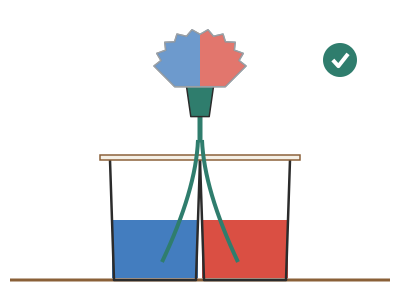
White carnations with freshly cut stems are put in water with lots of food colouring: within 2–6 hours streaks of colour appear on the edges of the petals, and by the next day the flower is dyed, because the water rises through the xylem vessels, pulled up by transpiration. With the stem split in two, the flower comes out two-coloured.
What they will learn
- That plants have tubes (xylem) that carry water from the root (or the cut) to the leaves and petals.
- That water rises mainly because it is «pulled» by evaporation from leaves and petals (transpiration), helped by capillary action.
- That each vessel in the stem feeds a specific part of the flower: that's why a split stem gives a two-coloured flower.
- To observe and record a slow change using a scale, at set times.
Prepare beforehand
- Buy the carnations on the same day or the day before and keep them in clean water until you start.
- Print pieces A, B and C at 100 % on card.
- Start in the morning: that way the children are still around at 2 h and 6 h to observe, and the next day they see the final result.
- Choose a bright spot without strong direct sun, away from radiators: a north-facing window or a well-lit table.
- Label each glass with the colour and the start time.
Materials and tools
- White carnations — 4 (3 colours + 1 for the split stem) buy
fresh, with stems at least 25 cm long; better if they have leaves - Liquid food colouring — 20–30 drops per glass (≈ 1.5 ml)
blue, red and green; blue shows up best - Clear glasses or jars — 5 (one per colour + two for the split stem)
200–250 ml, tall and narrow so the flower doesn't fall over; the two for the split stem must be identical - Lukewarm water — 100 ml per glass
at 25–30 °C (tepid to the finger): it is absorbed faster than cold water - Thin card or card — 1 piece 20 × 20 cm
for the split-stem holder (A) and the lid-holders (B) - Sticky tape — 10 cm
so the split stem doesn't split any further - Celery stick with leaves (experiment) — 1
from the inner part, with yellowish-green leaves
Tools
- Secateurs or strong scissors — cutting the end of the stem under water
- Craft knife — splitting the stem in two lengthways adult
- Bowl of water — cutting the stems under water
- Magnifying glass — seeing the streaks of colour in the petals and the tiny dots in the cut celery
- Ruler and clock — measuring the stem length and noting the observation times
Pieces and templates
- A · Split-stem holder ×1 — thin card or 300 gsm card
- B · Glass lid-holder ×3 — 300 gsm card
- C · Petal colour scale ×1 — paper
Step by step
Prepare the glasses
Fill 3 glasses with 100 ml of lukewarm water (25–30 °C), which is half of a 200 ml glass. Label each glass with its colour and the time.
1 Pour 100 ml of lukewarm water into each glass: halfway up 2 Label each glass with its colour and the start time Add lots of colouring
Add 20–30 drops of colouring to each glass (blue, red and green) and stir with a teaspoon until the colour is even and strong.
1 Add 20–30 drops of colouring to the glass, counting them 2 Stir with a teaspoon until the colour is even 3 Blue, red and green water: dark, almost opaque Check: The water should be so dark you can hardly see through the glass.Measure and remove lower leaves
Measure each stem with the ruler from the base of the flower and mark it with a felt-tip pen at 18–20 cm (the flower will stick out ≈ 10 cm above the glass). Don't cut yet: the extra is cut off at that mark under water in the next step. Remove the leaves that would end up in the water and keep the ones higher up.
1 Measure the stem with the ruler and mark it 18–20 cm from the flower 2 Pull off the leaves that would be in the water; keep the top ones Tip: Leaves left out of the water help to «pull» the water up; submerged ones rot.Cut under water
Dip the lower part of the stem in a bowl of water until the mark is under water, and cut diagonally at the mark with the scissors, without taking it out of the water. The leftover piece falls into the bowl. Move it to the coloured glass in less than 5 seconds.
1 With the mark under water, cut diagonally through it 2 Move it straight to the coloured glass, in less than 5 seconds 3 The cut must be clean, without crushing the stem Check: The cut is clean, not crushed. If the scissors crush it, use secateurs or a craft knife (adult).Put the flowers in
Put one flower in each glass, passing the stem through lid-holder B, so that the cut end is 3–5 cm under water and the flower stands upright.
1 Slide the stem through the cut in lid B up to the hole 2 The cut end is 3–5 cm under water and the flower is upright Prepare the split stem adult
With the fourth carnation, the adult splits the stem down the middle lengthways with the craft knife, from the bottom up to a height of 10–12 cm. Wrap one turn of tape around the stem just above the end of the cut so it doesn't split any further.
1 The adult splits the stem in two lengthways, 10–12 cm from the bottom 2 Wrap tape around the stem just above the cut Set up the two glasses
Put two identical glasses together, one with 100 ml of blue water and the other with 100 ml of red. Rest holder A on top with the slot right over the point where they touch. Pass the stem through the slot and put each half into a glass.
1 Put two identical glasses together: 100 ml blue and 100 ml red 2 Rest holder A with the slot over the join between the glasses 3 Pass the stem through the slot: each half 3 cm into its colour Check: Both halves are submerged at least 3 cm, each in its own colour. If they don't reach, add more water of the same colour.Leave somewhere bright
Put all the glasses in a bright spot, without strong direct sun and away from heating draughts. Light and dry air speed up transpiration.
1 Put them by a bright window, out of strong direct sun 2 Avoid strong direct sun and heating: the flower wilts Observe at 2 h and 6 h
Look closely at the petals with the magnifying glass and score each flower from 0 to 4 with scale C. The colour usually appears first as fine lines on the edges of the petals.
1 Look at the edges of the petals with the magnifying glass 2 Score each flower from 0 to 4 with scale C: at 2–6 h, 1 or 2 Check: At 2–6 h, the blue should already show on the edges (level 1–2).Observe the next day
At 24 h, score the flowers again. Compare colours: which has got furthest? Look at the split-stem flower: one half should be blue and the other red.
1 At 24 h score again: which colour has got furthest? 2 The split-stem flower: one half blue and the other red Look inside the stem adult
When you've finished, the adult cuts a stem straight across 5 cm above the water. With the magnifying glass you'll see coloured dots in a circle: these are the xylem vessels, the tubes the water travelled up.
1 The adult cuts the stem straight across, 5 cm above the water 2 With the magnifying glass you'll see a ring of coloured dots: the xylem Tidy up
Water with food colouring can be poured down the sink with plenty of water. The flowers last another 4–7 days: swap the coloured water for clean water to keep them fresh.
1 Pour the coloured water down the sink with the tap running 2 Put them in clean water: they last another 4–7 days
Does it work? The test
Score each flower from 0 to 4 with scale C at 0, 2, 6 and 24 hours.
What should happen: With white carnations and strong blue: level 1–2 (streaks on the edges) at 2–6 h and level 3–4 at 24 h. Red and green are a little slower or look paler. The split-stem flower comes out with one half in each colour.
If something goes wrong
- At 24 h the flower is still white — The stem vessels were blocked by air when cut, or the flower was old or a poorly absorbing species. Solution: Cut 2 cm off again under water and put the flower back in the glass. Use fresh carnations.
- It barely dyes — Too little colouring or a colour that doesn't show up well (yellow, orange). Solution: Double the colouring (40–60 drops) and use strong blue or red.
- The flower droops or wilts — The stem doesn't reach the water properly or it's very hot. Solution: Check that the cut end is 3–5 cm under water and move the flowers away from direct sun and radiators.
- The split stem splits all the way up — The tape is missing or the cut was made with scissors. Solution: Cut with a craft knife and put one turn of tape just above the end of the cut before separating the halves.
- Only one half of the two-coloured carnation dyes — One of the two halves isn't submerged or has dried out in the air. Solution: Add water of that colour until it covers 3 cm of that half and trim 1 cm off its end under water.
- The water in the glass doesn't go down at all — There is no transpiration: a leafless flower in a cold, damp place, or blocked stem vessels. Solution: Move the flower to a brighter, drier spot and cut the stem again under water.
Safety
- The craft knife for splitting the stem is used by an adult, cutting downwards on a board.
- Colouring stains clothes, wood and hands: put newspaper under the glasses and wear old clothes.
- If you use fountain-pen ink instead of food colouring, it is not safe to eat: keep the glasses away from small children and pets.
- Carnations are not edible; wash your hands after handling shop-bought flowers (they may have preservatives on them).
The science behind it
For children
Plants drink through tiny, very thin tubes inside their stem, like straws. When the sun and the air dry the leaves and petals a little, the flower «sips» water up those straws so it doesn't dry out. Because our water has colouring in it, the colour travels up with it and stays there, painting the white petals. If we split the stem in two, some straws drink blue and others red, and that's why the flower comes out in two colours.
For the adult
Water rises through the xylem, a bundle of dead, lignified vessels 20–200 µm in diameter. Capillary action alone (Jurin's law, h ≈ 15 mm·mm/r) would only lift water a few centimetres in vessels of that size; the main driving force is transpiration: water evaporates through the stomata in the leaves and through the petals, tension builds up in the water column and, thanks to cohesion between molecules (hydrogen bonds) and their adhesion to the walls, the whole column is «pulled» upwards (cohesion-tension theory). That is why light, dry air and the presence of leaves speed up the dyeing, and an air bubble at the cut (embolism) blocks it: hence cutting under water. Food colourings are soluble molecules that travel with the water and are deposited where it evaporates, mainly at the edges of the petals, where the veins end. The split stem shows that the vascular bundles run in parallel and each supplies one sector of the flower. Lukewarm water has a lower viscosity and slightly less dissolved gas, and is absorbed faster at first.
- xylem: the tiny tubes in the stem that water rises through.
- capillary action: water rising up very thin tubes because it «sticks» to their walls.
- transpiration: water leaving as vapour through the leaves and petals; it's what makes the water rise.
- stomata: tiny pores in leaves that water vapour escapes through.
- embolism: an air bubble that blocks a tube in the stem and stops water getting through.
By age
- 5–7 years: The adult cuts the stems and splits the one for the two-coloured flower. The child adds the colouring counting the drops, puts the flowers in and looks at them with the magnifying glass the next morning. Focus on «the flower drinks through straws».
- 8–10 years: They do everything except the craft knife, score with the scale at set times and do the with/without leaves experiment.
- 11–12 years: They design an experiment with a single variable (leaves, temperature, light), mark the water level to measure how many ml each flower has transpired and draw a graph of colour level against time. They look at the cut celery with a magnifying glass and draw the bundles.
In a group or in class
Teams of 3–4 children, each team with 2 carnations and a different variable (with/without leaves, lukewarm/cold, blue/red, split stem). Materials for 6 teams: 12–14 carnations, 3 bottles of colouring, 14 glasses. Set-up in 30 min in the morning; 5-min observations after break and at the end of the day; a 20-min sharing session the next day comparing all the teams' results on the board.
Challenges
- Make a three-coloured carnation by splitting the stem into three (clue: three small glasses together).
- Get purple without mixing colourings in the glass.
- Find out how many ml of water a carnation «drinks» in 24 h by marking the level in the glass and measuring with a syringe.
- Try a Chinese cabbage leaf or a white lettuce leaf: can you see the veins in colour?
More free projects
- Bouncy egg without a shell
- Fizzy drink and sweets fountain
- Foaming volcano
- Giant yeast foam
- Hidden colours in ink
- Homemade stretchy slime
- Moving colours in milk
- Oil bubble lamp
- Raisins that rise and sink
- Red cabbage acid indicator
- Secret messages with lemon juice
- Self-inflating ghosts
- Cubic salt crystals
- Rock candy on a string