Red cabbage acid indicator
With the purple water that red cabbage gives off you make a home-made pH indicator: in vinegar or lemon it turns pink, with bicarbonate of soda bluish-green and with detergent green, so you can rank any liquid in the kitchen from most acidic to most basic.
What they will learn
- That an indicator is a substance that changes colour depending on how acidic or basic a liquid is.
- What the pH scale is (from 0 to 14, with 7 as neutral) and how to place real substances on it.
- That an acid and a base “cancel each other out” (neutralisation), and that bicarbonate of soda with vinegar also makes bubbles of CO₂.
- That not everything that cleans is basic: washing-up liquid or hand soap are usually almost neutral.
- How to work as in a laboratory: a control glass, equal amounts and writing down results.
Prepare beforehand
- Print the templates page at 100 % (pH scale and labels) and cut out the 6 labels.
- If the children are young, cut the cabbage yourself beforehand (250 g in strips of about 5 mm).
- Bring 500 ml of water to the boil and let it stand off the heat for 1 minute before pouring it (80–90 °C).
- Set out the 6 glasses on a tray on a white A4 sheet, numbered 1 to 6, with the products already measured into spoons or small bowls beside them.
- Test your tap water: if the control glass ends up blue instead of violet, have bottled water to hand to repeat it.
Materials and tools
- Red cabbage — ¼ of a head (≈ 250 g) buy
deep purple leaves; one that has already been started is fine - Water — 500 ml hot + 500 ml cold
hot at 80–90 °C (boiled and left to stand for 1 min); the cold for diluting if the colour comes out too dark - Clear glasses — 6 (+ 2 spare)
colourless glass or plastic, 200–250 ml, all the same - White vinegar — 1 tablespoon (15 ml)
white wine or cleaning vinegar at 5–6 % acidity (colourless, so it does not tint) - Lemon juice — 1 tablespoon (15 ml)
freshly squeezed and strained - Bicarbonate of soda — ½ teaspoon (≈ 3 g) + 1 teaspoon for the neutralisation
from the kitchen or the chemist - Liquid soap — 1 teaspoon (5 ml)
washing-up liquid or hand soap (colourless if possible) - Laundry powder — ¼ teaspoon (≈ 1 g)
ordinary washing-machine detergent (contains carbonate); handled by an adult - Knife and chopping board — 1
for cutting the cabbage into 5 mm strips - Heatproof bowl and sieve — 1 + 1
1 l bowl (glass, ceramic or steel); fine-mesh sieve - White A4 sheet — 2
one under the glasses to see the colour clearly and another for the printed scale - Coloured pencils or felt-tip pens — 1 box
with pinks, violets, blues and greens
Tools
- Kettle or saucepan — heating the water to 80–90 °C adult
- Kitchen knife — cutting the cabbage into strips adult
- Measuring jug and measuring spoons — pouring 50 ml into each glass and measuring 15 ml / 5 ml / ½ teaspoon
- Plastic teaspoons (one per glass) — stirring without mixing products between glasses
- Rubber gloves and goggles (adult) — handling the laundry powder adult
Pieces and templates
- A · pH scale to colour in ×1 — white paper or card
- B · Glass labels ×6 — paper
- C · Indicator paper strips ×10 — coffee filter paper
Step by step
Set up the table
Lay a white A4 sheet on the table and stand the 6 glasses on it in a row, 3 cm apart. Stick a label B on each one with its number from 1 to 6.
1 Stand the 6 glasses in a row on a white A4 sheet, about 3 cm apart 2 Tape a label B near the top of each glass 3 Number the glasses 1 to 6, from left to right Tip: Set up near a window: in daylight the colours are much easier to tell apart.Cut the cabbage adult
Cut 250 g of cabbage (a quarter of a head) into thin strips of about 5 mm and put them in a 1-litre heatproof bowl. The thinner they are, the more colour they release.
1 Take a quarter of a red cabbage, about 250 g 2 The adult cuts it into thin strips of about 5 mm 3 Put the strips into a 1 l bowl that can take the heat Tip: Children can tear the strips up by hand: that gives more surface and more pigment comes out.Add the hot water adult
The adult pours 500 ml of water at 80–90 °C over the cabbage until it is covered. Stir with a wooden spoon and leave to steep for 20 minutes, stirring every 5 minutes.
1 The adult pours 500 ml of water at 80–90 °C over the cabbage 2 Stir and leave for 20 min, stirring every 5 minutes 3 After 20 min the water is very dark purple, almost opaque Check: After 20 minutes the water should be very dark purple, almost opaque.Strain the indicator adult
When the water is lukewarm (you can touch the bowl), strain the liquid into a jug, pressing the cabbage with the spoon. You will get about 400 ml of purple indicator.
1 Wait until the bowl is lukewarm: you must be able to touch it 2 Strain it into a jug and press the cabbage with the spoon 3 You will get about 400 ml of purple indicator Tip: Do not throw the cabbage away: you can cook with it or put it in the compost.Share it out between the glasses
Using the measuring jug, pour 50 ml of indicator into each of the 6 glasses (about 2 cm deep). If the colour is so dark it looks black, add 25 ml of water to each glass.
1 Pour 50 ml of indicator into each glass: about 2 cm deep 2 All 6 glasses at the same height and the same violet 3 If it looks black, add 25 ml of water to each glass Check: All 6 glasses should be filled to the same height with the same violet. If glass 6 already looks blue, your tap water is very hard: use bottled water to dilute.Glass 1: vinegar
Add 1 tablespoon (15 ml) of white vinegar to glass 1 and stir with its teaspoon. Watch the colour change and note it on the label.
1 Add 1 tablespoon (15 ml) of white vinegar to glass 1 2 Stir: within 1–2 s it turns pink. Note it on the label Check: It should turn bright pink within 1–2 seconds.Glass 2: lemon
Add 1 tablespoon (15 ml) of strained lemon juice to glass 2 and stir with another teaspoon. Compare its pink with glass 1: which is redder?
1 Add 1 tablespoon (15 ml) of strained lemon juice to glass 2 2 Compare with glass 1: the lemon usually comes out redder Check: Pinkish-red, usually a little stronger than the vinegar: lemon is more acidic.Glass 3: bicarbonate of soda
Add ½ level teaspoon (≈ 3 g) of bicarbonate of soda to glass 3 and stir until almost all of it dissolves. Look at the colour against the white sheet.
1 Fill ½ level teaspoon with bicarbonate of soda: about 3 g 2 Tip it into glass 3 and stir until almost all of it dissolves 3 Look at it against the white sheet: it is blue or bluish-green Check: It turns blue or bluish-green: bicarbonate of soda is a mild base (pH ≈ 8–9).Glass 4: liquid soap
Add 1 teaspoon (5 ml) of liquid soap (washing-up liquid or hand soap) to glass 4 and stir slowly so it does not foam. Compare with glass 6.
1 Add 1 teaspoon (5 ml) of liquid soap to glass 4 2 Stir slowly so it does not foam 3 Almost the same as glass 6: this soap is almost neutral Check: It nearly always stays violet or bluish-violet, very like the control: this soap is almost neutral. That is a discovery too!Glass 5: laundry powder (adult) adult
The adult, wearing gloves, adds ¼ teaspoon (≈ 1 g) of laundry powder to glass 5 and stirs. The children watch without touching.
1 The adult, wearing gloves, adds ¼ teaspoon of detergent 2 Stir: it turns green. The children watch without touching Check: It turns green: it is a stronger base (pH ≈ 10–11).Glass 6: the control
Do not add anything to glass 6. It is the control glass: the “unchanged” colour you compare the other 5 with. Put it in the middle of the row to compare more easily.
1 Do not add anything to glass 6: it is the control 2 Put it in the middle of the row to compare more easily Sort and colour in the scale
Arrange the glasses from reddest to greenest. On scale A, colour each glass's box with the colour you see and write the name of the product underneath.
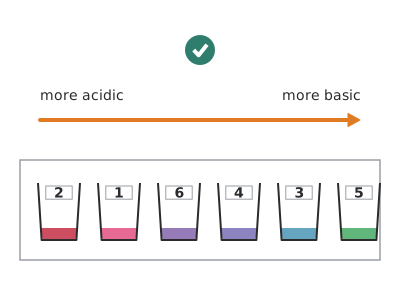
1 Arrange them from reddest to greenest 2 On scale A, colour each glass's box and write the product Check: Expected order: lemon, vinegar, control, soap, bicarbonate of soda, detergent.Neutralise glass 1
Add bicarbonate of soda to glass 1 (vinegar) in 0.5 g pinches, stirring after each pinch, until it turns violet again. Count how many pinches you need.
1 Add a pinch (≈ 0.5 g) of bicarbonate of soda to glass 1 2 Stir after each pinch and count them: it will froth 3 Stop when it turns violet again; if you overdo it, it goes blue Check: It will froth with each pinch and go from pink to violet in 2–3 pinches (15 ml of 5 % vinegar is neutralised by ≈ 1 g); by 5 or 6 pinches you have overdone it and it turns blue.Store the indicator and tidy up
Keep the leftover indicator in a closed jar in the fridge (3–5 days) or freeze it in an ice-cube tray. The contents of the glasses go down the sink with plenty of water.
1 Keep the leftover indicator in a closed jar in the fridge 2 Or freeze it in an ice-cube tray for another day 3 Pour the contents of the glasses down the sink with plenty of water
Does it work? The test
With the 6 glasses ready, arrange them on the white sheet from reddest to greenest without looking at the labels, then check whether the order matches the pH table.
What should happen: Lemon red-pink (pH ≈ 2), vinegar pink (≈ 3), control violet (≈ 7), liquid soap bluish-violet (≈ 7–8), bicarbonate of soda bluish-green (≈ 8–9), detergent green (≈ 10–11). In glass 1, 2–3 pinches (≈ 1–1.5 g) of bicarbonate of soda are enough to get back to violet.
If something goes wrong
- The indicator comes out very pale — Too little cabbage, thick strips or water not hot enough. Solution: Use 250 g in only 500 ml, 5 mm strips and water at 80–90 °C; squash the cabbage when straining. You can also chop it in a blender with the water (adult).
- The indicator is so dark that all the glasses look black — Too concentrated. Solution: Dilute: 25–50 ml of water per glass. Look at the glasses against the white sheet and against the light.
- The control glass comes out blue, not violet — Very hard tap water (contains carbonates, slightly basic). Solution: Make the indicator with low-mineral bottled water. Always compare with the control, not with the photo.
- The soap does not change colour — Most washing-up liquids and hand soaps have an almost neutral pH. Solution: That is a correct result. To see green, use laundry powder or grated bar soap.
- The bicarbonate of soda comes out violet instead of blue — Too little bicarbonate of soda or too much indicator. Solution: Add another ½ teaspoon and stir until dissolved. Baking powder comes out less blue because it contains an acid.
- The stored indicator smells bad or has turned brown — It has gone off (bacteria) after several days. Solution: Throw it away and make a fresh batch. Always store it cold and covered, or frozen in cubes.
Safety
- Water at 80–90 °C scalds: an adult pours and strains it, with the bowl resting on the table and the children an arm's length away.
- Laundry detergent irritates eyes and skin: an adult handles it with gloves, and keeps it away from faces. If it splashes into the eyes, rinse with plenty of water for 15 minutes.
- Never use bleach, ammonia, drain cleaners or caustic soda to “see the yellow”: they are dangerous and bleach also decolourises the indicator.
- Nothing in the glasses is for drinking, not even the lemon: label them and do not use the family's drinking glasses or mugs.
- Lemon juice and vinegar sting in cuts and eyes: wash your hands when you finish.
- Anthocyanin stains clothes and wood: wear an apron or an old T-shirt and cover the table.
The science behind it
For children
Red cabbage has a colouring inside it that is like a chameleon detective: it changes colour depending on who it meets. Sour things, like lemon or vinegar, are called acids and turn it pink. Slippery things that clean, like detergent, are called bases and turn it blue or green. If you put an acid and a base together, they fight and cancel each other out, and the colour goes back to purple. That way you can find out whether something is acidic or basic without tasting it.
For the adult
The colour of red cabbage comes from anthocyanins (mainly cyanidin derivatives), water-soluble pigments that hot water extracts by breaking the cell vacuoles. Their structure changes with the H⁺ concentration: in acid (pH < 3) the flavylium cation (red) predominates; around pH 4–6 the quinoidal base and the pseudobase form (pale pink-violet); around pH 7–8 the neutral and anionic quinoidal base (violet-blue); at pH 9–11 the anionic form (blue-green; the green is partly the blue mixed with yellow pigments) and above pH 12 the ring opens into yellow chalcones, irreversibly. pH is −log[H⁺]: each unit is a factor of 10 in the concentration of H⁺ ions, so lemon (pH ≈ 2.2) is about 4–6 times more acidic than vinegar (≈ 2.8–3): 0.6–0.8 units apart, and 10^0.7 ≈ 5. Bicarbonate of soda (NaHCO₃) gives pH ≈ 8.3; laundry detergents contain sodium carbonate (pH ≈ 10.5–11). Washing-up liquids and hand gels are formulated at around pH 6–8 so as not to irritate the skin, which is why they barely change the colour. In neutralisation, CH₃COOH + NaHCO₃ → CH₃COONa + H₂O + CO₂: the CO₂ is the foam. Hard water contains HCO₃⁻ and shifts the control towards blue, which is why you always compare with a blank.
- indicator: a substance that changes colour depending on how acidic or basic a liquid is.
- pH: a number from 0 to 14 that tells you how acidic (below 7) or basic (above 7) something is; 7 is neutral.
- acid: a sour-tasting substance, like lemon or vinegar; it turns the cabbage pink or red.
- base: the opposite of an acid, like bicarbonate of soda or detergent; it turns the cabbage blue or green.
- neutralisation: when an acid and a base mix and cancel each other out.
- control: a sample you leave alone, to compare the others with.
By age
- 5–7 years: The adult makes the indicator and shares it out. The child adds vinegar, lemon and bicarbonate of soda with ready-measured spoons and names the colour. Talk only about “sour” (pink) and “slippery / cleans” (blue-green). They love the frothy neutralisation.
- 8–10 years: They follow all the steps except the hot water and the detergent. They write predictions before each glass and complete scale A. Introduce the word pH and the number 7 as neutral.
- 11–12 years: Let them design the experiment like scientists: same amount in each glass, a control, results recorded in a table. Let them estimate the pH with the scale and compare with shop-bought pH strips if available. Challenge: the titration by counting pinches, and explaining why pH 2 is 10 times more acidic than pH 3.
In a group or in class
Teams of 4 children with 6 clear plastic cups, a teaspoon per cup and a scale A per child. The adult makes 2 l of indicator beforehand (1 kg of cabbage in 2 l of hot water) and shares it out in 500 ml bottles per team. The products are served at stations (vinegar, lemon, bicarbonate of soda, soap) with measuring spoons; the detergent stays only on the adult's table, and the adult adds it for each team. Duration: 50 min (10 explanation and predictions, 25 glasses, 15 shared scale on the board).
Challenges
- Find 5 new liquids at home (with permission) and place them on the scale on the wall.
- Get all 6 different colours (red, pink, violet, blue, bluish-green, green) using only mixtures of vinegar, water and bicarbonate of soda in different amounts.
- Make home-made pH strips and compare them with shop-bought swimming pool strips.
- Try other plants (blueberries, red onion, red rose petals, black tea): which makes the best indicator?
- Paint a picture with indicator and “develop” it afterwards with brushes of lemon and of bicarbonate of soda.
More free projects
- Bouncy egg without a shell
- Coloured carnations
- Fizzy drink and sweets fountain
- Foaming volcano
- Giant yeast foam
- Hidden colours in ink
- Homemade stretchy slime
- Moving colours in milk
- Oil bubble lamp
- Raisins that rise and sink
- Secret messages with lemon juice
- Self-inflating ghosts
- Cubic salt crystals
- Rock candy on a string