Moving colours in milk
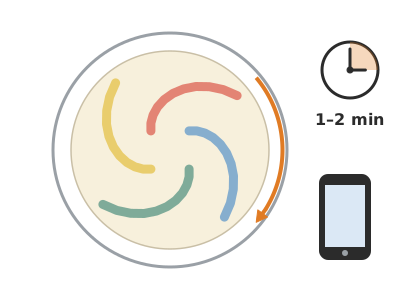
Four still drops of food colouring on a plate of whole milk burst into swirls of colour when you touch the centre with a cotton bud dipped in washing-up liquid, and they keep moving for 1–2 minutes.
What they will learn
- That the surface of a liquid is taut and that washing-up liquid reduces that tension.
- That when the surface pulls harder on one side than the other, the liquid moves towards where it pulls harder (the Marangoni effect).
- That washing-up liquid has molecules with one part that sticks to water and another that sticks to grease, which is why it cleans.
- That the fat in the milk makes the movement last longer: with skimmed milk or water it lasts less.
Prepare beforehand
- Cover the table with newspaper or a plastic tablecloth and put the children in old clothes or an apron.
- Rinse the plates well with plain water: any soap left on the plate makes the colours move too early.
- Open the food colourings and check that they drip one drop at a time.
- Put 1 ml of washing-up liquid in a bottle cap, away from the plates.
- If you are going to print, cut out disc A from watercolour paper or card.
Materials and tools
- Whole milk — 200 ml per plate (+ 200 ml of skimmed milk to compare)
whole (3.5 % fat), at room temperature or straight from the fridge - Liquid food colourings — 4 colours (red, blue, yellow, green) buy
for baking, liquid, in a dropper bottle - Washing-up liquid — 1 ml (a little squirt in a bottle cap)
for hand washing, concentrated - Cotton buds — 4–6
a new one for each test - White deep plate — 1 (2–3 to compare)
plain, Ø 20–24 cm, clean and rinsed with no traces of soap - Newspaper or plastic tablecloth — 1
to protect the table: food colouring stains - Watercolour paper or white card — 1 sheet (optional)
to print the pattern (disc A)
Tools
- Measuring jug — measuring 200 ml of milk
- Bottle cap — holding the washing-up liquid to dip the cotton bud in
- Mobile phone or camera — photographing or filming the swirls
- Microwave or saucepan — warming the milk for the temperature experiment adult
Pieces and templates
- A · Disc for printing the pattern ×2 — watercolour paper or card (200 gsm)
Step by step
Protect the table
Spread out newspaper or a plastic tablecloth and put the white deep plate on top, somewhere you won't need to move it later.
1 Spread newspaper or a plastic tablecloth over the table 2 Put the white deep plate in the middle and don't move it again Pour the milk
Measure 200 ml of whole milk with the measuring jug and pour it onto the plate until the whole bottom is covered to a depth of ≈ 1 cm.
1 Fill the measuring jug with 200 ml of whole milk 2 Pour the milk slowly into the centre of the plate 3 Keep going until the whole bottom is covered: ≈ 1 cm of milk Check: You can't see the bottom of the plate anywhere.Wait for it to be still
Wait 1 minute without touching the plate or the table, until the surface of the milk is completely smooth and still.
1 Don't touch the plate or the table while it settles 2 Wait 1 minute: the surface becomes as smooth as a mirror Add the drops of colour
Put 1 drop of each food colouring 3–3.5 cm from the centre (so they end up 4–5 cm from each other), like the 4 corners of a square, without them touching. Let each drop fall from a height of 1–2 cm.
1 Imagine a square around the centre, 3–3.5 cm from it 2 Let one drop of each colour fall from a height of 1–2 cm 3 You have 4 round, still drops that don't touch Check: The drops stay round and almost still on the surface.Dip the cotton bud
Dip the tip of a clean cotton bud in the bottle cap of washing-up liquid so that it is soaked but not dripping.
1 Put the tip of the cotton bud into the cap of washing-up liquid 2 Take it out with the tip soaked but not dripping Touch the centre and keep still
Rest the tip of the cotton bud in the centre of the plate, right on the surface (without reaching the bottom), and hold it still for 10–15 seconds.
1 Rest the tip in the centre, only on the surface 2 Hold it still for 10–15 s: the colours rush to the edge 3 If they shoot off in less than 1 second, you've done it right Check: In less than 1 second the colours shoot off towards the edge.Watch the swirls
Take the cotton bud out and watch without touching for 1–2 minutes: the colours keep turning and mixing in swirls even though you're no longer touching anything.
1 Take the cotton bud out and don't touch the plate again 2 Watch for 1–2 minutes as they turn on their own; film it if you like Tip: Film a slow-motion video from above to see the first “burst”.Second touch
When the movement calms down, touch again with the soapy cotton bud at another point, for example 3 cm from the edge. Compare the pattern with the first one.
1 Choose another point, for example 3 cm from the edge of the milk 2 Touch with the soapy cotton bud and compare the new pattern Print the pattern (optional)
Lay disc A flat on the milk for 5 seconds, lift it by one edge and leave it to dry on newspaper, colour side up, for 30 minutes.
1 Lay disc A flat on the milk and count 5 seconds 2 Lift it slowly by pulling on one edge 3 Leave it to dry on newspaper, colour side up, for 30 minutes Tidy up
Pour the milk down the sink (don't drink it: it has washing-up liquid in it) and wash the plate with soap and water. If you get stained, wash with cold water straight away.
1 Never drink the milk: it has washing-up liquid in it 2 Pour the milk down the sink 3 Wash the plate with soap and water; stains with cold water
Does it work? The test
Plate with 200 ml of whole milk, 4 drops of food colouring 3–3.5 cm from the centre and a cotton bud with washing-up liquid in the centre.
What should happen: When you touch it, the colours move away from the centre in less than 1 second and travel several centimetres towards the edge. For 1–2 minutes they keep forming swirls and spirals without anyone touching anything. A second touch gives another, smaller explosion.
If something goes wrong
- The colours move before you touch them with the cotton bud — The plate had traces of soap on it. Solution: Rinse the plate 2–3 times with plain water and start again with fresh milk.
- When you touch it, almost nothing happens — Skimmed milk, too little washing-up liquid or milk that has already been used. Solution: Use fresh whole milk and soak the tip of the cotton bud well.
- The drops of colour sink and disappear — Too much milk (very deep) or drops dropped from too high. Solution: Use only ≈ 1 cm of milk and let the drops fall from 1–2 cm.
- Everything turns brown straight away — Drops too close together or it has been stirred with the cotton bud. Solution: Space the drops 4–5 cm apart and keep the cotton bud still.
- The gel food colouring doesn't spread — The gel is very thick. Solution: Dilute it: a knife tip of gel in a teaspoon of water.
Safety
- Don't drink the milk with washing-up liquid in it: throw it away at the end.
- Food colouring stains clothes, wood and hands for hours: protect the table and wear old clothes.
- Washing-up liquid: if it splashes into the eyes, rinse with plenty of water.
- If the milk is warmed, an adult should do it and it should not go above 40 °C (lukewarm to the touch).
- Milk allergy: touching it isn't dangerous, but those children should wash their hands when they finish.
The science behind it
For children
The surface of the milk is tight like the skin of a drum, and the drops of colour are resting on top. When you touch the centre with soap, the skin goes slack right there, and the rest of the skin, which is still tight, pulls towards the edge and carries the colours racing away. On top of that, the soap goes looking for the tiny drops of fat in the milk to grab them, and all that coming and going stirs the colours like a very gentle whisk.
For the adult
Whole milk is an emulsion of fat globules (≈ 3.5 %) and proteins (caseins) in water. Its surface has a surface tension of ≈ 0.045–0.05 N/m. The drops of food colouring (water-based, slightly denser) sit on the surface and barely diffuse because the milk is still. Washing-up liquid contains anionic and non-ionic surfactants: molecules with a hydrophilic head and a hydrophobic tail that settle at the surface immediately and lower it to ≈ 0.03 N/m. That tension gradient drags the surface layer from the soapy area (low tension) towards the clean area (high tension): this is the Marangoni effect, responsible for the initial “burst”, which also moves the drops of colour. Underneath, the liquid flows back towards the centre and forms circulation cells. The later movement, which lasts minutes, happens because the surfactant keeps diffusing, adsorbs onto the fat globules and proteins and forms micelles, renewing local tension gradients. That's why the effect is shorter with skimmed milk, and with water there is only a brief push (and the colouring also sinks and diffuses in the water). It is the same mechanism that lets soap lift grease off plates and clothes.
- surface tension: the force that keeps the surface of a liquid taut, like the skin of a drum.
- surfactant: a substance, such as washing-up liquid, that loosens that tension.
- emulsion: a mixture of tiny drops of fat spread through water without joining together, like milk.
- micelle: a tiny ball made of soap molecules surrounding a drop of fat.
- Marangoni effect: the movement of a liquid from where its surface pulls less towards where it pulls more.
By age
- 5–7 years: The adult pours the milk and opens the food colourings; the child adds the drops (with help) and touches with the cotton bud. Message: “soap pushes the colours”.
- 8–10 years: They do everything and compare whole milk with skimmed milk or water, timing how long the movement lasts.
- 11–12 years: Have them design the fat experiment with four plates (skimmed, semi-skimmed, whole, diluted cream), measure how long it lasts and draw a graph of duration against fat percentage.
In a group or in class
Teams of 3, one plate per team (8 plates for 25 children), 2 L of whole milk in total and one set of food colourings for every 2 teams. The teacher hands out the washing-up liquid in bottle caps at the end, when everyone has their drops in place, and the class touches at the same time on the count of three. Then each team tests one variable (skimmed, water, lukewarm). 30 min + 10 to tidy up. Protecting the tables is essential.
Challenges
- Get the colours to form a spiral by touching with the cotton bud somewhere other than the centre.
- Make a single drop of colour travel from one side of the plate to the other without touching it directly.
- Create a greetings card by printing the pattern with disc A.
- Try cream, oat milk and soya milk and rank them from most to least spectacular. Does it match their fat content?
More free projects
- Bouncy egg without a shell
- Coloured carnations
- Fizzy drink and sweets fountain
- Foaming volcano
- Giant yeast foam
- Hidden colours in ink
- Homemade stretchy slime
- Oil bubble lamp
- Raisins that rise and sink
- Red cabbage acid indicator
- Secret messages with lemon juice
- Self-inflating ghosts
- Cubic salt crystals
- Rock candy on a string