Bouncy egg without a shell
A raw egg left in vinegar for 2–3 days loses its shell (the acid dissolves the calcium carbonate and gives off bubbles of CO₂) and is left wrapped only in its membrane: see-through, bigger and stretchy, able to bounce from 2–3 cm.
What they will learn
- That an acid (vinegar) reacts with a carbonate (shell) and produces a gas, carbon dioxide, which you can see as bubbles.
- That under the shell there is a thin, stretchy membrane that holds the egg together.
- What osmosis is: water passes through the membrane and the egg swells (in vinegar or water) or shrinks (in syrup).
- To measure and compare mass and circumference before and after an experiment and to express the change as a percentage.
- That chemical reactions have a speed that depends on temperature and on the amount of reactant.
Prepare beforehand
- Print tape measure A and bounce scale B at 100%; check that there are 100 mm from 0 to 100 on the tape.
- Take the egg out of the fridge 30 minutes beforehand so it is not ice-cold (it reacts better at the start).
- Check the egg against the light: if it has cracks, use the spare.
- Plan the timing: if you start on Monday afternoon, you change the vinegar on Tuesday at the same time and take the egg out on Wednesday or Thursday.
- Have kitchen roll and a tray to hand: the shell-less egg is slippery.
Materials and tools
- Raw eggs — 2 (one spare) + 1 normal one for comparison
size M or L, no cracks; white-shelled is best (you see the change sooner), although brown ones also work - White distilled vinegar — 500 ml (250 ml on day 1 and 250 ml on day 2); 750 ml if the jar is wide
5% acidity (it says so on the label); wine vinegar also works but stains - Glass jar or tall glass — 1
400–500 ml, mouth at least 60 mm wide so you can take the egg out without squeezing it - Small freezer bag — 1
zip-lock, filled with 50 ml of water and tightly closed: it acts as a weight to keep the egg under (a small plastic cup would float) - Plate or cling film — 1
to cover the jar without sealing it airtight (cling film with 3–4 holes) - Large spoon or slotted spoon — 1
to lift the egg out without pinching it - Food colouring and sugar (experiments) — 10 drops of colouring; 200 g of sugar
for the egg in coloured water and the egg in syrup
Tools
- Kitchen scales — weighing the egg before and after (to 1 g)
- Paper tape measure (piece A) or string and a ruler — measuring the egg's circumference
- Torch or phone torch — looking at the egg against the light
- Tray or flat plate — surface for the bounces (if it bursts, it catches everything)
Pieces and templates
- A · Paper tape measure ×1 — paper
- B · Bounce scale ×1 — card
Step by step
Measure the egg first
Weigh the egg on the scales and write down the grams (≈ 55–65 g). Wrap tape A round the widest part and write down the circumference (≈ 140–150 mm); repeat the long way round (≈ 160–170 mm).
1 Weigh the egg and write down the grams (about 60 g) 2 Wrap tape A round the widest part, without pulling tight 3 Measure the long way round too and write down all three numbers Check: You have 3 numbers written down: mass, wide circumference and long circumference.Put the egg in the jar
Put the egg into the empty jar with a large spoon, lowering it to the bottom without dropping it. The jar must hold at least 400 ml.
1 Lower the egg to the bottom on the spoon, without letting go 2 It lies on its side at the bottom of the empty jar Cover it with vinegar
Pour 250 ml of white vinegar down the side of the jar: the egg must be covered with at least 2 cm of vinegar above it. In a Ø 75 mm jar this is just enough; if yours is wider and it does not cover it, add more vinegar until it does.
1 Pour 250 ml of vinegar so it runs down the side of the jar 2 Covered by 2 cm of vinegar, tiny bubbles appear straight away Check: In less than 1 minute, tiny bubbles appear stuck to the shell.Keep it under
The bubbles make the egg rise and float. Fill a small freezer bag with 50 ml of water, close it tightly and rest it on top of the egg so it stays completely under the vinegar.
1 If the egg rises and sticks out, that part does not dissolve 2 Put a closed bag with 50 ml of water on top 3 The whole egg stays under the vinegar Tip: Any part sticking out of the vinegar does not dissolve and would leave a patch of shell. An upside-down plastic cup does not work: it floats.Watch the bubbles
Look at the jar from the side with a torch for 2–3 minutes. The bubbles are carbon dioxide, formed when the acid reacts with the shell. Write down how many you see in 10 seconds.
1 Shine a light on the side of the jar and watch the bubbles for 2 or 3 minutes 2 Count how many bubbles you see in 10 seconds and write it down Cover without sealing and put away
Cover the jar with a plate or with cling film with 3–4 holes (never with the lid screwed on: the gas would build up pressure) and put it in the fridge, somewhere nobody will move it.
1 Cover with cling film and make 3 or 4 holes in it (or use a plate) 2 Never screw the lid on: the gas would build up pressure 3 Put it in the fridge where nobody will move it Change the vinegar after 24 h adult
The next day you will see brown foam and the shell will be soft. Hold the egg back with the spoon resting across the mouth of the jar, pour the used vinegar down the sink and add fresh vinegar, the same amount as on the first day (250 ml or whatever was needed to cover it by 2 cm). Put the bag back on top.
1 The next day: brown foam and a soft shell 2 Hold the egg back with the spoon at the mouth and pour away the vinegar 3 Add 250 ml of fresh vinegar Check: If you touch the egg with the spoon, the shell is soft or already coming off in pieces.Tip: If, when you take it out, you see there is no shell left, you can go straight to rinsing it.Wait another 24–48 h
Cover it again and leave the jar in the fridge for another 24 h (48 h if you can still see white patches). Hardly any bubbles will come out now: a sign that there is little shell left.
1 Cover it again and leave it in the fridge for another 24 h 2 Hardly any bubbles now: there is little shell left Take the egg out and rinse it adult
Lift the egg out with the spoon onto the palm of your hand. Hold it under a thin stream of lukewarm tap water and rub very gently with your fingertip to remove the white bits of shell.
1 Lift it out with the spoon and move it onto the palm of your hand 2 Under a thin stream of lukewarm water, rub very gently with your fingertip 3 See-through, soft and stretchy: you can see the yolk Check: The egg is see-through, you can see the yolk against the light, and it feels soft and stretchy.Measure the egg afterwards
Dry it with kitchen roll and weigh it again and measure both circumferences with tape A. Work out how much it has grown by subtracting the numbers from step 1.
1 Dry it with kitchen roll, dabbing gently 2 Weigh it and measure both circumferences again with tape A 3 Subtract: it usually weighs 10–20 g more and measures 5–10 mm more Check: It usually weighs 10–20 g more and its circumference has grown by 5–10 mm: water has got in by osmosis.Look at it against the light
In a dim room, rest the egg on your phone's torch, switched on. You will see the yolk floating and the air pocket at the wide end.
1 In dim light, rest the egg on the phone's torch 2 You will see the yolk floating and the air pocket at the wide end Make it bounce
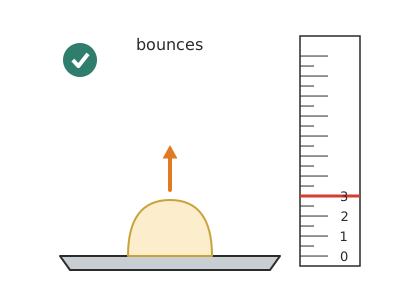
Place scale B next to a tray. Hold the egg 1 cm above the tray and let go; then try 2 cm and 3 cm. Do not go above the 3 cm line.
1 Stand scale B upright next to the tray, with the 0 level with it 2 Drop it from 1 cm, then from 2 cm and 3 cm 3 It squashes a little and bounces without breaking; do not go above 3 cm Check: The egg bounces a few millimetres and squashes a little when it hits the tray, without breaking.Throw it away when you finish
When you have finished the experiments (no more than 3 days after taking it out, kept in the fridge), break the egg inside a bag and put it in the food waste bin. Wash your hands with soap.
1 Break the egg inside a bag 2 Put the bag in the food waste bin 3 Wash your hands with soap and water
Does it work? The test
Compare the shell-less egg with a normal egg: weigh them, measure the circumferences, look at both against the light and drop the shell-less egg from 1, 2 and 3 cm onto a tray.
What should happen: The shell-less egg is see-through, has a circumference ≈ 5–10 mm bigger and weighs ≈ 15–30% more (e.g. from 60 g to 75 g). It bounces without breaking from 1–3 cm; from more than 5 cm the membrane usually bursts.
If something goes wrong
- After 48 h there are still hard bits of shell — The vinegar is used up (it is no longer acidic) or the fridge has slowed the reaction down. Solution: Add fresh vinegar and wait another 24 h. The last bits come off by rubbing gently under the tap.
- Part of the egg still has its shell and the rest does not — The egg was floating and one area stayed out of the vinegar. Solution: Put a closed bag with 50 ml of water on top so it stays under and leave it another 24 h.
- The egg broke when taking it out or rubbing it — It was pinched with the fingers or had a crack from the start. Solution: Always lift it out with a large spoon, rub with your fingertip and use the spare egg. Check the eggs against the light before you start.
- It bursts when bounced — It was dropped from too high or onto a surface with edges or crumbs. Solution: No more than 3 cm onto a smooth tray. A very big egg (after syrup or water) is more fragile: lower it to 1–2 cm.
- No bubbles appear at the start — The vinegar has low acidity or the egg is ice-cold. Solution: Check that the label says 5% and let the egg warm up for 30 min out of the fridge.
- The fridge smells strongly of vinegar — The jar is uncovered. Solution: Cover it with cling film with just a few holes. The smell goes away when you pour out the vinegar.
Safety
- Raw egg: it may carry salmonella. It must not be eaten or tasted; wash your hands with soap after touching it and wipe the table.
- Do not close the jar with the lid screwed on: the gas from the reaction can make the lid pop off or break a small jar.
- Vinegar stings in the eyes and in cuts: if it splashes, rinse with plenty of water.
- If the egg bursts, wipe up the white and the yolk with kitchen roll and clean with soap and water (it is slippery on the floor).
- Throw the egg away no more than 3 days after taking it out: it starts to smell bad.
The science behind it
For children
An eggshell is made of the same thing as chalk: calcium. Vinegar is an acid, and acids slowly “eat” chalk; while they eat it, they give off tiny gas bubbles, like the ones in a fizzy drink. When there is no shell left, all that remains is the thin skin that was underneath, which is stretchy like a balloon. What is more, that skin has holes so tiny that it only lets water through: the water from the vinegar sneaks inside and the egg swells a little. That is why it ends up big and soft and it bounces.
For the adult
The shell is ≈ 95% calcium carbonate (CaCO₃), about 5–6 g in a size M egg. Vinegar is a 5% aqueous solution of acetic acid (≈ 0.83 mol/l). Reaction: CaCO₃ + 2 CH₃COOH → Ca(CH₃COO)₂ + H₂O + CO₂↑. Dissolving 5.5 g of CaCO₃ (0.055 mol) uses up 0.11 mol of acid, the content of ≈ 130 ml of vinegar, and releases 0.055 mol of CO₂ (≈ 1.3 l of gas): that is why the vinegar has to be renewed and the jar must not be sealed. The rate drops with temperature (at 4 °C it is roughly half or less of the rate at 20 °C) and as the acid runs out. Under the shell are the shell membranes (fibres of keratin and collagen), which are semi-permeable: they let water and small molecules through but not the proteins of the egg white. Because vinegar has much less solute than the inside of the egg, water enters by osmosis and the mass increases by 15–30%; in syrup (more concentrated than the egg white) the gradient is reversed and the egg loses water and wrinkles. The bounce is due to the elasticity of the membrane, stretched taut by the internal pressure; a high drop exceeds its tensile strength and it bursts.
- acid: a sour-tasting substance, like vinegar or lemon, that can dissolve limescale.
- calcium carbonate: the material that eggshells, chalk and limestone are made of.
- carbon dioxide: the gas in the bubbles; the same one we breathe out.
- semi-permeable membrane: a skin with pores so small that it only lets some substances through, such as water.
- osmosis: the movement of water through a membrane from where there is less dissolved stuff to where there is more.
By age
- 5–7 years: The adult changes the vinegar and peels the egg. The child puts the egg in, pours the vinegar, counts bubbles, looks at it against the light and bounces it from 1–2 cm. Focus on “the acid eats the shell” and on feeling the difference between the two eggs.
- 8–10 years: They do the whole process, measure mass and circumference every day and make a table. They add the syrup experiment.
- 11–12 years: They work out the % increase in mass, write the chemical reaction and estimate how much vinegar is needed to dissolve the shell (by weighing dry shells from another egg). They design the temperature experiment with a controlled variable.
In a group or in class
One jar per team of 3–4 children (6–7 jars per class, ≈ 3–3.5 l of vinegar in total) and one control egg for the whole class. Day 1 (20 min): measure, set up and watch the bubbles; label each jar with the team's name. Day 2 (10 min): the teacher changes the vinegar. Day 3 (40 min): take out, measure, look against the light and a bounce contest at 1, 2 and 3 cm onto trays. If there is no fridge in the classroom, leave them somewhere cool and change the vinegar after 24 h: they will be ready in 48 h. Have 2–3 spare eggs in case one breaks.
Challenges
- Get the biggest shell-less egg in the class by alternating vinegar and tap water.
- Make a “wrinkled” egg in syrup and bring back its shape in water: how many times does it survive the cycle?
- Build a cardboard box that lets you drop the shell-less egg from 50 cm without it bursting.
- Work out how many litres of CO₂ your shell gave off (hint: weigh the dry shells of a boiled egg).
More free projects
- Coloured carnations
- Fizzy drink and sweets fountain
- Foaming volcano
- Giant yeast foam
- Hidden colours in ink
- Homemade stretchy slime
- Moving colours in milk
- Oil bubble lamp
- Raisins that rise and sink
- Red cabbage acid indicator
- Secret messages with lemon juice
- Self-inflating ghosts
- Cubic salt crystals
- Rock candy on a string