The bottle that swallows an egg
A peeled hard-boiled egg, wider than the mouth of a glass bottle, slips inside all by itself: the air heated by a burning piece of paper cools once the egg plugs the mouth, the pressure inside drops and the air outside pushes it in with a force of about 11 N, like the weight of a little over 1 kg.
What they will learn
- That air exists, has weight and pushes in every direction (≈ 10 tonnes per square metre).
- That hot air expands and cold air contracts: when the temperature changes, the pressure changes.
- That what moves the egg is not «suction» from inside, but the push of the air outside, which is stronger.
- To choose materials that fit together: the egg must be only slightly wider than the mouth.
Prepare beforehand
- Boil the eggs for 10 minutes from when the water boils, cool them for 5 minutes in cold water and peel them carefully: they must stay whole and smooth.
- Print gauges A and B on card at 100 % and cut them out.
- Measure the mouths of the bottles you have with gauge A and pick one of 30–38 mm.
- Cut 3 paper strips of 25 × 100 mm and fold them into a 1 cm concertina.
- Work in the sink or on a metal tray, with no papers or cloths nearby.
Materials and tools
- Eggs — 2–3 (to repeat)
size M (53–63 g, Ø ≈ 42–44 mm) or S if the mouth is narrow (≤ 32 mm) - Glass bottle with a medium mouth — 1
0.5–1 L, inner mouth Ø 30–38 mm (glass milk bottle, juice bottle or glass smoothie bottle) - Printer paper — 2–3 strips, 25 × 100 mm
80 gsm, not laminated - Long matches — 1 box
fireplace matches (10 cm) or a kitchen lighter - Cooking oil — 1 drop
to lubricate the mouth of the bottle - Card — 1 A4 sheet
200 gsm, for the two gauges
Tools
- Saucepan and hob — boil the eggs for 10 min adult
- Long kitchen tongs — hold the burning paper and drop it into the bottle adult
- Metal tray or sink — safe surface for working with fire and glass
- Scissors and ruler — cut the paper strips and the gauges
- Stopwatch (phone) — time how long the egg takes to go in
Pieces and templates
- A · Tapered gauge to measure the mouth ×1 — card 200 gsm
- B · Hole gauge to measure the egg ×1 — card 200 gsm
- C · Paper strip for burning ×3 — printer paper 80 gsm
Step by step
Boil and peel the egg adult
Put the egg in a saucepan of cold water, bring it to the boil and boil it for 10 minutes. Cool it for 5 minutes in cold water and peel it whole, without tearing off bits of the white.
1 Adult: boil the egg for 10 minutes from when the water boils 2 Cool it for 5 minutes in cold water 3 Peel it whole: smooth white, no bits torn off Tip: Eggs that are a few days old peel more easily than freshly bought ones.Measure the mouth of the bottle
Push gauge A edge-on into the mouth of the bottle until it touches both sides and read the measurement. You need a mouth with an inner diameter of 30 to 38 mm.
1 Gauge A: each line marks a width, from 45 to 25 mm 2 Push it in edge-on until it touches both sides of the neck 3 Read the line level with the rim: you want 30 to 38 mm Check: If it measures less than 30 mm or more than 38 mm, find another bottle: any smaller and the egg won't go through, any larger and it drops in by itself.Measure the egg
Pass the egg sideways through the holes in gauge B. Note the smallest hole it goes through: the egg measures that or a little less, but more than the hole before, which it doesn't go through. It must be between 4 and 10 mm bigger than the mouth.
1 Gauge B has holes of 38, 42 and 46 mm 2 Pass the egg through sideways, at its widest part 3 Note the smallest hole it goes through: here, 42 mm Check: Example: 35 mm mouth and 42 mm egg: perfect.Check it doesn't go in by itself
Wet the egg with water and rest it tip-down (narrow end downwards) on the mouth of the bottle. It must stay resting there without falling in, covering the whole mouth.
1 Wet the peeled egg with water 2 Rest it tip-first, narrow end towards the mouth 3 It must stay resting on the mouth, covering it, without falling in Check: If it drops in by itself, the mouth is too wide. If it wobbles and leaves a gap, the egg is too big or badly peeled.Grease the mouth
Take the egg off and wipe a drop of oil with your finger around the inside rim of the bottle's mouth. That way the egg seals better and slides in without breaking.
1 Take the egg off and put a drop of oil on your finger 2 Run your finger all round the inside rim of the mouth Prepare the paper strip
Cut a 25 × 100 mm paper strip (template C) and fold it into a 1 cm concertina. Keep the wet egg within reach, next to the bottle.
1 Cut a strip C of 25 × 100 mm 2 Fold it into a concertina every 1 cm, alternating sides 3 Keep the strip, the bottle and the wet egg to hand Light the paper and drop it in adult
With the bottle standing on the tray, the adult holds the strip with long kitchen tongs, lights it at one end and, once it is burning well (1–2 s), drops it into the bottle.
1 Adult: hold the strip with tongs and light it at the bottom 2 When it is burning well, drop it into the bottle 3 The paper burns inside and heats the air Put the egg on straight away
Within 3 seconds, while the paper is still burning, place the egg tip-first on the mouth and let go. Don't push it.
1 Put the egg tip-first on the mouth within 3 seconds 2 Let go and don't push it: if it bounces, that's normal Tip: It is normal for the egg to bounce a little at first: that is the hot air escaping round the sides.Watch and time it
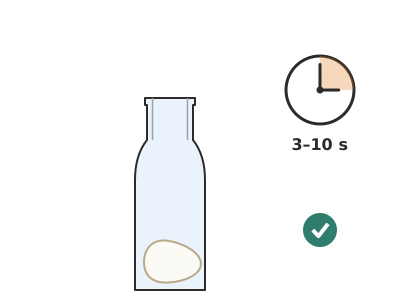
Time from when you put the egg on. The flame goes out within a few seconds, the air cools and the egg stretches and pops inside all at once, usually in 3–10 seconds.
1 The flame goes out and the air outside pushes the egg 2 In all at once in 3 to 10 s; if not in after 30 s, try again Check: If it hasn't gone in after 30 seconds, check the troubleshooting table and try again with another strip.Get the egg out adult
Turn the bottle upside down over the sink and move it until the egg slides down to the shoulder and its narrow end goes into the neck, blocking it. Run hot tap water (about 50 °C) over the body of the bottle for 30–60 seconds: the air inside expands and pushes the egg out.
1 Upside down, the egg rests on the shoulder with its tip in the neck 2 Run hot water over the bottle: the air pushes the egg 3 The egg comes out whole through the mouth Tip: Another way: with the bottle upside down and the tip of the egg in the neck, blow hard into it past one side of the egg and then move your mouth away.Tidy up
Throw the used egg in the food waste bin (it has touched ash: don't eat it). Wash the bottle with hot soapy water to remove the soot and the oil.
1 Throw the egg in the food waste bin: don't eat it 2 Wash the bottle with hot soapy water
Does it work? The test
With a bottle with a 30–38 mm mouth and a wet egg 4–10 mm wider, drop in the burning strip and put the egg on within 3 s.
What should happen: The egg bounces a couple of times, goes still, stretches like an hourglass and drops in with a «plop» 3 to 10 s after you place it.
If something goes wrong
- The egg doesn't go in — It was put on too late (the air had already cooled) or there is a gap letting air in. Solution: Put the egg on within 3 s, wet, and check that it covers the whole mouth. Grease the mouth with oil.
- The egg gets stuck halfway in the neck — The egg is too big for the mouth (more than 10 mm difference). Solution: Use a smaller egg (size S) or a bottle with a wider mouth. To get it out, use the hot water.
- The egg goes in but breaks — Badly peeled (with cracks) or undercooked egg. Solution: Boil it for the full 10 minutes and peel it carefully under the tap.
- The paper goes out as soon as it lands — It fell flat or had already gone out, or the strip is too small. Solution: Wait until it is burning well before letting go and use the concertina-folded strip.
- The egg falls in by itself, without fire — The mouth is too wide. Solution: Find a bottle with a narrower mouth (measure with gauge A) or use a bigger egg.
Safety
- The fire is always handled by an adult, with long tongs, on a metal tray or in the sink, away from curtains and papers. Hair tied back.
- Don't put your face near the mouth of the bottle while the paper is burning.
- Glass: don't pour in boiling water or suddenly put the cold bottle under very hot water; use warm-to-hot tap water (≤ 50 °C). If the bottle has cracks or chips, don't use it.
- If the bottle breaks, an adult should pick up the glass with gloves and a brush.
- Don't eat the egg from the experiment: it has been in contact with ash and soot.
The science behind it
For children
You can't see air, but it is pushing all the time from every side, as if we were at the bottom of a swimming pool full of air. When the paper burns, it heats the air in the bottle; hot air stretches out and some of it escapes. Then you cover it with the egg, the fire goes out and the air inside cools down and shrinks: the air left inside is «weaker» than the air outside. So the air outside, which pushes harder, squeezes the egg inwards until it pushes it into the bottle. The bottle doesn't suck the egg in: the air outside pushes it!
For the adult
The atmosphere exerts ≈ 101 kPa on every surface. The burning paper heats the air in the bottle, which expands (Charles's law, V ∝ T at constant pressure) and some escapes; the egg's bouncing at the start is that gas escaping. Once it is sealed, the available oxygen runs out and the flame goes out; the trapped gas cools on contact with the glass and, at constant volume, its pressure drops in proportion to the absolute temperature (Gay-Lussac's law). If the average air temperature falls from ≈ 340 K to 300 K, the internal pressure drops by ≈ 12 %, about 12 kPa. Over a Ø 35 mm mouth (area ≈ 9.6 cm²) that is a net force of ≈ 11 N, the weight of just over 1 kg, enough to deform a (springy) hard-boiled egg and push it in. Using up the O2 contributes very little, because combustion produces CO2 and water vapour in comparable amounts; the vapour that condenses does add a little extra suction. To get it out, the process is reversed: heating the bottle with the egg in the neck raises the internal pressure and pushes it out. The same principle is at work in suction cups, vacuum pumps and cans that crumple as they cool.
- atmospheric pressure: the push of the air around us on everything.
- expansion: a gas (or something else) getting bigger when it is heated.
- contraction: getting smaller when cooled.
- partial vacuum: a space with less air (lower pressure) than outside.
- seal: close completely so that no air gets through.
By age
- 5–7 years: The adult boils the eggs, lights the paper and drops it in. The child wets the egg and puts it on the mouth when the adult says «now!», and then counts the seconds. Explanation: «the air outside pushes».
- 8–10 years: They measure the mouth and the egg with the gauges, prepare the strips, place the egg and time it. They do the hot-water-instead-of-fire experiment.
- 11–12 years: They calculate the force of the air on the mouth (F = ΔP × area) for several temperature values and compare bottles. They explain why getting the egg out with hot water works.
In a group or in class
Adult demonstration with the fire in front of the class, followed by stations of 4 pupils with the hot-water version (safer): per station 1 measured bottle, 2 peeled eggs, a flask of water at 50 °C, gauges A and B and a stopwatch. 40 min: prediction (5), demonstration (5), stations (20), sharing results (10). Boil the eggs the day before.
Challenges
- Get the egg in using only hot and cold water, without fire, in under 30 seconds.
- Get the egg out whole without blowing or breaking it, using only hot water.
- Work out what force the air would exert on a mouth twice as wide with the same pressure difference.
- Crush an empty drinks can with a little water heated inside it by turning it upside down into cold water (only with an adult and tongs).