Giant soap bubbles
A wand made of two 50 cm sticks with a loop of cotton cord (80 cm at the top, 160 cm at the bottom with a washer as a weight) and a mix of water, washing-up liquid and a home-made thickener: open the sticks and walk backwards and out comes a soap film over 1 m long that closes into giant bubbles.
What they will learn
- That a bubble is a film of water a thousandth of a millimetre thick held by two layers of soap molecules, and that it bursts mainly when it dries out or gets thinner.
- That adding a thickener (cornflour, sugar or guar gum) makes the film more elastic and slower to drain, and that you can check this with a stopwatch.
- Why the wand needs TWO strings (one at the top and another at the bottom with a weight) to open a soap window.
- That the colours of the bubble depend on the thickness of the film (interference) and warn you when it is about to burst.
- To design a fair test: change only one thing (the recipe) and repeat several times.
Prepare beforehand
- Make the mix the night before: with cornflour or guar it improves a lot after 12 h of resting.
- Check the forecast: no wind (less than 10 km/h) and, if possible, cloudy, or early in the morning or at dusk.
- Find a large space with grass or earth (the mix makes tiles slippery).
- Keep a bucket of clean water and a towel handy for hands and eyes.
Materials and tools
- Water — 1 L
tap water; if it is very hard (limescale), better to use bottled low-mineral water or boiled and cooled water - Concentrated washing-up liquid — 80 ml (5⅓ tablespoons)
such as Fairy Original or Mistol; not «antibacterial» or «with bleach» - Sugar — 2 tablespoons (≈ 25 g)
white, dissolved in 100 ml of warm water - Cornflour (corn starch) — 1 level tablespoon (≈ 10 g)
for the improved recipe with nothing to buy - Baking powder — 1 teaspoon (≈ 5 g)
any ordinary brand; it helps disperse the cornflour - Guar gum (optional, pro recipe) — 1 g (half a level teaspoon) per litre buy
powdered, from a health-food shop or baking supplies shop; disperse it first in 1 tablespoon of surgical spirit - Wooden sticks — 2 of 50 cm
Ø 8–12 mm: dowel, cut-down broom handle or bamboo cane - Cotton cord — 2.7 m
100 % cotton, 2–4 mm (kitchen string, cotton twine or thick cotton yarn) - Metal washer or nut — 1
4–8 g (20–25 mm washer or M8 nut) - Washing-up bowl or tub — 1
at least 35 cm in diameter; with 1 L of mix the bottom is covered 1–2 cm deep, enough to soak the cord. An oven tray works too - Bottle or jar with a lid — 1 of 1.5 L
to store the mix and let it rest
Tools
- Measuring jug, tablespoons and dessert spoons — measure water, washing-up liquid and powders
- Craft knife or small saw — make a notch 1 cm from the tip of each stick so that the knot doesn't slip adult
- Scissors and tape measure — cut the cord to length
- Long spoon or stirring rod — stir slowly without making foam
Pieces and templates
- A · Wand sticks ×2 — wooden dowel Ø 8–12 mm
- B · Top string ×1 — cotton cord 2–4 mm
- C · Bottom string ×1 — cotton cord 2–4 mm
- D · Recipe label ×1 — sticky paper or paper + clear tape
Step by step
Dissolve the sugar
Warm 100 ml of water (lukewarm, not boiling) and dissolve 2 tablespoons of sugar (≈ 25 g) in it, stirring until there are no grains left.
1 Warm 100 ml of water: lukewarm, not boiling 2 Add the 2 tablespoons and keep stirring 3 Keep going until there are no grains left at the bottom Check: The liquid should be clear, with no crystals at the bottom.Make the thickener
In a glass, mix 1 level tablespoon of cornflour (10 g) and 1 teaspoon of baking powder (5 g) with 100 ml of cold water until there are no lumps. (Pro recipe: instead of this, disperse 1 g of guar gum in 1 tablespoon of surgical spirit and add it to 100 ml of cold water, stirring until there are no lumps.)
1 Get 100 ml of cold water, the cornflour and the baking powder ready 2 Add the powders and stir until the lumps break up 3 It should end up white and smooth, like milk Tip: Guar powder poured straight into water forms lumps that won't break up: always mix it with spirit first and then add the water.Combine the water
Put 800 ml of water in the bottle or bowl and add the dissolved sugar and the thickener. Stir slowly for 1 minute. You now have 1 litre of prepared water.
1 Pour 800 ml of water into the jar or bowl 2 Add the glass of sugar water and the glass of thickener 3 Stir slowly for 1 minute: you now have 1 litre Add the washing-up liquid last
Pour in 80 ml of concentrated washing-up liquid, letting it slide down the side of the container. Stir very slowly, in circles, for 30 seconds. Don't whisk: foam ruins the film.
1 Measure 80 ml of washing-up liquid in the jug 2 Pour it in, letting it slide down the side of the jar 3 Stir in circles for 30 seconds, without whisking or making foam Check: There should be almost no foam on top. If there is, skim it off with a spoon.Leave it to rest
Put the lid on the container, stick on label D and leave it to rest for at least 1 hour; overnight is better. Before using it, stir gently to lift the cornflour off the bottom.
1 Put the lid on the jar and stick label D on it 2 Leave it to rest for at least 1 hour; overnight is better 3 Before using it, stir gently to lift what has settled Prepare the sticks adult
Cut two 50 cm sticks. An adult makes a notch all the way round each stick 1 cm from one tip, with a craft knife or saw, about 2 mm deep.
1 Get two 50 cm sticks A ready 2 The adult marks the notch 1 cm from the tip, turning the stick 3 The notch goes all the way round and is about 2 mm deep Tie the top string
Cut 90 cm of cord (B). Tie one end in the notch of one stick with two knots and the other end in the notch of the other stick, leaving 80 cm of free cord between them.
1 Measure and cut 90 cm of cord: this is string B 2 Tie one end in the notch with two tight knots 3 Tie the other end to the other stick: 80 cm are left free Check: Hold the sticks together with the tips level: the cord hangs in a U 40 cm deep.Tie the bottom string with the weight
Cut 170 cm of cord (C), thread on the washer and tie the ends in the same notches, over the previous knots, leaving 160 cm free. Slide the washer to the middle.
1 Cut 170 cm of cord C and thread on the washer 2 Tie it in the same notches, on top of B's knots 3 Slide the washer to the middle of string C Check: Hold the sticks 70 cm apart and keep them upright: the two strands should form a triangle or a teardrop (at the top a gentle curve that sags about 15 cm, not taut; at the bottom a V with the washer at the point).Dip the wand
Bring the tips of the sticks together and put all the cord in the bowl: with 1 litre there is only 1–2 cm of mix, so lay the cord coiled on the bottom and turn it over with the sticks so that both sides get wet. Leave it for 10 seconds to soak right through.
1 Bring the tips of the sticks together and put all the cord in 2 Leave it for 10 seconds to soak right through Tip: The first time, dry cotton soaks up a lot: dip it twice.Lift out and open slowly
Lift the sticks out together, with the cord dripping, and move them apart little by little to 60–70 cm. A soap window should appear between the two strings.
1 Lift the sticks together, with the cord dripping 2 Move them apart little by little, without jerking 3 A soap window should appear between the two strings Check: If the film breaks when you open it, the mix hasn't rested long enough or there is foam: wait, skim off the foam and try again.Walk backwards or let the air blow
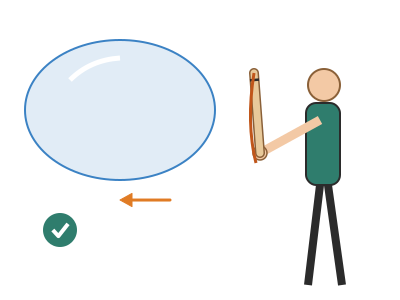
With the window open, walk backwards slowly (1 step per second) or let a gentle breeze push it. When the bubble is long, bring the tips of the sticks together to close it and let it go.
1 Walk backwards slowly, one step per second 2 When it is long, bring the tips together to close it 3 The bubble comes free and floats away Tip: Don't blow or move your arms quickly: the film breaks if you jerk it.
Does it work? The test
On a windless day, with the mix rested overnight, lift out the wand and open the sticks to 70 cm. Walk backwards 3 steps and close.
What should happen: You get a long bubble of 1–2 m that, when you close it, rounds off and floats for 5 to 20 seconds before bursting. With just water and washing-up liquid (no thickener) the window breaks when opened beyond 40 cm or within 1–2 seconds.
If something goes wrong
- The film breaks as soon as you open the sticks — Freshly made mix, with foam or with too little thickener; or the cord isn't soaked. Solution: Let the mix rest for longer, skim off the foam, dip the cord twice and open more slowly.
- No window forms, the cord just hangs — The second string or the washer is missing. Solution: Check that there are two cords between the tips (80 and 160 cm) and that the washer pulls the bottom one tight.
- Bubbles pop straight away in the sun — Evaporation: dry, hot air. Solution: Play in the shade, in the morning or at dusk, or after rain. Add 2 tablespoons of glycerine.
- The bubble bursts when it touches the ground or clothes — Dry, dusty surfaces break the film. Solution: That's normal: only touch the bubble with hands wet with the mix.
- The strings get tangled — Cord too thin and light. Solution: Use thicker cord (3–4 mm) and a slightly heavier washer (8 g).
- The film always breaks in the same place — A knot or a stretch of cord that doesn't get properly wet. Solution: Trim the loose ends off the knots and soak the whole cord again.
Safety
- The mix is not for drinking: store it with its label and out of reach of little ones.
- If it gets in the eyes it stings: rinse with plenty of clean water for 1–2 minutes.
- Tiled or wooden floors become very slippery: play on grass or earth, or mop afterwards.
- When walking backwards, have someone else check there are no obstacles, kerbs or traffic behind.
- The notch in the sticks is made by an adult, with the tool kept away from fingers.
The science behind it
For children
A bubble is like a super-thin sandwich: a layer of water in the middle and two layers of soap on the outside holding it, like the bread. The water wants to run downwards and dry out in the air, and when the layer gets too thin – pop! – it bursts. Cornflour and sugar make the water a little thicker and stretchier, like chewing gum, so it takes longer to drain and the bubble lasts longer. The rainbow colours warn you: when the bubble turns golden and then see-through, it is about to burst.
For the adult
Pure water has a high surface tension (72 mN/m) and does not form stable films. The surfactants in washing-up liquid sit at the two air–water interfaces with their hydrophobic tails towards the air, lower the tension to ≈ 25–30 mN/m and, above all, stabilise the film through the Marangoni effect: if an area stretches and thins, the surfactant concentration there drops, the local tension rises and pulls liquid in from neighbouring areas, «healing» the thinning. Films die from drainage (gravity drains the water downwards) and from evaporation. Polymers (guar, starch, PEG) increase viscosity and add extensional elasticity, which slows drainage and allows films metres long to be stretched; sugar and glycerine are hygroscopic and slow evaporation, but their effect on giant bubbles is smaller. The film thickness is of the order of 0.1–1 µm: light reflected from the outer and inner faces interferes and reinforces certain colours depending on thickness; when the film drops below ≈ 30 nm it no longer reflects colour (it looks black or transparent) and is about to burst. The two-string wand works because the bottom string, pulled taut by the weight, forms a closed, deformable frame with the top one: the film is held all round its outline and the opening is controlled by moving the sticks apart.
- film: a very thin layer of liquid, much thinner than a hair.
- surfactant: substance (like soap) that sits on the surface of water and makes it elastic.
- surface tension: force that makes the surface of a liquid behave like a stretched skin.
- viscosity: how thick a liquid is; honey is more viscous than water.
- evaporation: water turning into vapour: it dries the film and breaks it.
By age
- 5–7 years: The adult makes the mix and the wand. For them, a small wand: 30 cm sticks and strings of 50 and 100 cm. Focus on opening slowly and on watching the colours.
- 8–10 years: They make the mix, doing the measuring themselves, and tie the wand. They do the with-and-without-sugar experiment and time the bubbles.
- 11–12 years: They design their own experiment comparing 3–4 recipes with 5 repeats each, work out the average and make a graph. Challenge: a wand with 1 m sticks and strings of 1.5 and 3 m.
In a group or in class
For 20–25 children in the playground: the day before, make 4 L of mix with guar or cornflour, split between 4 tubs. Make 6–8 wands beforehand (or have the older ones tie them in pairs in 15 min). Groups of 3 per wand: one opens, one times and one takes notes; they swap every 5 bubbles. 45 min in total. Put the tubs in the shade and 3 m apart so that nobody walks backwards into someone else.
Challenges
- Make a bubble longer than you are and get someone to take a photo of you next to it.
- Make a giant bubble surround a seated friend (mix in a paddling pool and a hula hoop).
- Design a three-stick wand that opens a triangular window.
- Measure the humidity with a hygrometer (or a weather app) and look for a link with how long the bubbles last.