Pierced water bag that doesn't leak
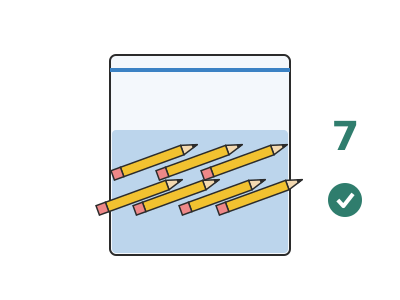
A zip-lock freezer bag full of water is pierced right through with 7 (or more) sharp pencils and not a single drop escapes: the polyethylene plastic stretches and grips each pencil like a rubber seal.
What they will learn
- That the plastic in bags is a polymer: long, tangled chains of molecules that stretch without breaking.
- That a stretched elastic material squeezes whatever is inside it and acts as a seal (like the rubber washers in taps).
- That the way you do things matters: a quick jab with a fine point makes a clean hole; a slow one tears.
- To predict, count and record: how many pencils the bag can take and what happens when you pull one out.
Prepare beforehand
- Sharpen all the pencils just before you start (a cone-shaped point of at least 15 mm).
- Print template A at 100 %.
- Check the bag has no holes: fill it, seal it and squeeze it gently over the sink.
- Keep a cloth handy and do the activity over the sink or a washing-up bowl.
Materials and tools
- Zip-lock freezer bag — 1 (plus 1 spare)
low-density polyethylene (LDPE), 1 L, ≈ 18 × 20 cm, clear; soft to the touch, not crinkly - Graphite pencils — 7–12
Ø 7 mm, round or hexagonal, with a long, fine, freshly sharpened point - Water — ≈ 700 ml
from the tap; to see it better, add 2 drops of food colouring - Fine permanent marker — 1
to mark the points on the empty bag
Tools
- Pencil sharpener — give all the pencils a long, fine point
- Measuring jug — measure the water
- Sink or washing-up bowl — work over it and empty the bag at the end
Pieces and templates
- A · Piercing points template (18 × 20 cm bag) ×1 — paper
Step by step
Sharpen the pencils
Sharpen 7–10 pencils to a long, fine point, a cone of at least 15 mm. Check that none of them has a broken lead.
1 Get 7–10 pencils and a sharpener ready 2 Turn the pencil in the sharpener 3 Leave a cone of at least 15 mm, with no broken lead Check: Touch the point carefully: it should prick like a thick pin.Mark the points
Lay the empty bag flat on template A, with the seal at the top, and trace the 10 numbered points onto the front with a permanent marker.
1 Lay the empty bag on template A, seal at the top 2 Trace the 10 points with a permanent marker 3 Check all 10 points are on the front Fill the bag
Measure about 700 ml of water (three quarters of a 1 L bag) and pour it into the bag, holding it inside a jug or bowl so it stands upright.
1 Measure about 700 ml of water in a jug 2 Pour in the water with the bag standing in a bowl 3 It should be three quarters full Check: The water should be above all the marked points (the «water level» line).Seal it, pushing the air out
Close the zip almost all the way, gently squeeze the bag to push the air out through the last centimetre and finish sealing it. Run your fingers along the seal twice.
1 Close the zip, leaving 1 cm open at the end 2 Squeeze the sides gently to let the air out 3 Seal it fully and run along the seal twice Check: Hold the bag upside down over the sink for 3 seconds: it should not drip.Hold the bag over the sink
Hold the bag by the seal with one hand (or have an adult hold it with both hands), hanging over the sink, with the marked side facing you.
1 Hold the bag by the seal, hanging over the sink 2 Or have an adult hold it with both hands Push in the first pencil
Rest the pencil point on point 1 and push it straight through in one quick, firm movement until it comes out of the back. Leave the pencil centred, with the same length sticking out on each side.
1 Rest the tip on point 1, with the pencil straight 2 Push it in one go until it comes out the back 3 Leave it centred: the same length on each side Check: Look at both holes: the plastic has stretched around the pencil and doesn't drip (one drop at the start at most).Tip: If it's hard to get through the back, twist the pencil slightly as you push, like a screw.Don't move it
Leave the pencil still where it is. Don't twist it or pull it out: if you move it backwards and forwards you enlarge the hole and it may start to drip.
1 Don't twist it or move it back and forth 2 Let go and keep it still: the plastic seals it by itself Carry on with the rest
Push pencils into points 2 to 7 in order, each with a quick movement. Count out loud each pencil that goes in without leaking.
1 Pierce points 2 to 7 in order, one at a time 2 Count out loud: 7 pencils, no leaks Check: With 7 pencils the bag should not drip. If a hole drips, check whether the pencil is crooked.Go for the record
If you like, carry on with points 8, 9 and 10: they are all 3 cm (30 mm) or more from the others. Write down how many pencils the bag takes before the first leak. To go beyond 10, use a 3 L bag and mark new points, always below the water and 30 mm apart.
1 Add pencils at 8, 9 and 10: each 3 cm or more from the others 2 Write down how many it takes before the first leak Pull out a pencil and empty it
Over the sink, pull out one pencil and watch the two little jets of water. Then open the seal, empty the bag into the sink and take out the rest of the pencils. Dry them with a cloth.
1 Pull out a pencil and watch the two little jets 2 Open the seal and empty the water into the sink 3 Take out the pencils and dry them with a cloth
Does it work? The test
With the 1 L bag three quarters full, push 7 sharp pencils through the marked points and hold it over the sink for 1 minute.
What should happen: None of the holes drips (at most the odd drop while piercing). A 1 L freezer bag usually takes 10–15 well-spaced pencils. When you pull one out, two thin jets of water come out.
If something goes wrong
- The bag splits when pierced — Blunt pencil, slow jab or a stiff, crinkly plastic bag. Solution: Sharpen to a long point, pierce in one go and use a soft freezer bag (LDPE).
- It drips around a pencil — The pencil has moved or is crooked, or the hole is too close to another one. Solution: Don't touch it again. For the next one, keep it at least 3 cm (30 mm) away and go in straight.
- The pencil won't come out of the back — The back of the bag moves away (the bag gives) instead of letting itself be pierced. Solution: Hold the bag tauter by the seal and twist the pencil slightly as you push.
- It drips from the seal — The zip isn't properly closed or there is water left in it. Solution: Dry the seal with paper, close it again and run your fingers along it.
- Air comes out or water splashes when piercing high up — You pierced above the water level: there is air there, which passes through the hole more easily than water, and when you squeeze the bag it blows out and carries droplets with it. Solution: Only pierce in the marked zone, below the water level.
Safety
- Sharp pencils prick: never put your hand behind the bag where the point comes out. Always hold it by the seal.
- Do the activity over the sink or a washing-up bowl and dry the floor if it gets wet (it's slippery).
- Plastic bags are not toys: never over the head, and keep them away from children under 3.
- When you take them out, wet pencils can splinter: dry them and sharpen them again.
The science behind it
For children
The bag is made of plastic, and inside, plastic is like a plate of spaghetti: millions of very, very long strands all tangled up. When the pencil point goes in fast, the strands don't get cut: they move aside and stretch around the pencil. Because they're elastic, they try to go back to where they were and hug the pencil really tightly, just like a hair band. That hug is so tight that the water can't find a way out. If you pull the pencil out, the hole stays open and the water comes out.
For the adult
Freezer bags are made of low-density polyethylene (LDPE): a polymer of very long –CH2– chains (thousands of units) with branches, semi-crystalline and above its glass transition temperature at room temperature, which makes it ductile: it allows elongations at break of 300–600 %. The conical point concentrates the force on one spot and punches a small hole; as the cone advances, the surrounding film deforms radially (partly elastically, partly plastically) up to the diameter of the pencil, and the elastic component leaves a tensioned ring pressing on the wood: an interference seal, just like an O-ring. The water pressure it has to hold back is small (hydrostatic pressure ρgh ≈ 1 kPa with 10 cm of water) and surface tension stops the water passing through micro-gaps of a few micrometres. If the jab is slow or the point blunt, the deformation spreads over a large area, the film stretches to its limit and a crack appears and propagates (tearing). HDPE films (crinkly bags) are more crystalline and stiffer, with lower elongation and a greater tendency to tear. When the pencil is removed, the plastic deformation stops the hole from closing: the water comes out.
- polymer: a material made of very long molecules, like chains or spaghetti.
- elasticity: the ability of a material to stretch and go back to its shape.
- polyethylene: the plastic bags are made of; one of the most widely used polymers.
- seal: a soft part squeezed between two parts so that a liquid or gas can't escape.
By age
- 5–7 years: The adult holds the bag by the seal and the child pushes the pencils in with both hands. Get them to count out loud. Message: «the plastic hugs the pencil».
- 8–10 years: They do it on their own: mark the points, fill, pierce and record the record. They compare two types of bag.
- 11–12 years: They compare bags, measure water pressure at different heights (jets when pulling out pencils from high and low) and research what LDPE and HDPE are (recycling symbols 4 and 2).
In a group or in class
Pairs in the playground or next to sinks/washing-up bowls, one bag and 8 pencils per pair (classroom pencils will do, well sharpened). Beforehand: sharpen pencils and fill a jug per table. 20 min: prediction (3), piercing (10), pulling out a pencil and emptying (5), tallying the records on the board. Have 5 spare bags and cloths.
Challenges
- Beat the record: how many pencils fit in a 3 L bag without leaks?
- Push the pencils in so the bag holds itself up with the pencil ends resting on two books.
- Turn the bag into a shower: decide where to push in and pull out pencils to get 3 equal jets.
- Find three seals or stoppers at home that work like the plastic around the pencil and explain how they seal.