Paperclip floating on water
A steel paperclip, almost 8 times denser than water, stays on the surface, held up by surface tension, if you lay it down flat and carefully; a drop of washing-up liquid breaks that “skin” and the paperclip sinks instantly.
What they will learn
- That water molecules attract each other and form an elastic film at the surface (surface tension).
- That an object denser than water can stay on top if it doesn't break that film: it is held up by the tension, not by buoyancy.
- That washing-up liquid (a surfactant) lowers the surface tension, which is why the paperclip sinks.
- That the way you lay it down matters: flat, spreading the weight along the whole wire.
Prepare beforehand
- Rinse the bowl 3 times with plain water. If it was washed with washing-up liquid, rinse it with very hot water and then cold.
- Wash your hands and rinse them well: traces of soap on your fingers also spoil the experiment.
- Bend the large paperclip into the lifter following template A.
- Separate the plies of the kitchen roll and cut 6 squares of 4 × 4 cm.
- Put 2–3 drops of washing-up liquid in a bottle cap, away from the bowl.
Materials and tools
- Bowl — 1
glass or china, Ø 15–20 cm, rinsed 3 times with plain water (no soap) and not dried with a tea towel - Tap water — ≈ 1 L
at room temperature, 4–6 cm deep - Small metal paperclips — 6–10
steel, 28–33 mm, no plastic coating, clean and dry - Large paperclips — 1 + 5
50 mm: one to bend into the lifter and 5 more for the hot-water and salt experiments - Kitchen roll — 1 sheet
separated into a single ply, cut into 4 × 4 cm squares - Washing-up liquid — 2–3 drops
in a bottle cap, to dip a cocktail stick in - Cocktail sticks or cotton buds — 2
one for the washing-up liquid, another clean one to push the paper - Fine salt — 2 tablespoons
only for the salt experiment
Tools
- Needle-nose pliers — bending the large paperclip into the lifter adult
- Scissors — cutting the paper squares
- Fork — alternative method
Pieces and templates
- A · Lifter bending template ×1 — large 50 mm paperclip, straightened (wire ≈ 1 mm)
- B · Kitchen roll square ×6 — single-ply kitchen roll
Step by step
Fill the bowl
Fill the rinsed bowl with tap water to a depth of 4–6 cm. Put it on a table where nobody will knock it and wait 1 minute for the water to become completely still.
1 Fill the rinsed bowl with water to a depth of 4–6 cm 2 Leave it somewhere quiet and wait 1 minute without touching it Control test: drop it
Drop a paperclip edge first from a height of 5 cm. It sinks straight away: steel is almost 8 times denser than water.
1 Drop a paperclip edge first from a height of 5 cm 2 Look: the steel paperclip sinks straight away 3 Leave it on the bottom: don't put your fingers in the water Check: The paperclip is on the bottom. Leave it there; don't put your fingers in (they carry grease and soap).Get the paper ready
Put a single-ply kitchen roll square B on the palm of your hand and place a small paperclip flat in the centre.
1 Put a single-ply paper square B on your palm 2 Place a small paperclip flat in the centre of the paper Lay the paper on the water
Bring your hand close to the surface and let the paper slide onto the water, flat, without dropping it. The paper floats with the paperclip on top.
1 Bring your hand close to the water and let the paper slide on 2 The paper floats with the paperclip on top Help the paper sink
Wait 10–30 seconds for the paper to soak through. If it doesn't sink, push each corner of the paper down, one at a time, with the tip of a clean cocktail stick, without touching the paperclip.
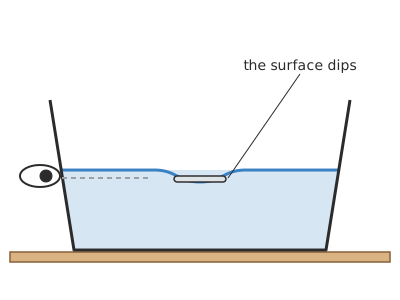
1 Wait 10–30 seconds for the paper to soak through 2 Push the corners of the paper with a clean cocktail stick, without touching the paperclip 3 The paper goes to the bottom and the paperclip stays on the surface Check: The paper goes to the bottom and the paperclip stays alone on the surface, in a small “dip” in the water.Lifter method
For the second paperclip, place it lengthways on the U of lifter A. Lower the lifter very slowly and flat until the U goes into the water; keep lowering it 1 cm more and pull it out sideways.
1 Place the paperclip lengthways on the two arms of the U 2 Lower the lifter slowly and flat down to the water 3 Lower it 1 cm more and pull the lifter out sideways Tip: If the paperclip tilts, the lifter isn't horizontal: adjust the bend in the handle.Look at the dip
Put your eyes level with the water and look at the paperclip against the light, or look at its shadow on the bottom of the bowl: the surface dips around the wire like a trampoline.
1 Put your eyes level with the water and look at the paperclip from the side 2 Also look at the paperclip's shadow on the bottom of the bowl Try with a fork
Another way: rest a paperclip flat on the prongs of a fork and lower it slowly and straight until the prongs are underwater. Compare how many attempts you need with each method.
1 Rest a paperclip flat on the prongs of the fork 2 Lower it slowly and straight until the prongs are underwater Break the skin with washing-up liquid
Dip the tip of a cocktail stick in the bottle cap of washing-up liquid and touch the water at the edge of the bowl, about 5 cm from the paperclips. The paperclips move away from the stick and sink within 1–2 seconds.
1 Dip the tip of a cocktail stick in the cap of washing-up liquid 2 Touch the water at the edge: the paperclips move away from the stick 3 Within 1–2 seconds the paperclips sink Clean up before repeating
Pour the water down the sink and rinse the bowl 3 times with plain water before trying again. A single drop of washing-up liquid is enough to stop the paperclip floating again.
1 Pour the soapy water down the sink 2 Rinse the bowl 3 times with plain water 3 With fresh water, the paperclip floats again Check: With fresh water, a paperclip floats again using the lifter.
Does it work? The test
With the bowl rinsed and the water still, lay a 28–33 mm paperclip on it with the lifter or the paper.
What should happen: The paperclip stays on the surface indefinitely (minutes or hours) if nobody touches the water; you can see the dip in the surface around the wire. When you touch the water with washing-up liquid, it sinks within 1–2 seconds.
If something goes wrong
- The paperclip always sinks, even when you lower it slowly — Traces of soap in the bowl, in the water or on your fingers. Solution: Change the water, rinse the bowl 3 times without soap and wash your hands with plain water only.
- It sinks at one end — You're lowering it at an angle: one end breaks the surface before the rest. Solution: Use the lifter and check that the U is horizontal before lowering it.
- The paper sinks and drags the paperclip down with it — Two-ply paper or a piece that is too big. Solution: Use a single 4 × 4 cm layer and push the corners of the paper with a clean cocktail stick, away from the paperclip.
- Large paperclips don't float — They are too heavy for the length of wire they have (≈ 1.2 g). Solution: Use 28–33 mm paperclips. Large ones only work if they are lowered absolutely perfectly.
- The floating paperclips cluster together or drift to the edge — The dips in the surface attract each other (the “cereal” effect). Solution: That's normal. If you want them to stay put, lower them far apart from each other.
Safety
- Watch out for spilt water: dry the floor to avoid slipping.
- The hot water experiment: an adult pours the water; 50 °C maximum (warm to hot to the touch) to avoid burns.
- Bending the large paperclip: use pliers; the ends of the wire are sharp.
- Paperclips and pins are small: keep them out of reach of children under 3.
- Don't drink the soapy water; pour it down the sink.
The science behind it
For children
Tiny bits of water hold hands with each other, and at the surface they hold on so tightly that they form a kind of stretchy skin, like a very thin trampoline. If you lay the paperclip down flat and carefully, the skin dips a little and holds it up, just like when you jump on a trampoline. If you drop it end first, it breaks the skin and sinks. Soap makes the bits of water let go of each other's hands: the skin breaks and the paperclip goes to the bottom.
For the adult
Water molecules attract each other through hydrogen bonds. Inside the liquid, each molecule is pulled in every direction; at the surface it is missing half its neighbours, and creating surface costs energy. That energy per unit area is the surface tension γ (≈ 0.072 N/m at 20 °C), which acts as a force per unit length along any line on the surface. A 28–33 mm paperclip (≈ 0.45 g, weight ≈ 4.4 mN) has about 10 cm of 0.8–0.9 mm wire. When it is laid down, the surface curves to form a meniscus on both sides of the wire; the vertical component of the tension can reach 2γL ≈ 2 · 0.072 · 0.10 ≈ 14 mN, about 3 times its weight (plus the small buoyancy of the water displaced in the dip). If it goes in end first, the contact length is minimal and the force isn't enough: it sinks. Slightly greasy steel is hydrophobic and the water doesn't “wet” it, which helps. Washing-up liquid is a surfactant: its molecules have a hydrophilic head and a hydrophobic tail, they settle at the surface and lower γ to ≈ 0.03 N/m; the maximum force drops to ≈ 6 mN and, in addition, the difference in tension between the soapy area and the clean one drags the surface along (the Marangoni effect), which moves the paperclips before sinking them. Hot water has slightly lower tension (≈ 0.066 N/m at 60 °C) and salt raises it slightly.
- surface tension: the force with which the molecules at the surface of a liquid attract each other, making it behave like an elastic film.
- molecule: the smallest part of a substance, such as water, that is still that substance.
- surfactant: a substance, such as soap, that settles on the surface of water and weakens its film.
- density: how much mass there is in each bit of volume; steel is almost 8 times denser than water.
- meniscus: the curve the surface of the water makes where it touches an object.
By age
- 5–7 years: The adult makes the lifter and lowers the first paperclips; the child does the paper method and is in charge of the drop of washing-up liquid. Message: “water has a skin”.
- 8–10 years: They do everything, including the lifter with help on the pliers. Have them compare methods (fork, paper, lifter) by counting attempts.
- 11–12 years: Have them work out the weight of a paperclip (by weighing 10 on kitchen scales) and the maximum surface tension force from the length of the wire, and design a wire object that can carry a load.
In a group or in class
Pairs, one small bowl or plastic tub per pair (12 containers for 25 children), 6 paperclips and 3 paper squares per pair. The adult bends the lifters beforehand. Only the teacher has the washing-up liquid and goes round the tables at the end: that way nobody contaminates the water too early. 30 min. Keep a jug of clean water handy for changing it.
Challenges
- Build an aluminium foil “boat” of 5 × 5 cm and find out how many paperclips it can carry before it sinks. Compare it with the paperclips that float on their own.
- Bend fine wire into a flat shape (a star, a letter) that floats on the water.
- Make a floating paperclip move to one side on its own without touching it (hint: a little soap on the opposite side).
- Get a 50 mm paperclip to float. What do you need to change in the method?