Spiral that spins with heat
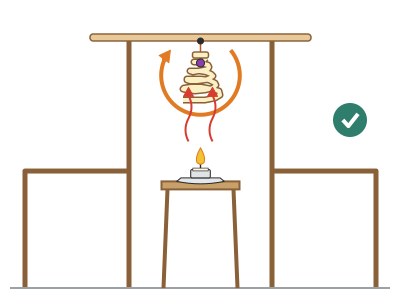
A 16 cm card spiral hanging from a thread spins on its own, at about 10–40 turns per minute, when the column of hot air rising from a candle placed 20–25 cm below passes through it.
What they will learn
- That hot air is less dense than cold air and rises, forming a current (convection).
- That a sloping surface (each stretch of the spiral is like the blade of a pinwheel) turns a rising current into a spin.
- That the direction of rotation depends on which way the spiral is coiled.
- That the temperature drops very quickly as you move away from the flame, and why there is a measurable safety distance.
- How to measure a rotation speed in turns per minute and compare variables one at a time.
Prepare beforehand
- Print the template at 100 % directly onto thin card and check with the ruler that the disc measures 160 mm.
- Find the spot: a draught-free room, away from curtains, with two high-backed chairs and a low stool or a sturdy box about 40 cm tall for the candle.
- Trim the candle wick to 5 mm (less smoke and a steadier flame).
- Keep a glass of water handy and clear papers and fabrics from the area within 1 m of the candle.
- If the children are young or candles are not allowed, prepare a radiator or an incandescent lamp as the heat source.
Materials and tools
- Thin card — 1 A4 sheet
120–180 gsm, able to go through the printer; light-coloured so you can decorate it - Candle — 1 buy
tealight or Ø 2–2.5 cm table candle in a stable candlestick; wick trimmed to 5 mm - Ceramic or glass plate — 1
Ø ≥ 15 cm, under the candle (catches the wax and does not burn) - Sewing thread — 60 cm
cotton or polyester, thin - Bead — 1
Ø 5–8 mm, plastic or wood, with a ≈ 1–1.5 mm hole - Broom handle or wooden batten — 1
≥ 70 cm long - Felt-tip pens or colouring pencils — as you like
for eyes and scales; do not use poster paint (it wets the card and makes it buckle) - Glass of water — 1
near the candle, for safety
Tools
- Round-tipped scissors — cutting out the disc and the spiral
- Sewing needle — piercing the centre and threading the thread
- Ruler or tape measure — measuring the flame–tail distance (20–25 cm)
- Long kitchen lighter or matches — lighting the candle adult
- Stopwatch (mobile phone) — counting turns per minute
Pieces and templates
- A · Spiral snake (16 mm pitch) ×1 — card 120–180 gsm
- B · Narrow spiral for comparison (10 mm pitch) ×1 — card 120–180 gsm
- C · Hanging thread ×1 — sewing thread
Step by step
Print and check
Print template A at 100 % on thin 120–180 gsm card. Measure the disc with the ruler: it must be 160 mm across. If it measures less, the printer has reduced the scale.
1 Print template A at 100 % on thin card 2 Measure the disc with the ruler from side to side 3 If it measures less, print again without «fit to page» Check: Diameter 160 mm ± 2 mm.Cut out the disc
Cut out the 160 mm circle along the outer edge. Turn the paper, not the scissors, so the curve comes out round.
1 Cut along the outer edge of the circle 2 Turn the paper, not the scissors: the curve stays round 3 Round 160 mm disc, with no points on the edge Decorate it flat
Before cutting the spiral, decorate both sides with felt-tip pens: eyes and tongue in the centre (head) and scales along the strip. It is much easier flat than once the spiral is cut.
1 Draw eyes and a tongue in the centre: that is the head 2 Colour scales along the strip, on both sides 3 No poster paint: it wets, buckles and adds weight Tip: No poster paint or glitter glue: they wet the card, make it buckle and add weight.Cut the spiral
Cut along the thick spiral line starting from the outer edge and working inwards, staying on the line. Stop when you reach the centre: the Ø 20 mm head is not cut.
1 Start at the edge and follow the thick line inwards 2 Stop when you reach the head: the centre is not cut 3 Lift it by the head: it hangs in a helix, no loose bits Check: When you lift the head with two fingers, the snake hangs in a helix with no loose bits and no cuts reaching the head.Pierce the centre
Pierce the centre point with the sewing needle and twist it a little to widen the hole to 1.5–2 mm. It has to be loose: the thread must pass through without rubbing.
1 Pierce the centre point with the sewing needle 2 Twist the needle to widen the hole to 1.5–2 mm 3 The thread must pass loosely, without rubbing the edge Fit the pivot with the bead
Thread the 60 cm of thread onto the needle. Pass it through the hole in the head from the top side downwards, slide the bead on underneath and tie a double knot below the bead. Remove the needle.
1 Pass the thread through the hole, from top to bottom 2 Slide the bead on underneath and push it up to the card 3 Double knot under the bead: the spiral spins on it Check: Hold the thread: the spiral hangs resting on the bead and, if you turn it with your finger, it spins without the thread winding up.Cold test
Hang the snake from the thread by hand and blow gently from below, from 20 cm away, or put a hairdryer on the cool setting 40 cm underneath. It should start spinning within 1–2 seconds.
1 Hold the thread and blow gently from below, about 20 cm away 2 Or use a hairdryer on cool: it spins within 1–2 seconds 3 If it barely spins, separate touching turns with a finger Tip: If it barely spins, check that no turn of the spiral is rubbing against another.Set up the support
Place two chairs back to back, 50–60 cm apart, and rest the broom handle across both chair backs. Tie the thread to the middle of the handle with two knots.
1 Put two chairs back to back, 50–60 cm apart 2 Rest the broom handle across both chair backs 3 Tie the thread to the middle of the handle with two knots Check: The handle does not move if you give one chair a little knock.Place the candle underneath adult
Put the candle on the ceramic plate, and the plate on a low stool or a sturdy box about 40 cm tall, right under the bead: use the thread as a plumb line to centre it.
1 Put the candle on the plate and the plate on a stool 2 Centre the candle right underneath: the thread is a plumb line Adjust the height adult
With the candle still unlit, measure upwards from the wick: the snake's tail must be 23–28 cm from the wick (the flame is about 3 cm tall, which leaves 20–25 cm to the tip of the flame). Lengthen or shorten the thread until you get it. If, with the thread already very short, the tail is still less than 23 cm from the wick, lower the candle: swap the stool for a lower box.
1 With the candle unlit, measure from wick to tail: 23–28 cm 2 Lengthen or shorten the thread until you get the measurement 3 Never less than 20 cm from the flame tip to the tail Check: Never less than 20 cm between the tip of the flame and the lowest part of the spiral.Tip: With chair backs of about 95 cm and a 40 cm stool there is plenty of height and you just need to lengthen the thread; with low-backed chairs (≈ 80 cm) you usually need a lower support for the candle.Close up and light adult
Close doors and windows and ask everyone not to walk nearby. The adult lights the candle and everyone stays still 1 m away. Within 10–30 seconds the snake starts spinning on its own.
1 Close doors and windows: no draughts 2 The adult lights the candle with a long lighter 3 Everyone still 1 m away: within 10–30 s it starts spinning Count the turns
Pick one eye on the head as a marker and count how many turns it makes in 1 minute with the stopwatch. Repeat 3 times and write down the average.
1 Pick one eye as a marker and follow it with your eyes 2 Count the turns it makes in 1 minute with the stopwatch 3 Repeat 3 times and write down the average Put out and tidy up adult
The adult puts out the candle by covering it or blowing from the side (not towards the spiral). Wait 5 minutes for the wax to cool before moving the plate or touching the snake.
1 Put out the candle by covering it (or blowing from the side) 2 If you blow, do it from the side, never towards the spiral 3 Wait 5 minutes before moving the plate or touching anything
Does it work? The test
With the candle lit and the tail 20–25 cm from the tip of the flame, in a draught-free room, count the turns for 1 minute.
What should happen: The snake starts spinning in under 30 s and keeps a steady spin of about 10–40 turns per minute, always in the same direction. When the candle is put out it slows to a stop in about 20–60 s. The card does not darken or curl.
If something goes wrong
- It does not spin or it sways from side to side — There are draughts deflecting the hot column, or the candle is not right underneath. Solution: Close doors and windows, all of you move 1 m away, and re-centre the candle using the thread as a plumb line (with the candle unlit).
- It turns 2–3 times, stops and turns back — The thread is tied to the paper and twists like a spring. Solution: Fit the pivot with the bead and the loose hole, or put a fishing swivel between the thread and the spiral.
- It spins very slowly — It is too high, the paper is heavy or the turns rub against each other. Solution: Lower it to 20 cm (never closer), use 120 gsm card (an A4 sheet spins with less heat, but wobbles more), and separate any coils that are touching with your finger.
- The card curls, darkens or smells burnt — It is too close to the flame. Solution: Put out the candle and raise the snake until the tail is at least 20–25 cm from the tip of the flame.
- There is black smoke and the flame flickers — Wick too long or draughts. Solution: Put it out, let it cool and trim the wick to 5 mm. A calm flame gives a steadier column of air.
- It spins the opposite way to a classmate's — It is not a fault: the spiral is hanging with the other side up, so the helix is coiled the other way. Solution: Turn the spiral over (pass the thread through from the other side) and it will spin the opposite way.
Safety
- The candle is always lit, watched and put out by an adult. It is never left alone, not even for a minute.
- Minimum distance of 20 cm between the tip of the flame and the lowest part of the spiral: at 10 cm the air is about 200 °C and the card can catch fire.
- Long hair tied back, loose sleeves rolled up and nobody leaning over the candle.
- Candle on a ceramic plate, on a stable surface and more than 1 m from curtains, papers and fabrics. Keep a glass of water next to it.
- Do not touch the snake or move the plate while the candle is lit; wait 5 minutes after putting it out (the wax burns).
- With children aged 5–7 or in class, use a radiator or an incandescent lamp: the effect is the same and there is no flame.
The science behind it
For children
Hot air is like an invisible balloon: it weighs less than the cold air around it, so it rises. Above the candle a stream of hot air forms and goes upwards, like a lift. When that air hits the spiral, it pushes each turn, which is tilted like the blade of a pinwheel, and makes it spin. If you take the candle away, the lift stops and so does the snake.
For the adult
The flame heats the air around it; the hot air expands (at constant pressure, its density is inversely proportional to absolute temperature: at 80 °C it is ≈ 17 % less dense than at 20 °C) and receives a net upward buoyant force. A thermal plume forms that rises at a few tens of cm/s and, as it rises, draws in surrounding air, widens and cools rapidly (in a point-source plume the excess temperature falls roughly as z^(−5/3)): ≈ 200 °C at 10 cm and ≈ 70–90 °C at 20 cm above a ≈ 50–80 W candle. The air that replaces the plume comes in from the sides at flame height (convection). The stretched spiral is a helix: each stretch is at an angle to the vertical, so the upward flow is deflected as it passes and the reaction on the card has a tangential component that produces a torque, just as in a pinwheel or turbine blades. The torque is small (of the order of micronewton·metres), so friction at the pivot is decisive: a thread tied to the paper builds up twist and stops the rotation; a loose hole resting on a bead offers almost no resistance. The direction of rotation is set by the chirality of the helix: hanging the disc with the other side up reverses it. A larger pitch (wider strip) gives more sloping surface but fewer turns; an 80 gsm A4 sheet (≈ 1.6 g disc) starts sooner than 180 gsm card (≈ 3.6 g).
- convection: movement of air or water in which the warm part rises and the cold part sinks, carrying heat from one place to another.
- density: how much mass there is in each bit of volume; hot air has less, so it floats on cold air.
- helix: the spring or helter-skelter shape the snake takes when it hangs.
- pivot: point on which something turns with very little friction.
- turbine: wheel with sloping blades that spins when a moving gas or liquid passes through it.
By age
- 5–7 years: The adult cuts out the spiral (or the child cuts it with round-tipped scissors following a thick line) and does everything involving the candle. Better to use a radiator or a hairdryer on cool so the child can get close. Focus on «hot air rises».
- 8–10 years: They do everything except lighting and putting out the candle. Let them measure the safety distance with the ruler themselves and count turns per minute.
- 11–12 years: Let them design their own spiral (pitch, diameter, number of turns), compare two variables with three measurements each and explain the direction of rotation using the idea of a helix. They can work out how much less dense air is at 80 °C than at 20 °C (ratio of absolute temperatures: 293/353).
In a group or in class
Each child makes their own snake (25 min with templates printed on card). For the test, no candles per team: 3 stations, each supervised by an adult (radiator, 60 W incandescent lamp pointing up and, if the school allows it, a single candle run by the teacher with the broom-handle support and the distance already measured). Teams of 3–4 rotate every 5 min, count turns per minute and write them on the board. Total ≈ 60 min. Keep 5 spare beads and extra thread.
Challenges
- Draw a smaller snake with a compass, on a Ø 120 mm disc, and compare its speed with the 160 mm one.
- Build a carousel: a card disc with 6 fins tilted at 30°, balanced on the tip of a pencil, above a radiator.
- Put two snakes (one normal and one hung upside down) over the same radiator: do they spin in opposite directions?
- Design a mobile with three snakes at different heights over a radiator and find out which one spins fastest.
- Invent a way of measuring the turns without counting them yourself (for example, filming with a mobile phone and counting in slow motion).