Air vortex cannon
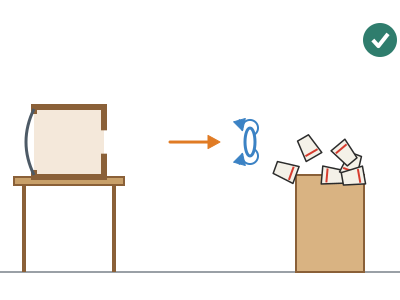
A sealed cardboard box about 30 cm across with a 10 cm round hole in the front and a plastic membrane at the back: give the membrane a sharp tap and out comes a spinning ring of air that travels 3–5 m and knocks over paper cups or blows out a candle from a distance.
What they will learn
- That air is matter: it has mass, it can be pushed and it can knock things over from a distance.
- What a vortex ring is: the air leaving past the edge of the hole slows down, curls up and forms a spinning doughnut that travels much further than a puff of breath.
- That the size of the hole compared with the box matters: a hole 1/3 of the box's side gives the best rings.
- How to make the invisible visible with smoke, and how to measure range fairly.
Prepare beforehand
- Print template A (Ø 100 mm hole) and template B (Ø 60 mm adapter) at 100 % and check the red 50 mm line in the header of each sheet.
- Choose a corridor or a room with 4–5 m of clear space and no draughts (close the windows).
- If you are going to use incense, remove or temporarily cover the smoke alarm (and put it back afterwards) and have a window ready to air the room at the end.
- Use tape on the floor to mark 1, 2, 3, 4 and 5 m from the firing line.
Materials and tools
- Medium cardboard box — 1
25–40 cm per side, ideally almost a cube (e.g. 30 × 30 × 30 cm), in good condition and with no holes - Large bin bag — 1
50 × 60 cm or larger, thin plastic (20–30 µm), with no holes - Duct tape or parcel tape — 1 roll
5 cm wide, to seal the joins and fix the membrane - Large rubber bands — 2
15–20 cm round; they act as springs, pulling the membrane back into place after each tap - Paper or thin plastic cups — 6–10
light, 2–4 g each - Incense stick — 1 (optional)
to make the ring visible; an adult lights it - A4 sheet and glue stick — 1
for the hole template
Tools
- Craft knife and cutting mat — cut the hole and the back face adult
- Compass or Ø 100 mm template — draw a nice round hole
- Scissors — cut out the membrane and tidy the edge of the hole
- 5 m tape measure — measure the range
- Lighter (only for the incense) — light the incense adult
Pieces and templates
- A · Main hole template ×1 — paper (template for drawing round)
- B · Small hole adapter ×1 — thin card (cereal box) or 300 gsm card
- C · Front face of the box ×1 — the box's own cardboard
- D · Membrane ×1 — bin bag plastic
- E · Pull handle ×1 — duct tape
Step by step
Close and seal the box
Close all the flaps of the box and tape every join and corner, including those on the base (the face resting on the table). Any gap lets air escape and weakens the ring.
1 Close all the flaps of the box 2 Tape every join and corner, underneath too 3 Squeeze it next to your ear: no air should hiss out Check: Squeeze the box with both hands close to your ear: you should not hear air hissing out of the joins.Mark the hole
On the front face, draw the two diagonals with a ruler to find the centre. Centre template A there and draw the 100 mm circle.
1 Draw the two diagonals with a ruler: they cross at the centre 2 Centre template A on the crossing and draw round it 3 You get a 100 mm circle right in the centre Cut the hole adult
An adult cuts out the circle with the craft knife, using short cuts and following the line. Tidy up any points or fluff with scissors so the edge is smooth and round.
1 The adult cuts along the line with short cuts 2 Trim the points and fluff on the edge with scissors 3 Run your finger round: the edge should be smooth and round Check: The edge must have no dents or flaps of cardboard: run your finger round it and it should feel smooth.Open the back face adult
On the back face (opposite the hole), draw a square leaving a 20 mm rim on all 4 sides. An adult cuts it out with a craft knife and removes it. The rim keeps the box rigid and supports the membrane.
1 On the opposite face, draw a square 20 mm in from the edge 2 The adult cuts the square with a craft knife, using a ruler 3 Remove the square: a 20 mm frame is left Cut the membrane
Open the bin bag by cutting along the sides and cut a 360 × 360 mm square (D), with no creases or holes.
1 Open the bag by cutting along both sides 2 Mark and cut a 360 × 360 mm square D 3 Check it has no creases or holes Tape on the membrane with slack
Lay the membrane centred over the open back face: it covers the rim with about 2–3 cm to spare on each side, which folds over the side walls. Tape that spare edge to the walls with duct tape on all 4 sides, leaving the centre 2–3 cm loose (so you can push it in with your hand). Seal the whole outline with no gaps.
1 Tape D over the frame on all 4 sides, with no gaps 2 Leave it loose: the centre should sink 2–3 cm 3 Push the centre: feel the puff with your other hand in front Check: Push the centre of the membrane with your palm: it should sink 2–3 cm and air should come out of the hole (feel the puff with your other hand in front).Fit the pull handle
Stick an 80 × 80 mm square of duct tape in the centre of the membrane and, on top of it, a 150 mm strip folded into a handle (E). Thread the 2 rubber bands through the handle, one to the left and one to the right, and tape their ends to the side walls, 2–3 cm from the back edge, slightly stretched: the bag does not spring back by itself, so the rubber bands reset it after each tap.
1 Stick an 80 × 80 mm square of tape in the centre 2 Fold strip E into a handle, with the ends flat 3 Stick the handle to the square and stretch a band to each side wall Check: Push the centre in with your hand and let go: the rubber bands should pull the membrane back into place in under 1 second. If not, stretch the bands a little more.Set up the target
Build a pyramid of 6 paper cups (3 at the bottom, 2 in the middle and 1 on top) on a table or a box, level with the hole and 2 m away.
1 Stack 6 cups: 3 at the bottom, 2 in the middle and 1 on top 2 Put them level with the hole and 2 m from the cannon Fire
Rest the box on a table, aimed at the target. Give the centre of the membrane a short, sharp tap with your palm (or pull the handle back 4–5 cm and let go suddenly). Do not leave your hand resting on it. Before the next tap, wait for the rubber bands to pull the membrane back into place.
1 Give the centre a sharp tap with your palm and pull your hand away 2 Or pull the handle back 4–5 cm and let go suddenly 3 The air ring travels and knocks the cups over Check: At 1 m, hold your hand in front: you should feel a concentrated “poof” of air, not a vague draught.Tip: Tap sharply, like hitting a drum. A slow push moves air but does not make a ring.Move the target back
If the cups fall, move them 50 cm further away and try again. Find the furthest distance at which they still fall: with a 30 cm box it is usually between 3 and 5 m.
1 If they fall, move the pyramid 50 cm back and try again 2 Find the furthest distance at which they still fall: usually 3–5 m Make it visible (with an adult) adult
An adult lights an incense stick and puts it through the hole for 30 seconds until the box fills with smoke. Cover the hole with your hand, take it away and tap gently: you will see smoke rings about 12 cm across travelling through the air.
1 The adult holds the lit incense in the hole for 30 s 2 Cover the hole with your hand, then take it away 3 With side lighting, tap gently: you will see rings about 12 cm across Tip: With light from the side (a torch from one side) and a dark background they are much easier to see. Air the room when you finish.
Does it work? The test
Pyramid of 6 paper cups level with the hole. Fire from 1, 2, 3, 4 and 5 m, 3 taps at each distance.
What should happen: With a 30 cm box and a 10 cm hole, the ring reliably knocks down the pyramid at 2–3 m and sometimes at 4–5 m. It also blows out a candle at 1.5–2 m (adult). The smoke rings look like 10–15 cm doughnuts travelling at about 2–4 m/s.
If something goes wrong
- Nothing reaches the target — Air leaking from the joins or the edge of the membrane. Solution: Re-seal all the corners and the edge of the membrane with tape; test by squeezing the box next to your ear.
- You can feel air close up, but nothing at 2 m — A slow tap (a push) or a membrane that is too tight and moves little air. Solution: A short, sharp tap, or pull the handle and let go. If the membrane is very tight, peel it off and tape it back on with 2–3 cm of slack.
- The ring veers off or breaks up — An uneven edge on the hole or draughts in the room. Solution: Tidy the edge so it is smooth and round; close doors and windows and switch off fans.
- It always misses to one side — An off-centre tap or the box is badly aimed. Solution: Tap the centre of the membrane and aim using a piece of tape stuck on top of the box as a “sight”.
- The membrane has torn — Tapping with fingers or nails. Solution: Tap with a flat palm on the tape reinforcement in the centre; replace the membrane if it has a hole.
- You cannot see the ring with smoke — Too little smoke or light from the front. Solution: Fill the box for 30–60 s, light it from one side and use a dark background; tap more gently so it comes out more slowly.
- After the first tap the membrane stays pushed in and the next shot is weak — Bin bag plastic is not elastic: it does not spring back into place by itself. Solution: Fit the 2 rubber bands from step 7, slightly stretched between the handle and the side walls; without bands, pull the handle gently outwards before each tap.
Safety
- Only an adult uses the craft knife, on a cutting mat.
- An adult lights and handles the incense, away from curtains and paper; put it out in a glass of sand or water. Air the room when you finish and do not use it with anyone asthmatic nearby.
- If you remove or cover the smoke alarm, put it back as soon as you finish.
- Never aim at another person's face from less than 1 m away: the puff of air is harmless, but the smoke irritates the eyes.
- If you try the candle challenge, an adult watches the candle, which stands on a plate, away from the box.
The science behind it
For children
When you tap the membrane, you suddenly push the air inside the box and it shoots out of the hole. The air in the middle comes out fast, but the air brushing past the edge of the hole slows down and turns back on itself, like a breaking wave. That makes a doughnut of air that spins round and round and travels a long way without falling apart, like a rolling hoop. You can't see it, but when it reaches the cups, it knocks them over! With smoke inside the box, the doughnut becomes visible.
For the adult
Tapping the membrane suddenly forces a volume of air (≈ 2–3 L) out through the opening. At the edge of the hole, the layer of air in contact with the cardboard slows down (boundary layer) and separates, forming a vortex sheet that rolls up on itself: this is a vortex ring, a toroidal structure in which the air rotates around a circular axis. That rotation induces a forward velocity on the ring itself, and the air it carries travels “packaged”, mixing little with its surroundings, so it keeps its momentum over distances many times its diameter, unlike a jet, which spreads out straight away. Rings form best when the length of the slug of air pushed out is about 4 times the diameter of the opening (“formation number” ≈ 4): with D = 10 cm, ≈ 40 cm of column, i.e. about 3 L. That is why a hole about 1/3 of the box's side and a slack membrane that displaces a large volume work better than a tight membrane. A smaller hole gives faster, narrower rings with less mass; a larger one gives slow rings that break up sooner. Viscosity and turbulence gradually slow the ring down, so the useful range is about 30–50 diameters.
- vortex: air or water spinning around an axis, like a whirlpool.
- vortex ring: a doughnut-shaped swirl that travels without falling apart.
- membrane: a thin, flexible sheet that pushes the air when you tap it.
- impulse: a short, strong push that sets something moving.
- mass of air: air has weight (1 litre ≈ 1.2 g), which is why it can push things.
By age
- 5–7 years: The adult cuts the hole and the back face. The child seals with tape, tapes on the membrane, builds the pyramid and fires. Focus on “air pushes”.
- 8–10 years: They do everything except the craft knife and the incense. They measure the range with the tape measure and compare the two holes.
- 11–12 years: They calculate the volume of the box and of the air pushed out (membrane area × depth pushed in ÷ 3), measure the ring's speed with slow-motion video and try several hole diameters.
In a group or in class
Teams of 3–4 children, one box per team (6–8 boxes). Before the session: collect similar boxes, cut the holes and back faces and print the templates. 60-minute session: 10 min smoke demonstration (adult only, a single box), 25 min building, 25 min “shooting gallery” in the playground or gym with pyramids at 1, 2, 3 and 4 m and a score table for each team.
Challenges
- Knock down a pyramid of 10 cups at 3 m with a single shot.
- Make a cannon from a dustbin or a 60 cm box with a 20 cm hole.
- Fire two rings in a row and get the second to catch up with the first.
- Blow out a candle at 2 m (with an adult watching the flame).
- Design a target that spins like a pinwheel when the ring hits it.