Soap-powered boat
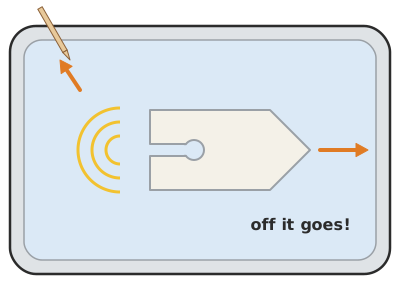
A flat little 8 cm boat, cut from a polystyrene tray, shoots across the washing-up bowl when you touch the water in its rear notch with a toothpick dipped in washing-up liquid: the water's «skin» pulls it forwards.
What they will learn
- That the surface of water behaves like a stretchy skin pulling in every direction (surface tension).
- That soap weakens that skin, and that if one side pulls less than the other, the boat moves towards the side pulling harder.
- That an experiment must be repeatable: why you need clean water every time.
- To compare designs by measuring distances in centimetres (wide or narrow notch, light or heavy boat).
Prepare beforehand
- Print the template at 100 % and cut out paper outlines A and B to use as patterns.
- Wash the tray in hot soapy water and rinse it very well with plain water; leave it to dry. Any trace of grease or soap on the boat ruins everything.
- Rinse the bowl with water only (no soap) and fill it with 4–5 cm of water. Leave it still for 2 minutes before starting.
- Have a bucket and a jug ready to empty and refill quickly: every race needs fresh water.
Materials and tools
- Polystyrene tray — 1 (enough for 6 boats)
from fruit or meat, washed in hot soapy water and rinsed very well; flat area of at least 10 × 6 cm, 3–5 mm thick - Washing-up liquid — 1 teaspoon in a bottle cap
any kind; you dip the tip of a toothpick in it - Washing-up bowl or baking tray — 1
40–50 cm across, filled with 4–5 cm of clean tap water - Toothpicks — 5–6
a new one for each test - Tap water — ≈ 5 l per fill
clean and at room temperature; have a bucket ready for emptying - Ground pepper or talc — 1 pinch (optional)
to see how the soap pushes the surface - Permanent marker — 1
for tracing the template and decorating (other paints may release substances that break the surface tension)
Tools
- Scissors — cutting out the boat
- Craft knife and cutting mat — cutting the narrow 6 mm notch in thick trays adult
- Pencil and empty ballpoint pen — marking the outline on the polystyrene (you mark it by pressing)
- Ruler or tape measure — measuring the distance travelled
- Bucket or jug — changing the water between tests
Pieces and templates
- A · Improved boat with reservoir ×1 — polystyrene tray 3–5 mm
- B · Classic boat (V notch) ×1 — polystyrene tray 3–5 mm
- C · Narrow racing boat ×1 — polystyrene tray 3–5 mm
Step by step
Trace the boat
Cut out paper template A and lay it on the flat part of the polystyrene tray. Go over the 80 × 40 mm outline, the channel and the reservoir circle with an empty ballpoint pen, pressing so that it leaves a mark.
1 Lay template A on the flat part of the tray 2 Go round the whole outline with an empty pen, pressing 3 Remove the paper: the boat is marked on the polystyrene Cut out the outline
Cut out the boat with scissors along the mark: first the straight sides and then the point of the bow (20 mm). Keep the stern (the straight back edge) nice and straight.
1 First cut the two long straight sides 2 Then cut the point of the bow 3 Check that the stern is nice and straight Check: The boat must be flat: if the tray was curved, use only the flat area of the base.Cut out the channel and reservoir adult
Cut the 6 mm wide channel from the stern to the reservoir (18 mm) and pierce the reservoir by twisting the tip of a pencil: this leaves a hole of about 7 mm, so finish it by twisting the point of the scissors inside until it reaches the Ø 10 mm mark. In thick trays, an adult cuts the channel with a craft knife.
1 Cut the two lines of the 6 mm channel, 18 mm inwards 2 Pierce the reservoir by twisting the pencil tip 3 The channel must reach right up to the reservoir Check: The reservoir reaches the Ø 10 mm mark and, held up to the light, the channel and reservoir form a single gap open at the back.Make the classic boat too
Repeat with template B: an 80 × 40 mm outline with a V notch 20 mm wide and 15 mm deep. You will use it to compare the two designs.
1 Trace template B with the V notch 2 Cut out the outline and then the V 3 Now you have both boats to compare Prepare the water
Fill the bowl, rinsed with water only (no soap), to a depth of 4–5 cm with clean tap water. Let it stand completely still for 2 minutes.
1 Fill the clean bowl with 4–5 cm of tap water 2 Wait 2 minutes for the water to be completely still Tip: If you are not sure the bowl is clean, sprinkle a pinch of pepper: if it stays spread out and still, the water is fine.Place the boat
Lay boat A flat on the water at one end of the bowl, about 5 cm from the side, with the bow pointing towards the other end. Let go gently without wetting the deck.
1 Place it 5 cm from the side with the bow facing the other end 2 Let go of it flat, without wetting the deck Check: The boat floats still and does not touch the side: if it does, the water «sticks» it to the edge.Dip the toothpick
Dip only the tip (2–3 mm) of a clean toothpick into the cap of washing-up liquid. Wipe off the hanging drop on the edge of the cap: you need very little.
1 Dip only the tip of the toothpick in the washing-up liquid 2 Wipe the drop off on the edge of the cap 3 A thin film of soap on the tip is enough Touch the reservoir
Touch the water inside the round reservoir with the tip of the toothpick, without pushing the boat, and take the toothpick away straight away. Watch it set off.
1 Touch the water in the reservoir with the tip, without pushing 2 Take the toothpick away at once and watch it set off Check: The boat shoots forwards in less than 1 second and travels 20–40 cm.Measure the distance
Use the ruler or tape measure to measure how many centimetres the boat travelled from the start to where it stopped, and write it down next to the type of boat.
1 Measure from the start to where the boat stopped 2 Write down the centimetres next to the type of boat Change the water
Before the next test, empty the bowl into the bucket, rinse it with tap water and refill it to 4–5 cm. In soapy water the boat no longer moves.
1 In soapy water the boat no longer moves 2 Empty the bowl into the bucket and rinse it with water 3 Refill it with 4–5 cm of clean water before each test Tip: A tip for a second race without emptying: use the boat at the other end with a little more soap. It works 2–3 times, worse each time.Test the classic boat
Repeat the test with boat B in clean water, touching the point of the V notch with the soapy toothpick. Compare the distance and time with boat A.
1 Touch the point of the V notch with the toothpick 2 Compare the distance and time of the two boats Check: B sets off very hard but usually travels less far than A, because the soap all comes out at once.
Does it work? The test
In clean, still water, place the boat 5 cm from the side, touch the reservoir with the soapy toothpick and measure the distance travelled. Repeat 3 times with fresh water each time and work out the average.
What should happen: Polystyrene boat A travels 20–40 cm in 2–5 s; if the bowl is small, it crosses to the opposite side. Boat B (V notch) sets off faster but usually stops at 15–30 cm. Once the water is soapy, neither moves.
If something goes wrong
- The boat does not move at all — The water already had soap in it (bowl badly rinsed or a previous test) or the boat has traces of soap or grease. Solution: Empty the bowl, rinse it with water only and refill. Rinse the boat under the tap and dry it with paper.
- It spins in circles instead of going straight — Off-centre channel, lopsided boat, or you touched one side of the notch. Solution: Cut it out again with the template, with the channel exactly in the centre, and touch the water in the centre of the reservoir.
- It sticks to the side — The water forms a small meniscus that draws floating objects towards the edge. Solution: Always start 5 cm from the side and in the middle of the short end.
- The cardboard boat sinks at the back — The cardboard has soaked up water and is heavier. Solution: Use polystyrene, or cover the cardboard with packing tape on both sides and round the edges.
- It moves very little and slowly — Boat too heavy or thick, or too little soap. Solution: Use a thinner tray (3 mm) and dip the tip of the toothpick a little more. Boat C, which is narrower, goes further.
- It shoots off but stops straight away — You used a big drop or the design releases the soap all at once (wide notch). Solution: Use less soap (just the tip of the toothpick) and boat A with the narrow channel and reservoir.
Safety
- Never leave a young child alone with a bowl of water, even if it is only a few centimetres deep.
- Washing-up liquid stings the eyes: if it splashes, rinse with plenty of water. Do not taste it.
- The craft knife for the narrow channel is used by an adult, on a cutting mat.
- Dry the floor when you finish: spilt soapy water is very slippery.
- If you test with alcohol, an adult handles it, a single drop and well away from any flame.
The science behind it
For children
The surface of water is like a very tight trampoline that pulls in every direction. When the little boat is still, it pulls just as hard at the front as at the back, so it does not move. Soap is like a pair of scissors that loosens the trampoline just behind the boat. Then the front part keeps pulling hard and the back part no longer does, so the boat shoots forwards. When all the water has soap in it, the trampoline is loose everywhere and the boat stops moving.
For the adult
Water molecules attract each other through hydrogen bonds; at the surface this attraction is not balanced from above, giving rise to a surface tension of ≈ 72 mN/m: a force per unit length acting tangentially to the surface along any line, such as the outline of the boat. As long as the tension is equal all round the perimeter, the forces cancel out. Detergent is a surfactant: its molecules have a head that dissolves in water and a tail that repels it; they settle at the surface and lower the tension to ≈ 30 mN/m. When it is added at the stern, the rear section pulls less strongly than the front; the difference (Δγ ≈ 0.04 N/m) multiplied by the width of the affected area (≈ 1–2 cm) gives a net force of 0.4–0.8 mN, enough to accelerate a 0.3–0.5 g polystyrene boat at more than 1 m/s². In addition, the surfactant spreads rapidly across the surface from the low-tension area to the high-tension one (the Marangoni effect), dragging the water and the boat with it. Once the detergent monolayer covers the whole surface, the tension evens out and the thrust disappears: that is why you have to change the water. A narrow channel with a reservoir releases the surfactant gradually and prolongs the thrust. Some aquatic insects (Stenus, Velia) secrete surface-active substances to escape in the same way.
- surface tension: the stretchy «skin» that water forms at its surface, pulling in every direction.
- surfactant: a substance such as soap that weakens the water's skin.
- propulsion: the push that makes something move forwards.
- balanced forces: when they pull equally in every direction and nothing moves.
- variable: the only thing you change in an experiment to see what effect it has.
By age
- 5–7 years: The adult cuts out the boats and prepares the water. The child places the boat, dips the toothpick and touches the reservoir. The key idea: «soap loosens the water's skin at the back». They love the pepper experiment.
- 8–10 years: They cut out boats A and B themselves with the template, measure distances and compare. Let them discover why the water has to be changed.
- 11–12 years: They design their own boat (shape, channel width, reservoir size), change only one variable at a time and make a table with averages of 3 tests. Challenge: work out the average speed (cm/s) with a stopwatch.
In a group or in class
Teams of 3–4 children, each with their own boat and one baking tray or bowl per team. Set up a water station (bucket and jugs) and an emptying station beforehand, and pre-cut the channels if the trays are thick. 40-minute session: 10 min cutting out with templates, 20 min testing with fresh water (the job of emptying and refilling rotates within the team), 10 min final race in a long tray and comparing distances on the board. Have a small bottle of washing-up liquid and toothpicks for each team.
Challenges
- Design a boat that goes more than 50 cm in a bath.
- Make a boat that spins in circles by putting the channel in a corner.
- Build a boat with two reservoirs and get it to make two bursts of speed in a row.
- Find out which channel width gives the greatest distance by testing 3, 6 and 10 mm.
- Find out which insects move like this on water and draw one.