Flameproof water balloon
A balloon blown up with air alone bursts in 1–3 seconds over a candle flame; an identical one with 150 ml of water inside lasts more than a minute over the same flame without breaking, because the water carries the heat away from the rubber.
What they will learn
- That heat passes from hot objects to cold ones and that some materials (water) carry it away very well.
- That water needs a huge amount of energy to warm up (specific heat 4.18 J/g·°C): that is why it cools the rubber.
- That air is a poor conductor of heat: rubber with air behind it heats up in an instant.
- That soot is carbon from incomplete combustion, which appears when the flame is cooled.
- To measure times and temperatures and compare results fairly (same height, same candle).
Prepare beforehand
- Do the experiment next to the sink (or with a bowl of water beside you) and with the table cleared of papers and cloths.
- Print height gauge A on card and fold it.
- Prepare the balloons beforehand: one blown up with air to about 20 cm in diameter and another with 150 ml of water (and almost no air).
- Tie back long hair and take off scarves and loose sleeves.
- Keep a glass of water and a damp cloth to hand in case wax drips or something catches fire.
Materials and tools
- Latex balloons — 4 (2 for the test and 2 spares) buy
round, all the same type and a light colour (to see the soot), normal size (25–30 cm at most); the air one is only blown up to about 20 cm - Candle — 1 buy
pillar or table candle, Ø 4–6 cm, that stands up on its own - Tap water — 150 ml per balloon
at room temperature (≈ 20 °C) - Matches or lighter — 1
long fireplace matches or a kitchen lighter - Ceramic plate — 1
flat, to stand the candle on - Empty plastic bottle — 1
500 ml, to fill the water balloon - Card — 1 strip, 40 × 160 mm
200 gsm or heavier, for the height gauge - Wooden clothes peg — 1
to hold the balloon's knot away from your fingers
Tools
- Measuring jug — measure 150 ml of water
- Stopwatch (phone) — time the seconds over the flame
- Kitchen thermometer (optional) — measure the water temperature before and after
- Scissors — cut out the height gauge and open the balloon to measure the water
Pieces and templates
- A · Flame height gauge ×1 — card 200 gsm
Step by step
Prepare the area adult
Put the plate next to the sink, 30 cm from the edge of the table. Stand the candle in the centre (stick its base down with 2 drops of melted wax if it wobbles) and leave a glass of water beside it.
1 Put the plate next to the sink, 30 cm from the edge of the table 2 If it wobbles, stick the candle's base down with 2 drops of wax 3 The candle stands firm in the centre with the glass of water beside it Blow up the air balloon
Blow up the first balloon with air only to about 20 cm in diameter (not to the maximum) and tie a knot. Clip a clothes peg onto the knot to hold it.
1 Blow up the balloon with air to about 20 cm, not to the maximum 2 Tie a knot and clip the clothes peg onto it Measure the water
Pour 150 ml of tap water into an empty 500 ml bottle. If you have a thermometer, measure the water temperature and write it down.
1 Measure 150 ml of tap water in the measuring jug 2 Pour it into the 500 ml plastic bottle 3 If you have a thermometer, measure the temperature and write it down Fill the balloon with water
Stretch the neck of the second balloon over the neck of the bottle. Turn the bottle upside down and squeeze it until all the water has gone into the balloon. Take the balloon off, let out any air left inside and tie a knot.
1 Stretch the balloon's neck over the neck of the bottle 2 Turn it upside down and squeeze until all the water has gone in 3 Let the air out and tie the knot: round, with no big bubble at the top Check: The balloon should be about 7 cm across, almost round and with no big air bubble at the top.Set up the height gauge
Cut out gauge A, fold the foot and stand it up next to the candle, 2 cm away. Prop the gauge up with cardboard until the WICK line is level with the wick.
1 Cut gauge A out of card along the red line 2 Fold the foot backwards and put a coin on it 3 Place it 2 cm from the candle, propped up: WICK level with the wick Light the candle adult
The adult lights the candle with long matches. Wait 1 minute for the flame to settle (about 2–3 cm tall) and make sure there are no draughts.
1 The adult lights the wick with a long match 2 Wait 1 minute for the flame to go still, with no draughts Test the air balloon adult
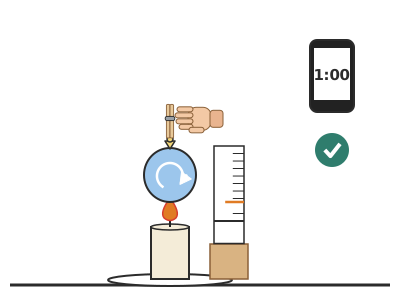
The adult holds the air balloon by the peg and lowers it slowly until its underside is at the BALLOON mark (25 mm above the wick). The child times from that moment until it bursts.
1 The adult lowers the air balloon by the peg to the BALLOON mark 2 When the rubber touches the flame, start timing 3 It bursts in 1–3 s: cover your ears and write down the time Check: Write the seconds down in the table.Tip: Cover your ears: the bang is loud. It usually bursts in 1–3 seconds.Test the water balloon adult
Now lower the water balloon to the same mark, knot upwards, so that the flame touches exactly where the water is. Hold it still and time 20 seconds; if you dare, keep going up to 60 seconds.
1 Lower the water balloon to the same mark, knot at the top 2 Hold it still: it lasts 60 s without bursting 3 Not like this: with lots of air inside, the flame touches dry rubber and it bursts Check: The balloon does not burst. If a lot of air was left inside, the flame heats rubber with no water behind it and it bursts; also don't let the flame touch the neck or the knot: hold it upright with the knot at the top.Look at the soot adult
The adult takes the water balloon away and blows out the candle. Then look at the black mark on the underside and rub it with a finger: it is soot (carbon), not a burn. It comes off with soap and water.
1 Take the water balloon away and blow out the candle 2 Rub the black mark with a finger: it is soot, carbon 3 Wash it with soap and water: it comes off, it isn't a burn Measure the water temperature
Over the sink, cut the balloon's neck with scissors, pour the water into a glass and measure its temperature. Compare it with the one you wrote down at the start.
1 Over the sink, cut the balloon's neck with scissors 2 Pour the water into a glass 3 Compare: after 60 s the water only rises 1–3 °C Check: After 60 s over the flame, the water has only warmed up by 1–3 °C.
Does it work? The test
With the candle at the same height and the bottom of the balloon 25 mm above the wick, time the air balloon and the balloon with 150 ml of water.
What should happen: The air balloon bursts in 1–3 s. The water balloon lasts 60 s or more without breaking; it comes out with a black soot mark and the water has barely warmed up by 1–3 °C.
If something goes wrong
- The water balloon bursts — A lot of air was left inside (the flame heats rubber with no water behind it), the flame touched the neck or the knot, which have no water behind them, or the balloon was faulty. Solution: Let all the air out before tying the knot, hold it upright with the knot at the top and check that the flame touches only the bottom, where the water is.
- The water balloon gets covered in soot very quickly — It is pushed down into the flame and cools it too much. Solution: Raise it a little: only the tip of the flame should touch the balloon (25–30 mm mark).
- The air balloon takes a long time to burst — It is too high, out of the flame. Solution: Lower it until the tip of the flame touches the rubber.
- The flame goes out when the balloon gets close — The balloon squashes the flame or there is a draught. Solution: Don't go lower than the 25 mm mark and close the windows.
- I can't get the water into the balloon — The neck of the balloon is very narrow: if you pour the water in directly (from the tap or a jug), it runs down the outside. Solution: Use the bottle trick: balloon neck over the neck of the bottle, bottle upside down, and squeeze.
Safety
- Fire: always with an adult, on a plate, away from curtains, papers and cloths, with a glass of water beside it. Long hair tied back and no loose sleeves.
- The air balloon bursts with a loud bang: cover your ears and keep your face away.
- Balloons: choking hazard for children under 8 with uninflated balloons or broken pieces. Pick up all the bits.
- Latex: if someone is allergic, use latex-free balloons or make sure they don't touch them.
- Hot wax burns: don't move the lit candle and let it cool for 5 minutes before tidying up.
The science behind it
For children
The balloon's rubber is very thin. If there is only air behind it, the heat from the flame stays in the rubber, which gets really hot and breaks: pop! But if there is water behind it, the water is like a heat sponge: it takes the heat away from the rubber straight away and spreads it around the whole balloon. Because water needs loads of heat to warm up, the rubber stays nice and cool and doesn't break. The black mark is soot, which is a tiny bit of candle that hasn't burnt completely.
For the adult
A candle flame is ≈ 1000–1400 °C at its tip and delivers around 10–20 W to the object it touches. The latex wall (≈ 0.1–0.2 mm) has very little mass: with air behind it (conductivity ≈ 0.026 W/m·K and weak convection) the heat cannot escape, the rubber quickly exceeds the ≈ 150–200 °C at which stretched latex loses strength and, because it is under tension, it tears in 1–3 s. With water behind it, the heat passes through the thin wall by conduction and the water spreads it by convection: the water next to the rubber warms up, rises and is replaced by cold water. The wall stays at little more than the water temperature (100 °C at most, which latex can withstand). Water has a very high specific heat, 4.18 J/g·°C: 150 g of water receiving 15 W for 60 s (900 J) only rises by ≈ 1.4 °C. That is why the balloon lasts for minutes. Soot appears because the cold surface of the balloon cools the flame below the temperature of complete combustion and the carbon is deposited unburnt. It is the same principle as water cooling in engines, or what lets you boil water in a paper cup.
- heat: energy that passes from a hot object to a colder one.
- conduction: heat passing through a material, from particle to particle.
- convection: hot liquid rises and cold liquid sinks, and that is how the heat gets spread.
- specific heat: energy needed to heat 1 g of a substance by 1 °C; water needs a huge amount.
- soot: black carbon powder left by incomplete combustion.
By age
- 5–7 years: The adult holds the balloons and lights the candle. The child helps fill the balloon with the bottle, times by counting out loud and rubs off the soot. Key message: «water takes the heat away».
- 8–10 years: They fill the balloons, set up the height gauge, time and fill in the table. The adult holds the balloon over the flame.
- 11–12 years: They measure temperatures with a thermometer, calculate the energy absorbed (Q = m·c·ΔT) and the power of the flame, and design the amount-of-water experiment with 3 repeats.
In a group or in class
As a demonstration for the whole class (a single candle on the teacher's desk, pupils 1.5 m away) or in stations of 4 pupils with one adult per station. Per station: 1 candle on a plate, 4 balloons, bottle with 150 ml of water, height gauge, stopwatch. 30 min: written prediction (5), tests (15), sharing results (10).
Challenges
- Heat water in a paper cup or a little paper box over the candle without the paper burning.
- Design a «heat shield» for the air balloon (aluminium foil, card...) and measure how much extra time it lasts.
- Find out whether a balloon with oil instead of water lasts as long (oil has half the specific heat). Only with an adult and over the sink.
- Work out how many minutes it would take for 150 ml of water to boil with a 15 W flame.