Cloud in a jar
A 1-litre glass jar with 3 cm of hot water, a little smoke from a match and a lid full of ice on top: in 30–60 seconds a white cloud forms that swirls inside the jar and floats out when you take the lid off.
What they will learn
- That warm air can carry a lot of invisible water vapour and that, when it cools, that vapour turns into tiny droplets (condensation).
- That clouds need condensation nuclei (dust, smoke, salt): without them the vapour doesn't form drops even when it's cold.
- That warm air rises and cold air sinks (convection), and that this makes the cloud swirl inside the jar.
- How to compare an experiment with its control (with smoke and without smoke), changing only one thing.
- How to time and record how long the cloud takes to form depending on the amount of ice or the water temperature.
Prepare beforehand
- Print pieces A (black backdrop) and B (level scale) at 100 %, or draw the scale with a ruler.
- Wash the jar and remove the label: the glass must be clean and dry on the outside so you can see well.
- Have the ice ready in a bowl and the plate of water for the matches before you start.
- Work on a stable table, away from curtains and loose papers, with the room fairly dark.
- Try it once yourself before the session to adjust the water and ice to your jar.
Materials and tools
- Glass jar with metal lid — 1
preserving jar, 0.75–1 litre, thick glass, wide mouth (≥ 7 cm) and metal screw-top lid - Hot water — 200–220 ml
at 70–80 °C (kettle switched off for 1 minute); just enough to reach 3 cm high in your jar - Ice cubes — 6–8
straight from the freezer - Table salt — 1 teaspoon (5 g)
sprinkled on the ice to make it colder - Matches — 3–4
wooden, to make the smoke (handled by an adult) - Black card — 1 A4 sheet
for the backdrop (piece A) - Torch — 1
a mobile phone torch will do - Sticky tape — 2 pieces
to stick the level scale (piece B) to the jar
Tools
- Kettle or saucepan — heat the water adult
- Measuring jug — measure about 210 ml of water
- Tea towel — hold the hot jar while swirling it adult
- Plate or glass of water — put out and leave the used matches adult
- Stopwatch (mobile phone) — time how long the cloud takes
Pieces and templates
- A · Folding black backdrop ×1 — black card
- B · Water level scale ×1 — paper
Step by step
Set the scene
Cut out and fold the black backdrop A and stand it up on the table. Tape scale B to the outside of the jar, with the «bottom» line level with the inside bottom. Keep the ice, the salt and the plate of water for the matches within reach.
1 Cut out the 270 × 190 mm backdrop A and fold the two wings 2 Tape scale B to the outside, with the edge level with the inside bottom 3 Jar in front of the black backdrop; ice and plate of water to hand Check: The jar in front of the black backdrop looks dark, with no reflections from the window.Warm up the jar adult
Fill the jar halfway with hot tap water and leave it for 1 minute. Pour it away. This way the glass warms up gradually and won't crack with the hotter water.
1 Half-fill the jar with hot tap water and wait 1 minute 2 Pour the water away: the glass is now warm and won't crack Tip: Hold the jar with a tea towel: the glass gets hot straight away.Pour in the hot water adult
Heat water in the kettle and wait 1 minute after it switches off (70–80 °C). Measure 210 ml with the jug and pour it into the jar up to the 3 cm mark on the scale (in a Ø 9.5 cm jar that's about 210 ml; if it falls short or goes over, add or remove water until it reaches the mark).
1 Heat water and wait 1 minute with the kettle off 2 Pour the water slowly into the jar 3 Fill exactly to the 3 cm mark: steam should come out Check: Steam should come out of the jar: that's a sign there's plenty of vapour.Warm the sides adult
Put the lid on top without screwing it and gently swirl the jar in circles 3–4 times, using the tea towel, so the water wets the sides up to about 8 cm high. Warm sides don't steal vapour too soon.
1 With the lid on and the tea towel, swirl the jar 3–4 times 2 The water wets the sides up to about 8 cm high Prepare the ice lid
Turn the lid over (inside facing up) and fill it with 6–8 ice cubes. Sprinkle a teaspoon of salt on top and add a tablespoon of cold water so the ice touches all of the metal.
1 Turn the lid over: inside facing up 2 Fill the lid with 6–8 ice cubes 3 Add a teaspoon of salt and a tablespoon of cold water Tip: If the lid is small, put the ice cubes in a thin plastic bag resting on the lid.Put the ice on top
Place the lid with the ice on the mouth of the jar, just resting (no need to screw it on), and wait 30 seconds with the stopwatch. The air at the top starts to cool.
1 Rest the lid with the ice on the mouth of the jar 2 Wait 30 seconds: the underside of the lid mists up Check: After a few seconds the underside of the lid mists up and you may see a very faint haze.Add the smoke adult
The adult lights a match, lets it burn for 2 seconds and blows it out. They lift the lid just 2–3 cm on one side, put the smoking match inside for 2–3 seconds, take it out and put the lid back immediately.
1 Light the match, let it burn for 2 seconds and blow it out 2 Lift one side of the lid and put the smoking match in for 2–3 s 3 Put the match on the plate and replace the lid immediately Tip: Without fire: a very short spray (half a second) of hairspray into the jar does the same job.Watch the cloud
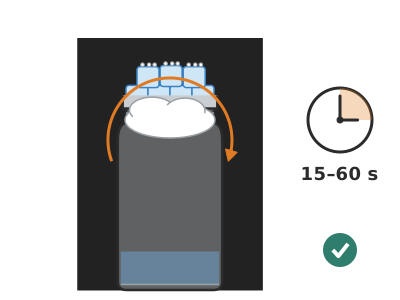
Turn off the room light and shine the torch on the jar from one side (not from the front). Within 15–60 seconds you'll see a white mist that swirls and thickens under the lid. Time how long it takes to appear.
1 Turn off the light and shine the torch on the jar from one side 2 Within 15–60 seconds a swirling white cloud forms: time it Check: You can see a well-defined white cloud against the black backdrop, swirling around.Let the cloud escape
Lift the lid with the ice off to one side and watch the cloud slowly drift out of the jar and vanish into the room air within a few seconds.
1 Move the lid with the ice off to one side 2 The cloud floats out and vanishes into the air Tip: If you blow gently over the top, the cloud moves like real ones in the wind.Repeat and compare
Put the ice lid back on (add 2–3 ice cubes if they have melted) and repeat, this time WITHOUT smoke. Compare: without nuclei only a faint haze forms, or nothing. To repeat with smoke, reheat the water if it has dropped below 50 °C.
1 Put the lid back on and add 2–3 ice cubes if they have melted 2 Repeat without smoke: only a faint haze appears, or nothing 3 Write down the seconds with smoke and without smoke Check: You have written down the time with smoke and without smoke.Tidy up
Let the water cool for 10 minutes and pour it down the sink. Throw the wet matches in the bin, dry the lid so it doesn't rust and wash the jar with soap and water.
1 Let the water cool for 10 minutes and pour it down the sink 2 Throw the wet matches in the bin 3 Dry the lid so it doesn't rust and wash the jar with soap
Does it work? The test
With the water 3 cm deep (about 210 ml) at 75 °C, cover with 8 ice cubes and salt, add the smoke from a match after 30 s and time from when you put the lid on until the cloud is clearly visible with the torch. Repeat without smoke.
What should happen: With smoke, the cloud appears in 10–40 seconds and keeps swirling for 1–2 minutes. Without smoke, in the same time barely a faint haze forms, or nothing: the difference is very obvious.
If something goes wrong
- No cloud forms — Water not hot enough, or no nuclei (the smoke escaped). Solution: Use water at 70–80 °C and add the smoke lifting the lid as little as possible, covering it again immediately.
- It forms but you can hardly see it — Light backdrop or light from the front. Solution: Use the black backdrop (piece A), darken the room and shine the torch from one side.
- The sides mist up and the cloud doesn't appear — The sides were cold and the vapour condenses on the glass before it does in the air. Solution: Warm up the jar beforehand and swirl it with the hot water to warm the sides.
- The cloud disappears straight away — The ice has melted or the lid is no longer cold. Solution: Add more ice cubes with salt. The colder the lid, the longer the cloud lasts.
- The match goes out before it smokes — It was blown out too soon. Solution: Let the match burn for 2 seconds so the wood catches and then blow it out: it gives a thread of smoke for 3–5 seconds.
- The jar creaks or cracks — Thermal shock: very hot water in cold or thin glass. Solution: Always warm up the jar first, use thick preserving-jar glass and never freshly boiled water.
Safety
- Water at 75 °C scalds in seconds: an adult pours it and the jar is held with a tea towel. Children do not swirl the hot jar.
- Only an adult lights and puts out the matches, away from loose hair, curtains and papers. Used matches go on a plate of water.
- The glass can break from thermal shock: warm up the jar first and always stand it on a tea towel on the table.
- Don't breathe the smoke up close or put your nose in the jar; air the room when you finish.
- If you use hairspray, only one spray, never near a flame: it is flammable.
- Salted ice can reach −5 °C: don't hold the salted ice cubes in your hand for long.
The science behind it
For children
Hot water gives off vapour, which is invisible water floating in the air. That warm air rises up to the lid, which is freezing cold from the ice, and cools down there. Cold air can't carry as much vapour, so it lets it go as tiny droplets. But the droplets need something to hold on to, just as you need a chair to sit on: the smoke particles are those chairs. Millions of droplets together make a cloud.
For the adult
The maximum amount of vapour air can hold rises very quickly with temperature (saturation vapour pressure ≈ 47 hPa at 32 °C compared with ≈ 6 hPa at 0 °C). Water at 70–80 °C evaporates rapidly and saturates the air in the jar; that warm, moist air rises by convection and cools on contact with the lid at 0 to −5 °C, becoming supersaturated. However, forming a drop from vapour molecules alone (homogeneous nucleation) requires supersaturations of several hundred per cent, because the vapour pressure over a very curved drop is higher (Kelvin effect). In the atmosphere, drops form on aerosols (condensation nuclei: sulphates, sea salt, dust, soot) at supersaturations of just 0.1–1 %. The 0.1–1 µm smoke particles from the match act as those nuclei: the vapour condenses on them, forming millions of droplets of ≈ 10 µm that scatter light in all directions (Mie scattering), which is why the cloud is white and is best seen lit from the side against a dark background. The cold air from the lid sinks and the warm air rises, creating convection cells that make the cloud swirl. When you take the lid off, the cloud drifts out and evaporates as it mixes with the dry room air.
- water vapour: water in the form of an invisible gas, floating in the air.
- condensation: when vapour cools and turns into droplets of liquid water.
- condensation nucleus: a tiny particle (smoke, dust, salt) on which a droplet forms.
- convection: movement of air: warm air rises and cold air sinks.
- dew point: the temperature at which air, as it cools, starts to release droplets.
By age
- 5–7 years: The adult does everything hot and the smoke. The children put the ice in the lid, turn off the light, shine the torch and count the seconds. Focus on «cold + vapour + smoke = cloud».
- 8–10 years: They set the scene, prepare the ice and the scale, time it and compare with smoke and without smoke in a table. The adult still handles the water and the match.
- 11–12 years: They design their own experiment changing a single variable (ice, water temperature, type of nucleus: smoke, hairspray, chalk dust) and make a graph. Challenge: the pressure cloud in a bottle, and explaining why air cools when it expands.
In a group or in class
Best as a demonstration with stations: one adult per jar and groups of 5–6 children around it (4 jars for 24 children). Each group has its own black backdrop, torch and record sheet. Prepare a flask of hot water for each station and ice in a cool box. 40-minute session: 10 min explanation, 25 min of tests (with smoke, without smoke, more ice) and 5 min of sharing. In classrooms where fire isn't allowed, use hairspray as the nucleus.
Challenges
- Get the cloud to last more than 2 minutes inside the jar.
- Try other nuclei: hairspray, chalk dust, very fine salt, incense. Which makes the densest cloud?
- Make a cloud that rains: put the jar in the fridge to cool with the ice lid on and watch the drops on the lid.
- Photograph clouds in the sky for a week and classify them (cumulus, stratus, cirrus).
- Build the cloud in a bottle and use a digital thermometer to measure how much the temperature drops when you let go.