Dry tissue under water
A ball of kitchen roll wedged into the bottom of a glass goes down to the bottom of a pan of water and comes out completely dry: the air trapped in the glass won't let the water in. If you tilt the glass, the air escapes in bubbles and the paper gets soaked.
What they will learn
- That air is matter: it takes up space, even though you can't see it, and water can't get in where there is already air.
- That air can be compressed a little: the deeper you push the glass, the more water gets in, just a bit.
- That if the air has a way out (tilted glass), it escapes upwards in bubbles and the water takes its place.
- How diving bells work and why you can «pour» bubbles from one glass to another under water.
Prepare beforehand
- Fill the container with water to a depth of at least 13 cm (measure it with the ruler) and put it on a towel on a low table or on the floor.
- Dry the inside of the glass thoroughly: any drop will wet the paper.
- Print and cut out scale A if you are going to measure how far the water rises.
- Keep a dry cloth and spare sheets of paper handy.
Materials and tools
- Clear glass — 1 (2 for the experiments)
glass or rigid plastic, ≈ 250 ml, ≈ 10 cm tall, mouth Ø 7–8 cm, no pictures on it - Kitchen roll — 1 sheet per attempt
sheet of ≈ 22 × 23 cm, white (it's easier to see if white paper gets wet) - Large container — 1
clear if possible (glass salad bowl, mop bucket, tall pan or fish tank), at least 15 cm tall and 20 cm wide - Tap water — enough for a depth of 13 cm (≈ 4–6 L)
cold or lukewarm; 3 drops of blue food colouring help you see the level inside the glass - Adhesive putty (Blu-Tack type) — 1 small 1 cm ball
in case the paper ball falls out - Clear sticky tape — 2 pieces of 5 cm
to stick scale A to the glass
Tools
- Ruler — measure the height of the glass and the depth of the water
- Tea towel — dry the rim of the glass and your hands
- Scissors — cut out scale A
Pieces and templates
- A · Millimetre scale for the glass ×1 — paper
Step by step
Check the depth
Stand the ruler upright in the container and check the water is at least 13 cm deep (3 cm more than the height of your glass). If it isn't deep enough, add water or use a taller container.
1 Stand the ruler upright: the water should reach 13 cm or more 2 Sink the glass upright to the bottom: the water covers it with 3 cm to spare Check: Sink the glass upright (mouth up, so it fills) until it touches the bottom: the water should be at least 3 cm above its rim. Take it out and dry it thoroughly before carrying on.Dry the glass
Dry the inside of the glass with the cloth until there isn't a single drop left, especially at the bottom, where the paper will go.
1 Dry the inside of the glass with the cloth, especially the bottom 2 There mustn't be a single drop: that's where the paper goes Make the paper ball
Scrunch a whole sheet of kitchen roll into a ball a little bigger than the bottom of the glass (about 6 cm). Push it in with your fingers right to the bottom so it is wedged in tightly.
1 Scrunch a whole sheet into a ball of about 6 cm 2 Push it with your fingers to the bottom of the glass 3 It stays wedged at the bottom, not going below halfway Tip: The ball mustn't reach below halfway down the glass: a tiny bit of water gets in at the rim.Check it doesn't fall out
Turn the glass upside down and shake it gently once. If the paper falls out, make it bigger or stick a small ball of adhesive putty to the bottom of the glass and press the paper against it.
1 Turn the glass over with the paper inside 2 Shake it gently once: the paper stays at the top 3 If it falls out, stick a small ball of putty to the bottom and press Check: With the glass upside down, the paper stays at the top, at the bottom of the glass.Stick on the scale (optional)
If you want to measure how far the water rises inside the glass, cut out scale A and also cut exactly along the 0 line to remove the 7 mm strip below it (the one with the «0 = RIM» label). Stick it to the outside of the glass with tape, with the cut at 0 exactly on the rim of the mouth.
1 Cut along the red line: cut exactly at 0 and throw away the bottom piece 2 Tape it to the outside, with the 0 exactly on the rim of the mouth Lower the glass straight
Hold the glass upside down by its base with one hand, perfectly upright. Lower it slowly and straight until the mouth touches the bottom of the container. You'll feel the water pushing upwards.
1 Hold the glass upside down by its base and lower it perfectly upright 2 Lower it until the mouth touches the bottom: the air keeps the water out Check: Look from the side: hardly any water has got into the glass; the paper is still at the top surrounded by air.Hold for 10 seconds
Keep the glass still and upright for 10 seconds without tilting it at all. If you've stuck on the scale, see how many millimetres the water has risen inside the glass.
1 Hold it still and upright for 10 seconds without tilting 2 Look at the scale: inside, the water rises barely 1 mm Lift the glass out straight
Lift the glass out just as straight. Before turning it over, dry the rim and the outside with the cloth so no drops fall on the paper.
1 Lift it out just as straight, without turning it 2 Dry the rim and the outside before turning it over Touch the paper
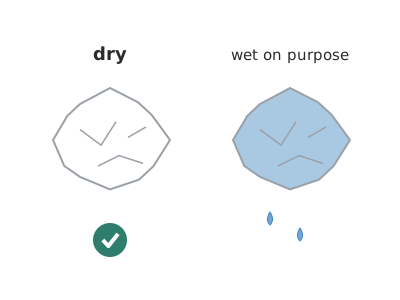
Turn the glass over, take out the paper and touch it: it's dry. Compare it with a sheet you wet on purpose.
1 Turn the glass over and take out the paper 2 Touch it: it's dry. Compare it with one you wet yourself Now tilt it
Put in a dry piece of paper again and lower the glass straight. Once it's on the bottom, tilt it about 45° to one side: you'll see big air bubbles come out. Take it out and touch the paper: now it's wet.
1 With dry paper and the glass on the bottom, tilt it about 45° 2 The air comes out in bubbles and water gets in at the rim 3 Take it out and touch the paper: this time it's wet
Does it work? The test
Lower the glass straight to the bottom of 13 cm of water, wait 10 s, lift it out straight, dry the rim and touch the paper.
What should happen: The paper comes out completely dry. Inside the glass the water has risen only 1–1.5 mm above the rim. When you tilt it 45° a big air bubble comes out and the paper gets wet.
If something goes wrong
- The paper comes out wet — The glass tilted as you lowered or lifted it, or drops fell from the rim when you turned it over. Solution: Lower and lift very straight and slowly, and dry the outside of the rim before turning the glass over.
- The paper falls out when you turn the glass over — Ball too small. Solution: Make the ball bigger and press it against the bottom, or fix it with a small ball of adhesive putty.
- The paper is wet only at the bottom — The ball came too close to the mouth of the glass. Solution: Make the ball fill only the top half of the glass.
- The glass doesn't get fully covered — Too little water or a container that's too shallow. Solution: Use a taller container or add water up to 3 cm more than the height of the glass.
- The paper was damp before you started — There were drops inside the glass or your hands were wet. Solution: Dry the glass and your hands before making each ball.
Safety
- A large container of water is very heavy (5 L = 5 kg): fill it where it stands with a jug and don't move it when full.
- Wet glass tumblers are slippery: use a hard plastic one with the youngest children.
- Put a towel underneath and dry the floor when you finish so nobody slips.
- Never leave a young child alone near a bucket or bath with water in it.
The science behind it
For children
Even though it looks empty, the glass is full of air. You can't see air, but it takes up space, just like you take up your chair. When you lower the glass upside down, the air is trapped inside like a giant bubble and has no way out, so the water can't get in: the space is already taken. That's why the paper stays dry. But if you tilt the glass, you open a door for the air: it goes up in bubbles and then the water gets in and wets the paper.
For the adult
The upside-down glass traps a volume of air at atmospheric pressure (≈ 101.3 kPa). For water to get in, the air would have to escape or be compressed. Because air is less dense than water, it can't escape downwards through the mouth while the glass is upright. It is compressed a little, though: at the mouth, at a depth h, the pressure is p0 + ρgh. With h = 0.13 m, ρgh ≈ 1.3 kPa, 1.3 % of p0; by Boyle's law (pV = constant at constant temperature), the volume of the air shrinks by 1.3 %, and in a 10 cm glass the water rises ≈ 1.3 mm. At a depth of 40 cm (bath or swimming pool) it would rise ≈ 4 mm, and at 10 m (double the pressure) the air would fill half the glass. This is the principle of the diving bell, used since ancient times, and of the pneumatic caissons used to build bridge piers. When you tilt the glass, part of the mouth ends up higher than the water surface inside the glass (the boundary between air and water); the air, pushed by Archimedes' buoyancy, comes out in bubbles and the water takes up its volume. The experiment also shows that air is matter: it has mass (≈ 0.3 g in a 250 ml glass) and takes up volume.
- matter: anything that takes up space and has mass, including air.
- air: a mixture of gases (mostly nitrogen and oxygen) all around us; you can't see it, but it takes up space.
- pressure: the force with which air or water pushes on each bit of a surface.
- compress: to squeeze something so it takes up less space; air can be compressed, water hardly at all.
- diving bell: a bell open at the bottom that is lowered into the water with air inside so divers can breathe.
By age
- 5–7 years: The adult prepares the container. The child makes the ball, lowers the glass with both hands and touches the paper. Stress the idea «the glass isn't empty, it's full of air».
- 8–10 years: They do it on their own, try glasses of different sizes and moving air between two glasses.
- 11–12 years: They use scale A to measure how far the water rises at two depths, calculate the compression with Boyle's law and compare it with what they measured.
In a group or in class
Teams of 4 with a washing-up bowl or bucket with 13 cm of water per team (in the playground or on towels), 2 hard plastic glasses and kitchen roll. 25 min: written prediction (5), upright and tilted test (10), moving air between glasses (5), sharing results (5). Have a mop and towels ready.
Challenges
- Build a mini diving bell from a cut-down bottle and take a small plastic figure to the bottom without it getting wet.
- Move the air from one glass to another three times in a row without losing a single bubble.
- Lower a glass with the paper to 40 cm (bath) and check whether it stays dry; measure how far the water rises.
- Explain with a drawing why a submarine needs to pump air to rise.