Spaghetti and marshmallow tower
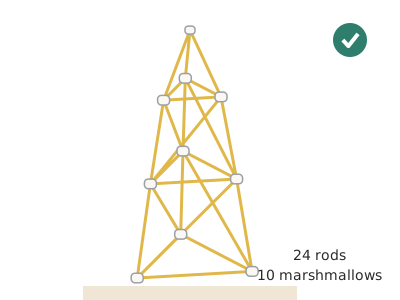
A tower about 45 cm tall made only from uncooked spaghetti and small marshmallows, built as three triangular storeys that narrow towards the top, with a diagonal on each face. It stands on its own because triangles do not change shape and the base is wide.
What they will learn
- That the triangle is the rigid shape: a square of jointed rods changes shape and a triangle does not.
- That a wide base and a tower that narrows towards the top lower the centre of gravity and make the structure more stable.
- That long, thin rods bend (buckle) when they are squeezed: that is why the lower sections must not be too long.
- That the joints are usually the weak point of a structure.
- To measure, record and compare results in order to improve a design.
Prepare beforehand
- Print template A (base triangle) and ruler B at 100 % and check that the side of the triangle measures 200 mm.
- Choose a firm, flat table, away from fans and draughts.
- Set aside 25 straight strands of spaghetti per tower and discard any that are broken or bent.
- Leave the bag of marshmallows open for 30–60 minutes beforehand: slightly dry on the outside, they grip the spaghetti better.
- For children aged 5–7, cut the rods yourself in advance and group them by length in labelled cups.
Materials and tools
- Uncooked spaghetti — 25 per tower (21 + 4 spare) buy
standard no. 5, Ø ≈ 1.8 mm × 250–260 mm, straight (not wholewheat, which breaks sooner) - Small marshmallows — 12 per tower (10 + 2 spare) buy
15–20 mm, soft but not sticky - Tape measure or 50 cm ruler — 1
to measure the height from the table to the marshmallow at the top - A4 sheet with the printed template — 2 A4 sheets
base template A and cutting ruler B - Masking tape — 10 cm
to fix the template to the table
Tools
- Fine felt-tip pen — mark the cutting point on the spaghetti
- Craft knife (optional) — score a notch so the spaghetti snaps more cleanly adult
- Stopwatch or mobile phone — time the 10 seconds of the test and the 18-minute challenge
Pieces and templates
- A · Base template (200 mm triangle) ×1 — paper
- B · Cutting ruler ×1 — paper (better glued onto card)
Step by step
Prepare the table
Tape template A to the table with masking tape at its three corners. Put cutting ruler B and 25 straight strands of spaghetti next to it.
1 Tape template A to the table at its three corners 2 Put ruler B and 25 straight strands of spaghetti next to it Cut the rods
Using ruler B, mark and snap: 3 of 244, 3 of 200, 3 of 196, 3 of 172, 3 of 153, 3 of 150 and 3 of 130 mm. From the 3 offcuts of the 150 ones, cut 3 of 100 mm. Put each length in its own pile.
1 Rest the spaghetti on the 0 and mark the length with a felt-tip pen 2 Put your thumbs together over the mark and bend downwards 3 Make 8 piles of 3 rods, each with its own length Check: You have 24 rods in 8 piles of 3.Tip: To stop it splintering, hold the spaghetti with both thumbs together right over the mark and bend downwards. An adult can score a notch with the craft knife first.Build the base triangle
Put 3 marshmallows on the corner circles of the template. Join the marshmallows with the 3 rods of 200 mm, pushing each end in about 8 mm, as far as the centre of the marshmallow and no further.
1 Put a marshmallow on each corner circle 2 Push each end in 8 mm, just to the centre of the marshmallow 3 The 200 mm triangle matches the template and lies flat Check: The triangle matches the template and lies flat on the table.Build the storey 1 triangle
Separately, on the table, make another triangle with 3 marshmallows and the 3 rods of 150 mm. This will be the “ceiling” of the first storey.
1 Separately, join 3 marshmallows with the 3 rods of 150 mm 2 You have two triangles: the 200 base and the 150 ceiling Add the storey 1 legs
Push a 172 mm rod into each base marshmallow, pointing up and leaning slightly towards the centre. Place the 150 mm triangle on top, pushing each leg into one of its marshmallows.
1 Push a 172 mm rod into each marshmallow, leaning inwards 2 Lower the 150 triangle and push each leg into one of its marshmallows 3 From above, the 150 triangle covers the green one on the template Check: Seen from above, the 150 triangle matches the green triangle on the template.Tip: Better with two people: one holds the top triangle and the other pushes in the legs.Add the storey 1 diagonals
On each of the 3 faces, push in a 244 mm rod from the bottom-left marshmallow to the top-right marshmallow. Do the same on all three faces, always turning the same way.
1 Push in a 244 mm rod from bottom left to top right 2 Repeat on all three faces, always turning the same way 3 Push the ceiling to one side: the storey no longer twists Check: Gently push the top triangle to one side: the storey no longer twists.Build storey 2
Make a triangle with 3 marshmallows and the 3 rods of 100 mm. Push a 153 mm rod into each top marshmallow of storey 1, place the 100 mm triangle on top and add a 196 mm diagonal on each face, running the same way as the ones below.
1 Push 3 legs of 153 mm into the top marshmallows of storey 1 2 Put the 100 triangle on top and a 196 diagonal on each face 3 From above, the 100 triangle covers the orange one on the template Check: Seen from above, the 100 triangle matches the orange triangle on the template.Add the spire
Push a 130 mm rod into each marshmallow of the 100 mm triangle, leaning towards the centre, and join the three tips in one last small marshmallow.
1 Push in 3 rods of 130, leaning inwards, and join them in one last marshmallow 2 The tower is complete: 24 rods and 10 marshmallows Check the joints
Go round all the marshmallows and carefully push back any spaghetti that has come out until it goes in 8 mm. If a marshmallow has split, replace it with a new one.
1 Push loose spaghetti back in until it goes in 8 mm again 2 If a marshmallow has split, replace it with a new one Let go and wait
Take your hands off the tower at the same time, without pushing it, and count 10 seconds on the stopwatch. If it stays standing, the tower counts.
1 Take both hands away at the same time, without pushing the tower 2 Count 10 seconds: if it is still standing, the tower counts Measure the height
Hold the tape measure upright next to the tower, with the 0 on the table, and measure to the top of the marshmallow at the tip. Write the height in your notebook.
1 Measure from the table to the top of the marshmallow at the tip 2 Write the height in your notebook Check: Following this plan, the tower is about 44–46 cm tall.
Does it work? The test
Let go of the tower, wait 10 seconds and measure from the table to the highest marshmallow. Then blow gently from 30 cm away and check whether it stays standing.
What should happen: The tower in the plan is about 45 cm tall, stands on its own and survives a gentle puff. Pressing down on the tip with a finger, it holds the weight of 2–3 extra marshmallows before a long rod bends.
If something goes wrong
- The tower leans and falls to one side — Off-centre storeys or a base that is too narrow: the centre of gravity moves outside the base. Solution: Check from above with the template that each triangle is centred. If you want it taller, make the base bigger.
- A storey twists like a screw — Diagonals are missing or run in different directions. Solution: Put a diagonal on each face, all running the same way.
- The spaghetti comes out of the marshmallows — Not pushed in far enough, or marshmallows too soft and sticky. Solution: Push in 8 mm, to the centre. Leave the marshmallows out in the air for 30–60 min beforehand so they form a firmer skin.
- The long rods bend or break — Rods longer than 20 cm are flexible and buckle under little weight. Solution: Use two strands of spaghetti together for the storey 1 legs and diagonals, or make the storey shorter.
- The marshmallows split — Too many rods in a small marshmallow. Solution: At the joints of the middle triangles use slightly larger marshmallows and push the rods in spread around them.
Safety
- Marshmallows are a choking hazard for children under 4: make sure they do not put them whole into their mouths.
- Do not eat the building materials (they have been through many hands). Keep a separate bag if you want to eat some.
- Many marshmallows contain pork gelatine: bear this in mind for allergies, diet or religion, and use gelatine-free marshmallows or vegan sweets.
- Broken spaghetti has sharp points: keep it away from eyes and clear the splinters off the table.
- Only an adult uses the craft knife to score notches.
The science behind it
For children
Make a square with 4 sticks and 4 marshmallows: if you push it at one corner, it squashes like an empty cardboard box. Now make a triangle: however hard you push, it does not change shape, unless you break a stick. That is why we put a diagonal on each face: it turns the squares into triangles. And because the tower is wide at the bottom and narrow at the top, the weight stays close to the ground and it does not tip over, just like when you stand with your legs apart so nobody can knock you over.
For the adult
A structure of rods joined by pinned joints (the marshmallows transmit hardly any moment) is rigid if it is triangulated: the triangle is the only polygon whose shape is fixed by the length of its sides. A pinned quadrilateral has one degree of freedom and collapses into a rhombus; a diagonal divides it into two triangles and removes that mechanism. Each section of the tower is a triangular frustum with 9 rods (3 shared at the bottom, 3 legs, 3 at the top) plus 3 diagonals: without diagonals, the trapezoidal faces rotate and the section twists. In a pin-jointed truss the rods work almost purely in tension or compression. Compression is spaghetti's problem: its critical buckling load (Euler) is P = π²·E·I/L²; with Ø 1.8 mm (I ≈ 0.5 mm⁴) and E ≈ 3–4 GPa, a 200 mm rod buckles under only ≈ 0.4 N (40 g), and a 100 mm one under ≈ 1.7 N: that is why the upper storeys use shorter rods and, if you want to carry weight, it is worth shortening the sections or doubling up the rods. Stability against toppling depends on the vertical through the centre of gravity falling inside the base triangle; narrowing the tower towards the top lowers the centre of gravity and increases the angle it can lean before toppling. The marshmallow joints are the weak link: they creep slowly under load, hence the 10-second test.
- structure: a set of joined parts that bears its own weight and the loads on it.
- triangulation: using triangles so that a structure does not change shape.
- joint: point where several rods meet.
- centre of gravity: point where we can imagine all the weight is concentrated.
- buckling: when a long, thin rod bends as it is squeezed from the ends.
By age
- 5–7 years: The adult cuts the rods and leaves them in cups with the length written on. The child builds the base triangle and storey 1, with help holding them. A 1–2 storey tower and the square-against-triangle experiment are enough.
- 8–10 years: They follow the full plan in pairs, cutting the rods themselves with ruler B. Let them discover why the diagonals are needed by taking one out.
- 11–12 years: Let them design their own tower with the same 21 strands of spaghetti to beat 45 cm, drawing the plan with measurements before cutting. Challenge: work out the length of a diagonal with Pythagoras.
In a group or in class
Teams of 3 (one cuts, one builds, one holds and measures; taking turns), with 25 strands of spaghetti, 12 marshmallows, a template and a cutting ruler per team. Beforehand: print templates, sort the materials into bags and draw a height table on the board. 45-minute session: 5 min square-against-triangle experiment, 25 min building, 5 min 10-second test and measuring, 10 min discussing which towers held up and why. Hand out extra marshmallows just for eating at the end.
Challenges
- Go over 60 cm with only 30 strands of spaghetti and 15 marshmallows.
- Build a tower that holds a large marshmallow on its tip for 1 minute.
- Make a tower with a 4-sided square base that is as rigid as the triangular one.
- Build a 30 cm spaghetti bridge between two books that holds an apple.