Accordion paper bridge
A flat A4 sheet resting between two stacks of books sags under a single coin; the same sheet folded into a 10 mm accordion, with a deck on top and the ends held, carries hundreds of grams and even a book.
What they will learn
- That the stiffness of a sheet depends hugely on its height (depth): folding the sheet makes it thousands of times stiffer without adding any material.
- That a folded structure fails because the folds spread out sideways, and that holding the ends or adding a deck prevents this.
- That the longer the gap (span), the less weight a bridge can carry.
- To measure one variable at a time (fold size, span, deck) and record the results in a table and a bar chart.
- Why corrugated cardboard (a wave between two faces) is so strong for its weight.
Prepare beforehand
- Print the fold ruler (piece A) at 100 % and check that there are 190 mm from the first to the last line of the top row (one every 10 mm).
- Make two identical stacks of books on a sturdy table and set their inner edges 150 mm apart (measure with the tape).
- Count and weigh the coins: weigh 10 and divide by 10 to find out how much each one weighs.
- Weigh the books for loading and write the weight on a sticky note stuck to each one.
- Draw the results table (type of bridge / maximum load in grams) on a sheet of paper.
Materials and tools
- A4 sheets of paper — 6–8
80 gsm (ordinary printer paper), all the same; 1 flat, 3 for 5, 10 and 20 mm accordions, 1–2 for the deck - Books for the stacks — 2 stacks 8–12 cm high
thick, flat books; both stacks the same height (±3 mm) - Identical coins — 30–60
all the same value: €1 = 7.5 g; 10 cents = 4.1 g; 1 cent = 2.3 g - Light plastic cup — 1
200 ml, flat base Ø 50–55 mm (weighs ≈ 3 g) - Card or thin card — 1 strip 110 × 297 mm
cereal-box card or 200 gsm card, for the deck (optional; otherwise another A4 sheet) - Sticky tape — 4 pieces 12 cm long
masking tape or clear tape - Books for loading — 2–3
paperback (300–500 g) and one hardback (600–1000 g), weighed beforehand on the scales - Glue stick — 1
only for the «sandwich» variation (accordion glued between two sheets)
Tools
- 30 cm ruler and pencil — mark the folds every 10 mm on both edges of the sheet
- Empty ballpoint pen or blunt scissor tip — score along the lines with the ruler so that the fold comes out straight
- Kitchen scales — weigh the load each bridge carries
- Tape measure — set the stacks exactly 150 mm apart
Pieces and templates
- A · Fold ruler ×1 — paper (or card)
- B · Folded bridge sheet (10 mm accordion) ×1 — A4 paper 80 gsm
- C · Deck (top surface) ×1 — 200 gsm card or cereal-box card
Step by step
Set up the stacks
Make two stacks of books of the same height (8–12 cm) on a sturdy table. Set their inner edges exactly 150 mm apart, measuring with the tape measure at both ends.
1 Set the stacks 150 mm apart; measure at the front and back 2 Lay the ruler from one stack to the other: it must be level Check: Lay the ruler across from one stack to the other: it should be level and touch both.Test the flat sheet
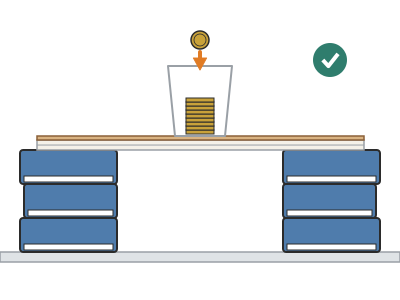
Lay a flat A4 sheet across the gap, with the long side (297 mm) running from stack to stack: about 73 mm rests on each side. Put a single coin in the middle and watch.
1 Lay the flat sheet with the long side from stack to stack 2 Put a coin in the middle: the sheet sags and it falls 3 Write «0 coins» in the table Check: The sheet sags and the coin slides into the gap: write «0 coins» in the table.Mark the folds
Take another A4 sheet in portrait. Lay the fold ruler (A) on the top edge, with its left end exactly at the corner, and mark each line of the «every 10 mm» row (10, 20... 200 mm). Do the same on the bottom edge: 20 marks on each edge.
1 Ruler A at the corner, against the top edge: mark every 10 mm 2 Repeat on the bottom edge, line by line 3 You have 20 marks at the top and 20 at the bottom, lined up Tip: Number the marks 1, 2, 3... at the top and bottom so you don't join one to the one next to it.Score the lines
Join each top mark to the bottom one using the ruler and score the line by pressing with an empty ballpoint pen. The 20 lines end up parallel to the 297 mm long side.
1 Join each top mark to the bottom one and score firmly 2 20 parallel lines: 10 mm at the top and 10 mm at the bottom Check: The lines must not converge: the gap between them is 10 mm at the top and at the bottom.Fold into an accordion
Fold along the first line towards you (valley), along the second away from you (mountain), and keep alternating to the end. Flatten each fold with your fingernail, then open the accordion a little until it is about 105 mm wide.
1 Fold towards you, then away, and keep alternating 2 Flatten each fold with your fingernail 3 Open it to 105 mm: an even zigzag about 9 mm high Check: Look at the accordion end-on: you should see an even zigzag about 9 mm high.Place the bridge
Lay the accordion across the gap, with the folds running from one stack to the other (never crosswise). Centre it: 73 mm of support on each side.
1 Folds from one stack to the other 2 Not like this: with the folds crosswise it won't hold 3 Centre it: 73 mm of support on each side Load it with coins
Put the empty plastic cup in the middle of the bridge. Drop the coins in one at a time, slowly, counting out loud, until the bridge sags or spreads open. Write down how many it held.
1 Put the empty cup in the middle of the bridge 2 Drop the coins in one at a time and count them 3 Write down how many it held: it usually fails by spreading Check: Without a deck, the accordion usually holds 100–300 g and fails by spreading out sideways.Tip: If you don't have enough coins, pour in water with a measuring jug: each ml is 1 g.Hold the ends
Fold the accordion back up to 105 mm wide. Stick a 12 cm piece of tape across the folds on top and another underneath, 3 cm from each end (in the part that rests on the stack). That way they can't open out.
1 Squeeze the accordion back to 105 mm 2 Stick tape across the folds 3 cm from each end 3 One tape on top and one underneath: it no longer opens Add the deck
Place deck C (110 × 297 mm) on top of the accordion, well centred. Put the cup back in the middle and load coins until it fails. Write down the result.
1 Place deck C (110 × 297 mm) on top, centred 2 Load coins again: now it holds much more Check: Now it should hold a lot more: 400 g–1 kg depending on the paper.Test with books adult
Remove the cup and lay a paperback (300–500 g, already weighed) flat and centred on the deck. If it holds, add the next heavier one. Keep your hands close to catch it if it falls.
1 Lower a book flat and centred onto the deck 2 Keep your hands close: the bridge doesn't touch the table Check: The bridge should hold at least one paperback without touching the table underneath.Compare fold widths
Make two more accordions with the same ruler: one with 5 mm folds and one with 20 mm folds. Test them the same way (ends taped and deck on top) and write down the maximum load for each one.
1 Use the 5 mm row and the 20 mm row of ruler A 2 Fold two more accordions: 5 mm and 20 mm 3 Test them the same way, with tape and deck, and note the grams Make the chart
Draw a bar chart: on the horizontal axis each bridge (flat, 5 mm, 10 mm, 20 mm, 10 mm with deck) and on the vertical axis the grams it held, 1 square = 50 g.
1 Draw the axes: 1 square is worth 50 g 2 One bar per bridge: flat, 5, 10, 20 and 10 with deck
Does it work? The test
150 mm gap between stacks, cup in the middle, identical coins one at a time until failure. At the end, weigh cup + coins on the scales.
What should happen: Flat sheet: 0 coins (it sags under its own weight). Loose 10 mm accordion: ≈ 100–300 g. With the ends held and a deck: ≈ 400 g–1 kg (holds a paperback). Glued as a «sandwich» between two sheets: more than 1 kg.
If something goes wrong
- The accordion opens out and goes flat with little load — The folds can spread apart sideways. Solution: Stick tape across both ends (top and bottom) and put the deck on top.
- It folds in half like a fan — The folds run across the bridge. Solution: The folds must run from stack to stack, parallel to the 297 mm side. Turn the sheet round.
- It crumples just under the cup — All the load is on 2–3 folds (local crushing). Solution: Use the deck to spread the load or put the cup on an 8 × 8 cm piece of card.
- The bridge slips off one stack — Too little support or stacks of different heights. Solution: Check the 73 mm of support on each side and level the stacks with a notebook.
- Very different results when repeating — Uneven folds or load dropped in all at once. Solution: Mark with the ruler, add the coins slowly and repeat each test 3 times, taking the average.
- The accordion twists into a spiral — Lines not parallel. Solution: Mark both edges and join them with a ruler; don't fold «by eye».
Safety
- Heavy books can fall when the bridge collapses: work on the table, away from the edge, and never with hands or feet underneath.
- Coins are small parts: keep them out of reach of children under 3.
- When scoring lines with scissors, use round-tipped scissors and rest the sheet on an old magazine.
The science behind it
For children
A flat sheet is so thin that it bends with almost nothing, like a leaf on a tree. When we fold it into a zigzag, each fold is like a little wall standing on its edge, and walls on edge are very hard to bend: try bending a ruler flat and then on its edge. The problem is that the zigzag wants to open out like a fan; that's why we put tape on the ends and a lid on top, so all the folds work together. The cardboard in boxes has exactly that inside: a zigzag between two flat sheets.
For the adult
A beam's resistance to bending depends on the second moment of area of its cross-section, which grows with the cube of the depth. A 210 × 0.1 mm sheet has I = b·t³/12 ≈ 0.02 mm⁴; folded into a 10 mm accordion at about 60° (depth ≈ 9 mm, width ≈ 105 mm), each inclined face contributes ≈ t·L·(L·sin θ)²/12 ≈ 6 mm⁴ and the 21 faces add up to ≈ 130 mm⁴: about 7000 times more stiffness with the same paper. For a point load P at the centre of a 150 mm span, the maximum moment is P·L/4; the stress in the paper is M·c/I, and with c ≈ 4.5 mm the paper would in theory hold more than 1 kg. In practice it fails sooner through instability: the section opens out (the folds rotate and the depth drops) or the thin faces buckle under the load (local buckling). Tape on the ends and a deck on top stop it opening and spread the load; gluing one sheet on top and another underneath turns the accordion into a sandwich panel, just like corrugated cardboard (two «liners» working in tension and compression and a flute that keeps them apart). Wider folds give more depth (more stiffness) but more slender faces that buckle sooner: that's why there is an optimum size. The span matters a lot: doubling it doubles the moment for the same load and multiplies the deflection by 8.
- stiffness: how much something resists bending.
- depth: the height of a beam seen from the side; the deeper it is, the stiffer.
- span: the clear distance between a bridge's two supports.
- rib: a fold or reinforcement that gives strength to a thin sheet.
- buckling: when a thin piece suddenly bends as you press on it.
By age
- 5–7 years: The adult marks the lines and the child folds along them; the child counts the coins and compares «flat sheet» and «accordion». Two tests are enough.
- 8–10 years: They mark and fold on their own, make the three fold widths and the results table. Let them work out for themselves why the accordion opens out and how to stop it.
- 11–12 years: They draw the bar chart, test the span (100/150/200 mm) and work out the grams held per gram of paper (an 80 gsm A4 sheet weighs 5 g). Challenge: the most efficient bridge with 2 sheets.
In a group or in class
Pairs, 4–5 A4 sheets and 40 coins or a cup with water per pair; the stacks can be two identical shoeboxes per pair. 45 min session: 5 min demonstrating the flat sheet, 25 min folding and testing, 15 min sharing with a big chart on the board showing every pair's results. Prepare the photocopied fold ruler and the table beforehand.
Challenges
- Build a bridge with a 25 cm span using only 2 A4 sheets and 20 cm of tape that holds a 500 g book.
- Design the bridge that holds the most grams per gram of paper used.
- Make an arch bridge: curve the accordion and brace it against two stops. Does it hold more than the straight one?
- Build an «I» or «U» beam out of card and compare it with the accordion.