Vinegar and bicarbonate of soda rocket
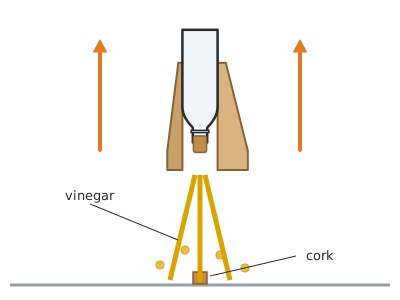
A 500 ml fizzy drink bottle with three cardboard fin-legs and a cork. Inside, vinegar and a parcel of bicarbonate of soda that only starts reacting when you turn the bottle over: the CO2 gas builds up pressure until the cork pops and the rocket shoots 2–6 m into the air.
What they will learn
- That mixing an acid (vinegar) and a base (bicarbonate of soda) produces a new gas: carbon dioxide.
- That a trapped gas pushes on all the walls and that the pressure rises the more gas is produced in the same space.
- Newton's third law: the vinegar shoots downwards and the bottle upwards.
- That the fins steady the flight and also act as legs so it takes off straight.
- To control variables: change only one thing (vinegar, bicarbonate, fins) and measure the result.
Prepare beforehand
- Print the templates at 100 % and check the red 50 mm line in the header with a ruler.
- Find an open outdoor space with firm, level ground (playground, field, park with no one nearby) and no strong wind. You are going to get the ground wet with vinegar.
- Cut the cork to 30 mm and check how it fits in the bottle before the session.
- Prepare 4 parcels of bicarbonate of soda (with their thread) in advance in a dry plastic tub: that way each launch takes 1 minute.
- Bring a bucket of water, kitchen roll, an old towel and safety glasses for everyone.
Materials and tools
- Fizzy drink bottle — 1
500 ml PET, cylindrical (Ø ≈ 64 mm, ≈ 205 mm tall), no dents, label removed - Natural wine cork — 1 (better 2, one spare)
Ø 24 mm, natural or agglomerated cork (synthetic plastic ones grip too tightly) - Wine or spirit vinegar — 150 ml per launch (≈ 600 ml for 4 launches)
5–6 % acidity (it says on the label) - Bicarbonate of soda — 1 level tablespoon (≈ 12 g) per launch
cooking bicarbonate of soda; not baking powder - Kitchen roll — 1 square of 10 × 10 cm per launch
single ply (separate it if it is two-ply) - Sewing thread — 40 cm per launch
thin cotton or polyester (not wool: it lets the gas escape) - Corrugated cardboard — 1 piece 25 × 22 cm
single-wall, 3 mm, flat - Packing tape — ≈ 60 cm
clear or brown, 48 mm wide - Glue sticks — 1
for a hot glue gun
Tools
- Measuring jug and funnel — measure and pour the 150 ml of vinegar
- Tablespoon — measure the bicarbonate of soda (level)
- Serrated knife — cut the cork to 30 mm adult
- Craft knife, metal ruler and cutting mat — cut the fins adult
- Hot glue gun — glue the fin tabs to the bottle adult
- Permanent marker — mark the fin positions on the bottle
- Safety glasses — a pair for everyone near the launch
- Tape measure — mark the 5 m safety distance and measure the launches
Pieces and templates
- A · Fin-leg ×3 — 3 mm corrugated cardboard
- B · 120° marking disc ×1 — paper
- C · Bicarbonate of soda parcel ×1 — single-ply kitchen roll
- D · Trimmed cork ×1 — natural cork Ø 24 mm
Step by step
Prepare the bottle
Wash the 500 ml bottle, remove the label and dry the outside. Squeeze the bottle with your hand: if it has cracks or deep dents, swap it for another one.
1 Remove the label, wash the 500 ml bottle and dry the outside 2 Squeeze it: if it has cracks or deep dents, use another one Cut and fit the cork adult
Cut the cork to 30 mm long with a serrated knife. Push it into the mouth of the bottle, twisting, until 12 mm has gone in (mark that depth on the cork with a felt-tip pen).
1 Cut the cork to 30 mm long with a serrated knife 2 Twist it in until 12 mm has gone in and mark that depth 3 Squeeze the empty bottle: the cork stays in, but twists out Check: With the cork in, squeeze the empty bottle with both hands: the cork must not pop out. Afterwards you should be able to pull it out by twisting it by hand. If it comes out on its own, push it in 3 mm further; if it is very hard to remove, sand the cork.Mark the fin positions
Cut out disc B. Stand the bottle on it, centred on the circle of its size, and make a mark on the base of the bottle over each of the 3 lines. Extend each mark in a straight line along the whole body, resting the marker on a book.
1 Stand the bottle centred on the circle of its size 2 Mark the bottom of the bottle where the 3 lines fall 3 Lay it down and extend each mark with the marker resting on a book Check: The 3 lines should be the same distance apart (≈ 67 mm, measured with a strip of paper round the bottle).Cut the three fins adult
Stick template A onto the cardboard with the flutes running lengthways and cut 3 identical fins with a craft knife and ruler. Score the fold of the 10 mm tab with an empty ballpoint pen and bend it to 90°.
1 Stick template A with the cardboard flutes running lengthways 2 Cut 3 identical fins with a craft knife and metal ruler 3 Score the 10 mm fold, bend it to 90° and check they match Check: Stack the 3 fins on top of each other: they must match. If one is longer, the rocket will lean.Glue on the fins adult
Turn the bottle upside down. Place each fin on its line with the «BOTTLE MOUTH» mark exactly level with the rim of the mouth, and glue the tab with a bead of hot glue. Hold for 20 seconds until it cools.
1 Upside down: the fin's MOUTH line level with the bottle mouth 2 Glue the tab with a bead of hot glue and hold for 20 seconds 3 Repeat with the other two: three identical fins at 120° Tip: If your bottle has a longer shoulder, the tab may overlap the start of the curve: that is fine, what matters is the mouth line.Reinforce with tape
Wrap 2 turns of packing tape round the bottle over the 3 tabs, one at the top and one at the bottom of the tabs. Press the tape against the cardboard with your fingernail.
1 Wrap 2 turns of tape at the top and bottom of the tabs 2 Press the tape with your nail and pull each fin: it does not move Check: Gently pull each fin: it must not move or come unstuck.Test the rocket standing still
Fit the cork and stand the rocket upside down on its 3 legs on a table. It must stand straight, without wobbling, and the tip of the cork must be at least 20 mm off the table.
1 Stand it on its 3 legs: the cork is more than 20 mm off the table 2 Look at it from two sides: it has to be vertical 3 If it wobbles, trim 1–2 mm off the longest leg Check: Look at the rocket from two sides: it has to be vertical. If it wobbles, trim 1–2 mm off the longest leg.Make the bicarbonate parcel
Cut a 10 × 10 cm square of kitchen roll (single ply). Put 1 level tablespoon of bicarbonate of soda (≈ 12 g) in a line 2 cm from the edge and roll it up like a cigar about 15 mm thick. Twist both ends.
1 Put 1 level tablespoon of bicarbonate in a line 2 cm from the edge 2 Roll it up like a cigar about 15 mm thick 3 Twist the ends: it should fit through the mouth without squeezing Check: Push the parcel into the mouth of an empty bottle: it should go in without squeezing. If it does not fit, roll it thinner.Tie on the thread
Tie 40 cm of sewing thread to one of the twisted ends of the parcel with two knots. Prepare all the parcels you are going to use this way and keep them in a dry plastic tub.
1 Tie 40 cm of sewing thread to one end with two knots 2 Prepare all the parcels and keep them in a dry plastic tub Set up the launch area adult
Go outside. Choose a spot with firm, level ground and mark a safety line 5 m away with chalk or a piece of string. Everyone puts on safety glasses and stays behind the line, except the adult doing the launch.
1 Mark the rocket spot and a chalk line 5 m away 2 Everyone in glasses and behind the line, except the launching adult Pour in the vinegar
With the bottle upright (mouth up), pour in 150 ml of vinegar measured with the jug and funnel. It comes up to about 5 cm: roughly a quarter of the bottle's height (and a third of its volume).
1 Measure 150 ml of vinegar in the jug 2 With the bottle upright, pour it in through the funnel 3 It comes up to about 5 cm: a quarter of the bottle's height Hang the parcel and cork it adult
Lower the parcel into the bottle holding it by the thread, so that its top end hangs about 3 cm below the mouth WITHOUT touching the vinegar: as the parcel is about 8 cm long, its tip ends up about 4 cm above the liquid. Put the cork on top, clamping the thread against the neck, and twist it in up to the 12 mm mark. Leave 5 cm of thread hanging outside, not stuck down.
1 Lower the parcel on its thread, 3 cm below the mouth 2 Fit the cork clamping the thread and twist it to the 12 mm mark 3 Check through the side: the parcel hangs dry above the vinegar Check: Look through the side: the parcel hangs dry above the vinegar. If it has touched it and is already fizzing, set the rocket in place straight away and move away.Turn, place and step back adult
Turn the bottle upside down in one quick move and stand it on its 3 legs on the marked spot, with the fins on the ground. The vinegar falls onto the parcel and starts to fizz. Walk (do not run) to the 5 m line.
1 Turn the bottle upside down in one quick move 2 Stand it on its 3 legs: the vinegar soaks the parcel 3 Walk, without running, to the 5 m line Tip: Do not shake the bottle or lean over it once it has been turned over.Lift-off
Count out loud: between 10 and 40 seconds later, the cork pops, the vinegar shoots downwards and the rocket rises several metres. Wait until it has landed and stopped moving before going to get it.
1 Count out loud from the line: it takes 10 to 40 seconds 2 The cork pops, the vinegar shoots down and the rocket goes up 3 Wait until it lands and stops moving before going to get it If it does not launch within 2 minutes adult
Wait 2 more minutes from behind the line. Then the adult, wearing safety glasses, approaches from one side (never in line with the mouth), covers the rocket with an old towel, lays it down pointing away from everyone and twists the cork out slowly to release the gas.
1 Wait 2 more minutes from behind the line 2 Approach from one side in glasses and cover it with an old towel 3 Lay it down pointing away and twist the cork out slowly Reload and clean up
Rinse the bottle with water, take out the used paper and check that the fins are still firm. Start again from the «Pour in the vinegar» step with a new parcel. When you have finished, rinse the ground with a bucket of water.
1 Rinse the bottle with water and take out the used paper 2 Check the fins are still firm and load it again 3 When you have finished, rinse the ground with a bucket of water
Does it work? The test
Launch in an open space with 150 ml of vinegar and 12 g of bicarbonate of soda, with everyone behind the 5 m line. Count the seconds until lift-off and mark where the rocket lands.
What should happen: The cork pops after 10–40 s. The rocket rises between 2 and 6 m (roughly the height of a first or second floor) with a jet of vinegar foam underneath, and lands a few metres from the launch spot.
If something goes wrong
- The cork pops but the rocket barely lifts — The cork is loose and pops at low pressure. Solution: Push the cork in 3–4 mm further or use a slightly fatter cork. Check that it withstands a hard squeeze with the bottle empty.
- 2 minutes go by and it does not launch — Cork too tight, gas escaping along the thread or the parcel has not got wet. Solution: Follow the misfire procedure (towel, from one side, pointing away). Afterwards, sand the cork a little, use thinner thread or check that the parcel ends up in the vinegar when the bottle is turned over.
- It starts fizzing before the bottle is turned over — The parcel hangs too low and touches the vinegar. Solution: Shorten the length of thread inside the bottle: the top end of the parcel should be about 3 cm from the mouth, and its tip several centimetres above the vinegar.
- The rocket goes off crooked or falls on its side — Fins of different lengths or not spaced at 120°. Solution: Even out the legs by trimming the longest one and check the spacing with disc B.
- The parcel does not fit through the mouth — It has been made into a ball. Solution: Roll it up like a cigar 15 mm thick; the mouth is ≈ 21 mm across on the inside.
- A fin comes off on landing — Hot glue does not grip well on smooth plastic. Solution: Rub that area of the bottle with fine sandpaper before gluing and add one more turn of packing tape.
Safety
- Outdoors only, with safety glasses and everyone 5 m away. Nobody ever stands over or under the mouth of the bottle.
- Always use a PET fizzy drink bottle and a cork. Never glass bottles or screw caps: a bottle closed with a screw cap can burst.
- If it does not launch, do not go near it for 2 minutes and never approach in front of the mouth: cover it with a towel, point it away and take the cork out slowly.
- Vinegar stings the eyes: if it splashes, rinse with plenty of water for 5 minutes.
- Knife, craft knife and hot glue: adult only.
- The leftovers (sodium acetate dissolved in water) are not dangerous: you can pour them down the sink or rinse the ground with water.
The science behind it
For children
Vinegar is an acid and bicarbonate of soda is a base: when they touch, they fight and make loads of bubbles of a gas called carbon dioxide, the same gas that is in fizzy drinks. There is no room for them inside the closed bottle, so they push on the walls and the cork harder and harder, like when you blow up a balloon. In the end the cork cannot hold on and flies out downwards together with the vinegar. And since anything that pushes one way pushes you the other way, the bottle shoots upwards.
For the adult
Reaction: NaHCO3 + CH3COOH → CH3COONa + H2O + CO2. 12 g of bicarbonate of soda (M = 84 g/mol) is 0.14 mol; 150 ml of 6 % vinegar contains ≈ 9 g of acetic acid (M = 60 g/mol) = 0.15 mol, so they react almost stoichiometrically and release ≈ 0.14 mol of CO2, about 3.4 L at 25 °C and 1 atm. Some of it dissolves, but a fraction of it in the ≈ 350 ml of free space is enough to raise the pressure by 1–3 bar, which is when a natural cork pushed 12 mm into a Ø 21 mm neck (area ≈ 3.5 cm²) overcomes its friction (≈ 40–100 N). If the cork did not pop, the pressure could exceed 8 bar, close to the limit of a PET bottle: that is why the cork fit and the misfire procedure matter. When it pops, the pressurised gas drives the liquid out of the mouth at several m/s; by conservation of momentum (Newton's third law) the bottle (≈ 40 g with fins) receives an equal and opposite impulse. It is the expelled mass (vinegar) that provides the thrust: without liquid, the gas would just give a «pop». The fins move the aerodynamic centre of pressure behind the centre of mass and stabilise the flight; here they also form a tripod that holds the bottle upright and leaves room for the cork to come out. Hanging the parcel from the thread turns the reaction into something you can start at will: it is a safe «detonator».
- acid: a sour-tasting substance, like vinegar or lemon, that reacts with bases.
- base: the opposite of an acid, like bicarbonate of soda; together they neutralise each other.
- carbon dioxide (CO2): an invisible gas formed in the reaction; it is the gas in the bubbles of fizzy drinks.
- pressure: the force with which a gas pushes on every little bit of the wall that encloses it.
- action and reaction: if you push something one way, it pushes you the opposite way.
By age
- 5–7 years: Only watching and safe tasks: measuring the vinegar with the jug, filling the spoon with bicarbonate of soda, rolling the parcel and doing the countdown from the 5 m line. The adult does all the hot-glue assembly, corks, turns over and places the rocket.
- 8–10 years: They build the whole rocket (except cutting the cork and the hot glue) and make the parcels. The adult corks it and turns it over. Have them record the seconds until lift-off and the height in a table.
- 11–12 years: They design and test a single-variable experiment with 3 repeats, calculate the moles of gas and estimate the height with the inclinometer. They can launch it themselves under direct supervision.
In a group or in class
Teams of 4, one rocket per team (bottle and corks brought from home). Beforehand: cut corks, fins and 3 parcels per team. 60-minute session: 25 min building in class, 30 min in the playground with ONE single launch area and one adult launching in turns (everyone else behind a line 5 m away). Bring 2 L of vinegar, 200 g of bicarbonate of soda, old towels and a bucket of water.
Challenges
- Design a nose cone (a card cone) for the base of the bottle and check whether the rocket goes higher or straighter.
- Get the cork to pop at exactly 20 s by adjusting how you wrap the parcel (more or fewer layers of paper).
- Build a launcher tilted at 70° and compare the horizontal distance with the vertical launch.
- Work out how many litres of gas your quantities produce and compare them with the volume of the bottle.