One-sided strips
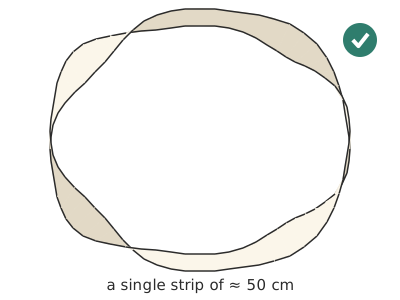
Using paper strips 3 cm wide, you make an ordinary ring and a Möbius strip (with a half twist). Tracing along it with a felt-tip pen shows that it has only one side, and when you cut it down the middle it doesn't come apart into two: you get a single ring twice as long.
What they will learn
- That a surface can have just one side and one edge, and how to check this with a felt-tip pen and a finger.
- To predict and then check: write down what they think will happen before each cut.
- That the number of half twists (0, 1, 2, 3) decides what the cut produces: two separate rings, one long ring, two linked rings or a knot.
- Topology vocabulary: side, edge, linked, knot.
Prepare beforehand
- Print the template at 100 % (not «fit to page»): each strip should measure 30 × 260 mm.
- For a group, print strip A and strip B on paper of 2 different colours so they don't get mixed up.
- Draw a table on the board with three columns: «type of strip», «what do I think will happen?» and «what happened?».
- Pre-cut 4 cm pieces of tape and stick them along the edge of the table so the children have them to hand.
Materials and tools
- Paper — 1–2 A4 sheets
80 gsm paper, preferably a light colour, or thin kraft paper - Clear sticky tape — ≈ 40 cm
19 mm wide; a 4 cm piece on each side of each join - Felt-tip pens — 2
two different colours, medium tip - Notebook or A4 sheet — 1
to write down predictions and results
Tools
- Round-tipped scissors — cut out the strips and cut the rings
- Ruler — check the 30 mm width and measure the rings
- Sewing tape measure — measure the circumference of each ring before and after cutting
Pieces and templates
- A · Strip A: ordinary ring (no twist) ×1 — 80 gsm paper
- B · Strip B: Möbius (half twist) ×2 — 80 gsm paper
- C · Strip C: full twist (two half twists) ×1 — 80 gsm paper
- D · Strip D: three half twists (challenge) ×1 — 80 gsm paper
Step by step
Cut out the strips
Cut out the 5 strips from the template (A, two B, C and D) along the solid line. Each one is 30 mm wide and 260 mm long; the first 10 mm are the gluing area.
1 Cut out the 5 strips from the template: A, two B, C and D 2 Check with the ruler: 30 × 260 mm and 10 mm for gluing Check: Measure one with the ruler: 30 × 260 mm.Make the ordinary ring
Take strip A. Bring its two ends together without twisting it, overlapping the end onto the 10 mm gluing area. Tape it with a 4 cm piece of tape on the outside and another on the inside, across the full width.
1 Bring the two ends of strip A together without twisting it 2 Overlap the end onto the gluing area and tape each side 3 You get a ring about 8 cm across with the line on the outside Check: It's a ring ≈ 8 cm across; the centre line is visible on the outside.Colour the ordinary ring
Rest the tip of the felt-tip pen on the outside and draw a continuous line along it, turning the ring, until you get back to where you started. Look inside: it's not coloured. It has two sides.
1 Rest the pen on the outside and turn the ring without lifting it 2 The inside is still blank: the ring has two sides Make the Möbius strip
Take a B strip. Bring the ends together as before, but give one of them a half twist (180°), so that the top side of one end is stuck to the underside of the other. Tape both sides.
1 Take a B strip and give one end a half twist 2 Bring the ends together with the twist and tape both sides 3 The strip has a twist: it can't be flattened like a ring Check: The strip has a «twist» and can't be flattened like a ring.Tip: Tip: the word GLUE on the gluing area should end up face down, covered by the other end.Predict before you colour
Before colouring, ask and write in the notebook: «If I draw a line along the middle of strip B without lifting the pen, will I colour just one side or both?».
1 Look at strip B before colouring: what do you think will happen? 2 Write down your prediction: one side or both? Colour the Möbius strip
Rest the pen on the centre line and move along without lifting it, turning the strip with your other hand. After one lap you won't be back at the start, but «on the other side». Keep going until you find the starting point: you'll have gone round twice.
1 Start on the centre line and move along without lifting the pen 2 After one lap you reach the start, but on the other side: keep going 3 After two laps the whole strip is coloured without crossing the edge Check: The whole strip, on «both sides», is coloured without crossing any edge: it has only one side.Trace the edge
Put your finger on the edge of strip B and slide it along without letting go. Then repeat with ring A. On A you follow one edge and the other stays untouched; on B you touch the whole edge: it has only one.
1 Slide your finger along the edge of B: you go round all of it 2 On A you only touch the top edge; the bottom one stays untouched Cut the ordinary ring down the middle
Pinch ring A on the centre line so it bends a little and make a small cut with the tip of the scissors. Slide the scissors in and cut along the line all the way round.
1 Pinch the ring on the line and make a small cut 2 Slide the scissors in and follow the line back to the start 3 You get two separate rings, 15 mm wide Check: You get two separate rings, 15 mm wide and the same circumference (≈ 25 cm).Cut the Möbius strip down the middle
Do the same with strip B along its centre line (the 15 mm one). Write down your prediction first. Follow the line without wandering off it for a whole lap until you reach the first cut.
1 Cut strip B along the centre line for a whole lap 2 You get a single strip, twice as long and half as wide Check: You get ONE single strip, 15 mm wide and ≈ 50 cm round (twice as long), with two full twists. It's no longer a Möbius strip: it has two sides.Cut it down the middle again
Cut the long strip you've got down the middle again (leave about 7.5 mm on each side). Write down first what you think will happen.
1 Cut down the centre of the long strip again 2 You get two identical linked strips: they can't be separated Check: You get two identical strips of ≈ 50 cm, linked together (they can't be separated without tearing them).Cut at one third
Take the second B strip and stick it with a half twist. Cut along the line 10 mm from the edge. You'll see that the cut doesn't meet its start after one lap: keep going and it goes round twice before closing.
1 Stick the second B with a half twist and cut 10 mm from the edge 2 The cut doesn't close after one lap: keep going for two 3 You get two linked strips: a short Möbius and a long one Check: You get two linked strips: a short one (≈ 25 cm, another Möbius strip, the central band) and a long one (≈ 50 cm, with two twists).Try the full twist and the knot
Stick strip C with a full twist (360°) and cut it down the middle: you get two ≈ 25 cm rings hooked together. Stick strip D with three half twists and cut it down the middle: you get a single long ring with a knot in it.
1 Stick strip C with a full twist and cut it down the middle 2 You get two rings hooked together 3 Strip D with three half twists gives a ring with a knot Tip: Before sticking D, count out loud: half, one, one and a half.
Does it work? The test
Make the prediction table with the 6 cuts (A down the middle, B down the middle, B twice, B a third of the way in, C down the middle and D down the middle) and check each one by measuring the perimeter with the tape measure.
What should happen: A → 2 separate 25 cm rings. B down the middle → 1 ring of 50 cm. B twice → 2 linked 50 cm rings. B at one third → 1 of 25 cm (Möbius) linked with 1 of 50 cm. C → 2 linked 25 cm rings. D → 1 knotted 50 cm ring.
If something goes wrong
- Cutting the Möbius strip gives two rings — It was stuck without a half twist or with a full twist. Solution: Before cutting, check that the pen goes over the whole strip on «both sides» without lifting it; if not, it isn't a Möbius strip.
- The join comes apart while cutting — Tape on one side only or too small a piece. Solution: Before cutting, tape it with 4 cm of tape on the outside and inside, across the full width.
- The cut runs off the edge — Large scissors or a crumpled strip. Solution: Use small scissors, cut slowly holding the strip close to the scissors and follow the printed line.
- When cutting at one third, it gets back to the start after one lap — You've drifted onto the centre line. Solution: Always stay 10 mm from the edge; the cut goes round twice before closing.
- You can't tell whether the strips are linked — They are tangled and squashed. Solution: Hold one strip and let the other hang: if it doesn't fall to the floor, they are linked.
Safety
- Round-tipped scissors for children under 8; an adult should help to pierce the strip and start the cut.
- Paper cuts hurt: don't run your finger quickly along the edge of the strip.
- Pick up the scraps of sticky tape: small children put them in their mouths.
The science behind it
For children
Imagine an ant walking along the ordinary ring: if it's on the outside, it can never reach the inside without jumping over the edge. On the strip with a half twist, the ant walks and walks... and turns up on the other side without jumping over anything! That's because the Möbius strip has only one side, even though it looks like it has two. That's why, when you cut it down the middle, the scissors never split it into two pieces: they always carry on along the same path and you get a longer ring.
For the adult
The Möbius strip (Möbius and Listing, 1858) is a non-orientable surface with a single side and a single edge (its edge is one closed curve, twice the length of the strip). Topology studies the properties that don't change when you deform something without tearing or gluing: number of sides, edges, links and knots. Cutting along the centre line of a band with n half twists: if n is even (0, 2, 4...), the centre line is a closed curve that separates the band into two bands, each with n half twists and linked n/2 times (for n = 0, separate). If n is odd, the cut doesn't separate it: you are left with a single band of double length with 2n + 2 half twists (for n = 1, four half twists, i.e. two full twists, and orientable); for n = 3 the resulting band is tied in a trefoil knot. Cutting the Möbius strip at one third of its width: the cut goes round twice and separates the central band (a Möbius strip of the original length) from the outer one (a band of double length with two twists), linked together. Real-world application: conveyor belts and printer ribbons with a half twist spread the wear over the whole surface.
- side: each face of a surface that can be coloured without crossing an edge.
- edge: the line where the surface ends.
- topology: the part of mathematics that studies shapes that don't change when you stretch or twist them without tearing them.
- linked: two rings hooked together like the links of a chain.
- half twist: a 180° turn: what was on top ends up underneath.
By age
- 5–7 years: The adult tapes the joins (with the half twist) and starts each cut; the child colours with the felt-tip pen, traces the edge with a finger and finishes the cut. A and B are enough: the surprise that «it doesn't split in two».
- 8–10 years: They make all the strips and the prediction table. Have them try to explain in their own words why the pen colours «both sides».
- 11–12 years: Have them find the general rule (even/odd number of half twists) using the table, measure the circumferences and try the trefoil knot (strip D) and the magic square. Challenge: predict what happens with 4 half twists before trying it.
In a group or in class
Individually or in pairs, each child with their sheet of 5 strips and a felt-tip pen. Beforehand: print one template per child (plus 5 spares) and pre-cut pieces of tape. 45 min session: 5 min introduction with an ordinary ring, 10 min colouring A and B, 15 min cutting with the prediction table on the board (show of hands before each cut), 15 min experiments C and D and group discussion.
Challenges
- Make a giant Möbius strip from strips of newspaper stuck together (2 m) and trace it with your finger with your eyes closed: can you feel when you «change sides»?
- Using two rings stuck in a cross and two cuts, make a square frame; then repeat it with one of the rings given a half twist and describe the shape you get.
- Predict and check what you get when you cut a band with 4 half twists down the middle.
- Draw your own version of Escher's ants on a 5 cm wide Möbius strip.