Ghost that levitates with static electricity
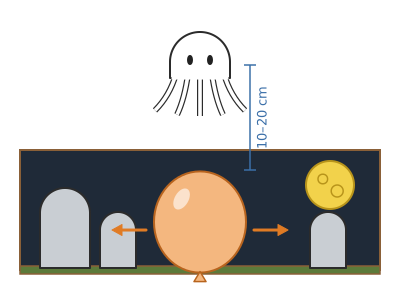
A 9 × 17 cm ghost cut from a very thin plastic bag floats in the air, 10–30 cm above a balloon rubbed with wool, and flies over a cardboard graveyard with tombstones and a moon. A homemade aluminium electroscope shows that the ghost and the balloon have the same charge, and that is why they repel each other.
What they will learn
- That when you rub two materials together some electrons move from one to the other: one ends up with a negative charge (−) and the other with a positive charge (+).
- That like charges repel (the ghost floats above the balloon) and unlike charges attract (the ghost sticks to your hand or the wall).
- That an uncharged object is also attracted by a charged one, because its charges rearrange themselves (induction).
- That moisture in the air discharges objects: static electricity works much better when the air is dry.
- How to use a detector (electroscope) to find out whether something is charged and whether its charge is the same as or different from another.
Prepare beforehand
- Print the templates at 100 % (without «fit to page») and check with a ruler that the red line in the header measures 50 mm.
- Choose a dry day and a dry room: away from the bathroom, and from the kitchen while cooking, with no humidifier. With the heating on it usually works very well. If you have a hygrometer, aim for less than 50 % humidity.
- Test the bag before the session: cut a 3 × 15 cm strip, rub it on the table with the wool and lift it up: if it sticks to your hand or «chases» your fingers, it will do.
- Blow up the balloon to Ø 25–30 cm and tie it (an adult); have a spare one ready.
- If the children are young, cut the base, the backdrop, the ring and the lid from corrugated cardboard with a craft knife beforehand.
- Wash and dry your hands well: damp hands discharge the ghost when you touch it.
Materials and tools
- Very thin plastic bag — 1 (a 20 × 25 cm piece is enough)
8–15 µm polythene, the kind that rustles like tissue paper: one of the thinnest small bin bags (white, 10 L), a dry-cleaning bag or a fruit bag if it is not compostable - Latex balloon — 1 (better 2, in case one pops)
round, blown up to Ø 25–30 cm; plain, without metallic prints - Woollen cloth — 1
a dry wool sock, scarf or jumper - Corrugated cardboard — 2 sheets of 30 × 20 cm
single-wall, 3–4 mm (delivery box), flat - Thin card — 1 opened-out cereal box
for the tombstones and brackets; grey side outwards for painting - Yellow card — 1 square of 8 × 8 cm
160–250 gsm, for the moon - Black permanent marker — 1
fine or medium tip; writes on plastic - Large metal paperclip — 1
bare wire (no coloured plastic coating), 32–50 mm - Kitchen aluminium foil — 1 piece of 15 × 15 cm
the ordinary, thin kind (11–16 µm); not heavy-duty - Rigid clear plastic cup — 1
9–12 cm tall with a Ø 7–9 cm mouth, clean and very dry - PVA glue or glue stick — 1
PVA glue for cardboard on cardboard; glue stick for sticking on templates - Sticky tape — 1 roll
clear, to reinforce joints and fix the balloon ring - Bulldog clips or paperclips — 4
to hold the bag between two sheets while you cut - Poster paints or felt-tip pens — as you like
dark blue or black for the sky, grey for the tombstones
Tools
- Scissors — cutting out the templates, the ghost, the tombstones and the foil
- Craft knife, metal ruler and cutting mat — cutting the corrugated cardboard for the base, the backdrop and the discs adult
- Pencil and ruler — marking the positioning lines
- Empty ballpoint pen — scoring the folds of the tombstones and the brackets
- Awl or wooden skewer — making a hole in the centre of the electroscope lid adult
- Small pliers (optional) — straightening the paperclip and bending the hook
Pieces and templates
- A · Graveyard base ×1 — corrugated cardboard 3 mm
- B · Backdrop (sky) ×1 — corrugated cardboard 3 mm
- C · Moon ×1 — yellow card 200 gsm
- D · Large tombstone ×1 — thin card (cereal box)
- E · Small tombstone ×2 — thin card (cereal box)
- F · Backdrop bracket ×2 — thin card (cereal box)
- G · Ghost ×1 — very thin plastic bag (8–15 µm)
- H · Balloon ring ×1 — corrugated cardboard 3 mm
- I · Electroscope lid ×1 — corrugated cardboard 3 mm
- J · Electroscope leaves ×1 — kitchen aluminium foil
Step by step
Test the bag and the air
Cut a 3 × 15 cm strip of bag. Lay it flat on the table, rub it 10 times with the woollen cloth and lift it by one end. Bring your other hand to within 5 cm: the strip should move towards your fingers.
1 Rub a 3 × 15 cm strip of bag 10 times with the wool 2 Bring your other hand close: the strip moves towards your fingers Check: If the strip doesn't move, the bag is too thick or the air is damp: try another bag or change rooms before carrying on.Tip: Bags that rustle like tissue paper (high-density polythene) are the best.Trace the ghost
Cut a 20 × 25 cm piece of bag. Make a sandwich: template G on top, the bag in the middle and a sheet of paper underneath. Hold the four corners with clips so the bag doesn't move.
1 Template on top, the bag in the middle and a sheet of paper below 2 Hold the four corners with clips so nothing moves Tip: If the bag is two layers (open at the top), use only one: cut along the sides and separate them.Cut out the ghost
Cut through all three layers at once along the line of template G, slowly, with the tip of the scissors. Cut each tentacle all the way up (7 strips of 10 mm, 60–72 mm long). Remove the clips and separate the ghost from the papers.
1 Cut through all three layers at once along the line 2 Cut each tentacle up to the body: 7 strips of 10 mm 3 The 7 tentacles are separate up to the body Check: The 7 tentacles must be separate from each other up to the bottom of the body: if they are joined at the top, they won't spread out when you charge it.Draw the face
Place the ghost on template G and trace the two eyes (8 × 12 mm) and the mouth with a permanent marker. Use little ink and don't press hard: the ink weighs very little, but crumpled plastic floats less well. Leave to dry for 1 minute.
1 Trace the eyes and the mouth with a permanent marker 2 Use little ink and don't press hard; leave to dry for 1 minute Tip: Make one or two more ghosts while you have the bag to hand: that way there is one for each child.Cut the base and the backdrop adult
Stick templates A (250 × 130 mm) and B (250 × 160 mm) onto corrugated cardboard with a glue stick and cut them out with a craft knife and metal ruler. Also cut ring H (Ø 80 mm with a Ø 50 mm hole) and lid I (Ø 100 mm).
1 An adult cuts A, B, H and I with a craft knife and metal ruler 2 Base A, backdrop B, ring H and lid I ready Check: Backdrop B must be straight: stand it on its edge on the table and it shouldn't wobble.Paint the sky and stick on the moon
Paint backdrop B dark blue or black. Cut moon C out of yellow card (Ø 70 mm), draw its craters and stick it with a glue stick inside the circle marked in the top right corner of B.
1 Paint backdrop B dark blue or black 2 Stick moon C inside the marked circle 3 Night sky with a full moon Tip: Paint base A dark green or brown: it will look like the graveyard grass.Stand up the backdrop
Cut out the two brackets F from thin card and score their two folds. Stand backdrop B on the line on base A that is 40 mm from the back edge, stick a strip of tape along the join at the back and glue the two brackets F behind it, on their lines (30 mm from each side).
1 Score the two folds of each bracket F and fold them 2 Backdrop B standing 40 mm from the back edge and brackets F behind 3 Push gently from the front: the backdrop doesn't bend Check: Push the backdrop gently from the front: it shouldn't bend backwards.Put up the tombstones
Cut out the large tombstone D and the two small ones E from thin card. Fold the tab of each one back along the fold line (15 and 12 mm). Put glue on the tabs and stick them on the lines on base A, with the tombstones standing up.
1 Cut out tombstone D and the two E and fold their tabs back 2 Put glue on the tab and stick it on its line on the base 3 All three tombstones stand up on their own Check: All three tombstones should stand up on their own, slightly away from the backdrop.Get the balloon and its ring ready adult
Stick ring H onto base A over the circle marked on the right, with two pieces of tape. Blow up the balloon to Ø 25–30 cm (an adult), tie it and rest it on the ring so it doesn't roll away.
1 Stick ring H on its circle on the base with two pieces of tape 2 Blow up the balloon to Ø 25–30 cm and rest it on the ring Tip: Don't blow it up fully: a very tight balloon pops more easily when you rub it.Charge the balloon
Rub the top half of the balloon with the woollen cloth (or against your dry hair) 20 times, always in the same direction and pressing a little. From now on, hold the balloon only by the knot.
1 Rub the top half of the balloon 20 times with the wool 2 Hold the balloon by the knot: the bits of paper jump towards it Check: Bring it to within 3 cm of your hair or some small bits of paper: your hair stands up and the bits of paper jump onto the balloon.Charge the ghost
Lay the ghost flat on the table (wood or plastic, clean and dry). Hold it by the head with one finger and rub it 15 times with the woollen cloth, from the head to the tips of the tentacles.
1 Hold the head and rub 15 times from the head to the tips 2 The ghost is charged from end to end Tip: Rub the whole ghost, tentacles included: each charged strip pushes the others away, so it opens out like a jellyfish.Lift off and release the ghost
Lift the ghost by the top of its head with two fingers: the tentacles spread apart on their own. Hold the charged balloon about 20 cm below it and let go of the ghost (or give it a little flick upwards) so it falls towards the balloon.
1 Lift it by the head: the tentacles fan out 2 Hold the balloon 20 cm below and let go of the ghost Check: The tentacles should fan out when you lift it: that is the sign it is well charged.Tip: If it sticks to your fingers when you let go, shake it off with a flick: your hand attracts it because it has no charge.Make it levitate over the graveyard
Keep the balloon below the ghost, 10–20 cm away, and follow it gently when it drifts to one side. Float the ghost over the tombstones and the moon without it touching anything.
1 Follow the ghost with the balloon, always just underneath 2 Not like this: near the wall the ghost sticks to it 3 Make it float for at least 5 seconds without touching anything Check: The ghost should stay floating for at least 5 seconds without touching the balloon.Tip: Keep the ghost away from the wall, the lamp and your body: they all attract it. If it falls, charge the balloon and the ghost again.Build the electroscope adult
Straighten the paperclip and bend a 10 mm hook at the bottom end. Make a hole in the centre of lid I and push the paperclip through so that 30 mm sticks out above and the hook is 40 mm below. Make a Ø 20 mm aluminium ball on the top end. Fold strip J (12 × 70 mm) in half, hang it from the hook and put the lid on the cup.
1 Straighten the paperclip and bend a 10 mm hook 2 An adult makes a hole in the centre of lid I with the awl 3 Ball on top, leaves hanging from the hook and lid on the cup Check: The two aluminium leaves should hang together, without touching the sides of the cup.Detect the charges
Bring the charged balloon to within 5 cm of the ball, without touching it: the leaves spread apart. Move it away: they come together. Touch the ball with the balloon, rolling it, and take it away: the leaves stay open. Now bring the charged ghost close: if the leaves open further, it has the same charge as the balloon.
1 Bring the balloon close without touching: the leaves spread apart 2 Touch the ball with the balloon, rolling it, and take it away 3 Bring the ghost close: if they open more, it has the same charge Check: The leaves open at least 1 cm at the bottom when you bring the balloon close.Tip: To discharge the electroscope, touch the ball with your finger: the leaves drop at once.
Does it work? The test
In a dry room, charge the balloon and the ghost (steps 10 and 11), release the ghost over the balloon and count how many seconds it stays floating without touching anything. Repeat 3 times and measure with a ruler how high above the balloon it stays.
What should happen: Estimate with dry air (humidity below 50 %): the ghost floats 10–30 cm above the balloon for 5–20 s per launch, with its tentacles fanned out. After 3–5 launches it loses charge and you need to rub again. With damp air (over 65 %) it may only last 1–2 s or not float at all.
If something goes wrong
- The ghost falls onto the balloon and stays stuck — The ghost had no charge (or very little): the balloon attracts it by induction, like a piece of paper. Solution: Wait 1–2 seconds: when it touches the balloon it usually picks up its charge and jumps off. If not, rub it again 15 times on the table with the wool.
- The tentacles don't spread out when you lift it — Not enough charge: damp air, a wet table, damp hands or a bag that doesn't charge well (some compostable ones). Solution: Move to a dry room (with the heating on), dry your hands, rub on a dry wooden or plastic table and try another, thinner bag.
- It escapes to one side and falls to the floor — This is normal: the repulsion holds it up but not sideways; as soon as it drifts, the balloon pushes it even further out. Solution: Follow the ghost with the balloon, moving it slowly to keep it always just underneath. Practise with short launches.
- It sticks to your hand, your clothes or the wall — Uncharged things (your body, the wall) attract it by induction. Solution: Release it with a flick, move at least 50 cm away from walls and furniture and hold the balloon only by the knot, with your arm outstretched.
- The balloon loses its charge straight away — Damp hair or hair with conditioner, a wet cloth or damp air; touching the balloon with your hand too. Solution: Use a dry woollen cloth, rub 20 times in a row and hold the balloon only by the knot.
- The ghost is heavy and falls even though it is charged — Bag too thick (over 20 µm) or a crumpled ghost. Solution: Use a thinner bag or print template G at 70 % to make a mini ghost, which weighs half as much.
- The electroscope leaves don't move — Plastic-coated paperclip, leaves stuck to the side of the cup, thick foil or a damp cup. Solution: Use a bare-wire paperclip, centre the leaves, switch to thin aluminium foil and dry the cup with a hairdryer first.
Safety
- Balloons: children under 8 can choke on an uninflated balloon or on pieces of a burst one. Always with an adult; pick up and throw away the pieces straight away. An adult blows it up (or uses a pump), never a young child with their mouth.
- Latex: if anyone is allergic to latex, use a latex-free balloon (foil ones won't work: they are metallic) or a rubbed PVC pipe.
- Plastic bags: never over the head or face. Keep the leftover bag out of reach of young children.
- The craft knife and the awl are used by an adult, with a metal ruler and cutting mat.
- The little sparks or crackle when you touch the charged balloon are harmless, but don't bring the charged balloon close to mobile phones or open computers.
The science behind it
For children
Everything is made of tiny particles, and some of them carry an electric charge: electrons, which are negative. When you rub the balloon with wool, the wool «gives» it electrons and the balloon ends up with extra electrons. The same thing happens when you rub the ghost. Now both have the same kind of charge, and like charges push each other away, like two magnets turned the wrong way round. That is why the ghost can't come down onto the balloon: it floats in the air. Your hands, on the other hand, have no charge and attract the ghost, which is why it sticks to your fingers. The water in damp air carries away the extra electrons: that is why it works better when the air is dry.
For the adult
When two different materials are rubbed together, electrons are transferred from the one that holds them less tightly to the one that holds them more tightly (the triboelectric effect). In the triboelectric series, wool and hair are at the positive end; the latex of the balloon and, even more so, the polythene of the bag are at the negative end. So, when rubbed with wool, the balloon and the ghost both become negatively charged and repel each other (Coulomb's law: F = k·q1·q2/r², with k ≈ 9·10⁹ N·m²/C²). The flight figures (order-of-magnitude estimate): the ghost has ≈ 120 cm² of film ≈ 10 µm thick with a density of 0.95 g/cm³, that is ≈ 0.1 g; its weight is ≈ 1 mN. A well-rubbed Ø 25 cm balloon can hold ≈ 0.1–0.3 µC; treated as a point charge at its centre, at 15 cm above its surface (r ≈ 0.28 m) it creates a field E = kQ/r² ≈ 1–3·10⁴ V/m, so q ≈ 30–100 nC on the ghost is enough, a charge density of 3–8 µC/m², well below the limit at which the air ionises (≈ 26 µC/m²). As the field decreases with distance, the equilibrium is stable vertically: if the ghost rises, the push drops and it falls a little; if it drops, the push increases. Horizontally, however, it is unstable (no stable equilibrium exists with electrostatic forces alone, Earnshaw's theorem), which is why you have to chase it with the balloon. The tentacles spread apart because each strip, with a charge of the same sign, repels its neighbours: the fan increases the area and slows the fall like a parachute. Design: 7 strips of 10 mm because narrower ones get tangled and wider ones barely open; a 9 × 17 cm template because a larger one weighs more than the balloon can hold up with normal rubbing. A neutral object (your hand, the wall, a piece of paper) is attracted by induction: the nearby charge displaces its charges and leaves the opposite sign closer, and the attraction beats the repulsion because it depends on 1/r². Humidity adsorbs a film of water onto surfaces which conducts and discharges them in seconds: with relative humidity < 50 % the effect is strong; > 65 % it weakens a lot. The electroscope works in the same way: when the negative balloon is brought close, the free electrons in the paperclip and the foil move away towards the leaves, which both become negative and spread apart; when it is removed, they return. If the ball is touched with the balloon, charge passes across and the leaves stay open; an object with the same charge opens them further and one with the opposite charge (the woollen cloth just used, positive) closes them.
- electron: a tiny particle with a negative charge that is part of everything; when you rub, some move from one material to another.
- static electricity: electric charge that stays still on an object instead of flowing through a wire.
- repulsion: the push between two charges of the same sign (− with − or + with +).
- attraction: the pull between charges of different signs; it also attracts uncharged objects (induction).
- induction: the rearranging of the charges in an object when a charged one is brought close, without touching it.
- electroscope: a device that detects whether something is charged: its metal leaves spread apart.
By age
- 5–7 years: The adult cuts the cardboard, blows up the balloon and makes the electroscope. The child cuts out the ghost (the paper sandwich helps a lot), draws the face, paints the graveyard and does the rubbing. Focus on «like charges push, unlike charges pull». With under 8s, the balloon is always supervised by an adult.
- 8–10 years: They do all the steps; the adult only does the craft-knife cutting and pierces the lid. Let them discover for themselves that they have to follow the ghost with the balloon, and test which material charges best.
- 11–12 years: Have them use the electroscope to put 5 materials in order in their own triboelectric series and record the flight time against humidity (if there is a hygrometer) on a graph. Challenge: calculate the weight of the ghost from its area and the thickness of the bag.
In a group or in class
Pairs: one holds the balloon and the other launches the ghost; then they swap. Per pair: 1 balloon (+ 5 spares for the class), 2 ghosts and 1 piece of wool. There can be one scene per table of 4 and one electroscope for the whole class, on the teacher's desk. Beforehand: pre-cut the bases and backdrops, print 2 templates G per pair, check the bag and the humidity in the classroom (windows closed, best in the morning with the heating on). 60 min: 10 min demonstration with the balloon and bits of paper, 30 min building, 15 min of flights in the middle of the classroom (away from walls) and 5 min with the electroscope. Pick up burst balloons immediately.
Challenges
- Ghost race: carry the ghost floating from the large tombstone to the moon without it touching anything. Who can do it fastest?
- Make a bat out of bag (12 cm wings with 3 points) and see whether it floats better or worse than the ghost.
- Set the night scene: turn off the light and shine a torch on the floating ghost from one side to project its shadow onto the graveyard backdrop.
- Get two ghosts to float at the same time over the same balloon. Do they move towards or away from each other?
- Build a «ghost hoover»: a cardboard tube covered in foil that, without rubbing, attracts the ghost when you bring it close.