Funnel stethoscope
A funnel with a balloon membrane, 50 cm of PVC tubing and a small funnel for the ear: pressed against the chest, it lets you hear the heart's "ba-dum" clearly and count your pulse before and after jumping.
What they will learn
- That sound is vibration, and that a tight membrane picks up the vibrations of the skin.
- That a closed tube guides sound without letting it spread out, and that any leak makes it fade.
- What the two heart sounds ("ba-dum") are, and that they are made by the valves closing.
- How to measure heart rate (beats in 15 s × 4) and check that it goes up with exercise and down with rest.
Prepare beforehand
- Check in the shop or at home that the funnel spout fits into the 8 mm tubing: it should go in tightly for at least 10–15 mm.
- If the tubing comes coiled and stiff, leave it in hot tap water for 5 minutes so it softens and straightens.
- Ask whether anyone is allergic to latex; if so, use a nitrile glove or cling film.
- Find a quiet room (no TV or washing machine) for listening.
- Print the listening map (piece C) at 100 %.
Materials and tools
- Clear PVC tubing — 50 cm (+50 cm for experimenting) buy
internal Ø 8 mm, external Ø 11–12 mm, 1.5–2 mm wall (not too soft) - Large funnel (chest piece) — 1
plastic, mouth Ø 70–80 mm, spout Ø 8–12 mm - Small funnel (earpiece) — 1
mouth Ø 45–50 mm, spout that fits the tubing - Balloon — 1 (+1 spare)
latex, standard size (25–30 cm inflated), brand new - Rubber bands — 2
that grip the funnel mouth with 2–3 turns - Electrical tape or duct tape — 40 cm
to seal the tube–funnel joints (seals better than clear tape) - Modelling clay — 1 small ball Ø 15 mm
only if you use cut bottles, to seal the cap - Alcohol wipes — 2–3
to clean the ear funnel between users
Tools
- Scissors — cut the balloon and the tubing
- Craft knife or small saw — trim the funnel spout if it is thicker than the tubing adult
- Ruler — measure 50 cm of tubing
- Stopwatch (phone) — count beats for 15 s
Pieces and templates
- A · Tube ×1 — PVC tubing, inner Ø 8 mm
- B · Bottle cutting guide band (alternative to funnels) ×1 — paper
- C · Chest listening map ×1 — paper
Step by step
Cut the tube
Measure 50 cm of PVC tubing and cut it straight with scissors. If it is curved, leave it in hot tap water for 5 minutes and straighten it out on the table.
1 Measure 50 cm of tubing and mark it with a felt-tip pen 2 Cut straight along the mark with scissors 3 If it is curved, leave it 5 min in hot water and straighten it Fit the funnel spouts adult
Push the spout of the large funnel into one end of the tube: it should go in tightly for 10–15 mm. If it is too thick, trim the spout where its outer diameter is about 9 mm; if it is too thin, wrap it with electrical tape until it fits. Repeat with the small funnel.
1 Push the spout into the tube: it should go in tightly 10–15 mm 2 If it is thicker than the tube, the adult trims it where it measures Ø 9 mm 3 Pull the tube gently: the funnel should not come out Check: Pull the tube gently: the funnel should not come out.Prepare the balloon
Stretch the balloon a couple of times with your hands to soften it. Cut off the neck just where it starts to widen (about 3 cm from the mouthpiece). You are left with a rubber dome with a round hole.
1 Stretch the balloon a couple of times with your hands 2 Cut the neck where it starts to widen, at 3 cm 3 You get a rubber dome with a round hole Stretch the membrane
Put the rim of the large funnel inside the balloon's hole and stretch the rubber until it covers the whole Ø 75 mm mouth, like the skin of a drum. Pull on alternate sides until there are no wrinkles at all on the flat part.
1 Put the rim in the hole and stretch the rubber over the mouth 2 No wrinkles: tap it and it should sound like a drum Check: Tap it with your finger: it should go "tock" like a drum, not "flup".Tip: It's easier with two people: one holds the funnel and the other stretches the balloon.Fix the membrane
Put a rubber band round the rim of the funnel, over the balloon, with 2–3 turns. Cover the band with one turn of electrical tape so it doesn't slip off when you press it against the chest.
1 Put the band round the rim, over the balloon 2 Cover the band with one turn of electrical tape Join the tube to the chest piece
Fit the tube onto the spout of the large funnel, pushing it on at least 10 mm. Wrap the joint with 3 turns of electrical tape, covering 1 cm of spout and 1 cm of tube.
1 Fit the tube onto the spout at least 10 mm 2 Wrap it with 3 turns of tape: 1 cm of spout and 1 cm of tube Attach the earpiece
Fit the other end of the tube onto the spout of the small funnel and seal it the same way with 3 turns of tape. This funnel rests over the ear, not inside it.
1 Fit the other end of the tube onto the small funnel 2 Seal it the same way with 3 turns of tape 3 Rest the funnel over the ear, never inside it Leak test
Hold the small funnel over your ear and scratch the membrane very gently with your fingernail. Then cover the membrane with your palm and blow gently into the small funnel: no air should escape from the joints.
1 With the funnel on your ear, gently scratch the membrane with a fingernail 2 Cover the membrane with your palm and blow gently into the small one 3 If air escapes or it sounds faint, seal that joint again Check: The scratching should sound loud and clear. If it sounds faint, check the joints and seal them again.Find the heartbeat
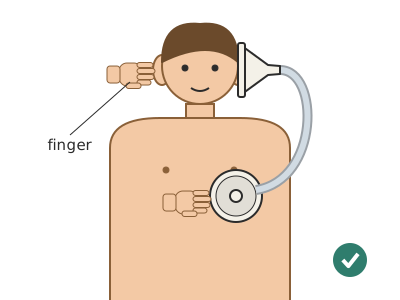
In a quiet room, sit still for 2 minutes. Place the membrane on bare skin or a thin T-shirt, below the left nipple (orange circle on map C), and press a little. Put the small funnel over your ear and block your other ear with a finger.
1 Find the orange circle on map C 2 Press the membrane there, funnel on your ear, and block the other ear 3 If you can't hear it, move it 2 cm at a time without lifting it Tip: If you can't hear it, move the funnel 2 cm at a time without lifting it and hold your breath for 5 seconds.Count your resting pulse
With the stopwatch, count the "ba-dums" for 15 seconds (each pair of thumps is one beat). Multiply by 4 and write down the result: that's your beats per minute.
1 Count the "ba-dums" for 15 seconds 2 Multiply by 4 and write it down: that's your beats per minute Tip: Example: 22 beats in 15 s × 4 = 88 beats per minute.Jump and listen again
Do 20 jumps with your feet together (or run for 1 minute) and listen straight away. Count for 15 s again and multiply by 4. Repeat after 1 minute and after 3 minutes to see how it comes back down.
1 Do 20 jumps with your feet together 2 Listen straight away and count again: 15 s × 4 3 Repeat after 1 minute and after 3 minutes: the pulse comes back down Clean and store
Clean the ear funnel with an alcohol wipe before someone else uses it. Store the stethoscope with the tube loosely coiled (loops of 15 cm or more) so it doesn't kink.
1 Clean the ear funnel with an alcohol wipe 2 Coil the tube loosely, in loops of 15 cm or more
Does it work? The test
In silence, with the membrane below the left nipple, listen for 15 s at rest, right after 20 jumps, and after 1 and 3 minutes.
What should happen: You can clearly hear two thumps per beat ("ba-dum" or "lub-dub"). At rest, a child aged 6–12 has about 70–110 beats per minute; after 20 jumps it goes up by 20–50 and returns to normal within 2–3 minutes. Scratching the membrane sounds loud; with the membrane in the air you can hardly hear anything.
If something goes wrong
- You can't hear anything — A leak at a joint or a slack membrane. Solution: Seal the joints with electrical tape and stretch the balloon again until it sounds like a drum.
- There is a lot of rubbing noise — The membrane is moving over clothing or the tube is rubbing against something. Solution: Press it on bare skin or a thin T-shirt, keep still and don't touch the tube while listening.
- The heartbeat is very faint — Wrong spot, background noise or the earpiece isn't sealing the ear. Solution: Find the spot below the left nipple, turn off the TV and press the small funnel against your ear with your hand.
- The tube slips off the funnel — Spout too thin. Solution: Thicken the spout with 2–3 turns of electrical tape before fitting it.
- The tube kinks and stops working — Tubing too soft or bend too tight. Solution: Use tubing with a 1.5–2 mm wall and avoid bends with a radius under 5 cm.
- You hear a hum or a "seashell" sound — The open earpiece is picking up noise from the room. Solution: Seal your ear well with the funnel and block the other ear with a finger.
Safety
- Never shout, blow hard or tap the membrane while someone else is listening: the sound goes straight into their ear.
- Don't put the tube or anything else into the ear canal: the funnel rests over the ear.
- Balloons: pieces of balloon can choke children under 8; pick up all the offcuts. Watch out for latex allergies.
- The craft knife or saw for trimming the spout is used by an adult.
- This is a science toy, not a medical device: if you hear something that worries you, see the paediatrician; don't make diagnoses.
The science behind it
For children
Every time your heart beats, some little doors inside it (the valves) close and go "ba-dum", like a door shutting. That little thump makes your chest shake a tiny bit. The balloon rubber, tight like a drum, shakes with it and pushes the air in the tube. Because the air is shut in, the shaking can't escape and travels along the tube to your ear, just like a voice through a toy tube. After jumping, your muscles need more blood and your heart beats faster.
For the adult
Heart sounds are low-frequency vibrations (20–200 Hz) produced as the valves close: the first (S1) by the atrioventricular valves (mitral and tricuspid) at the start of systole, the second (S2) by the semilunar valves (aortic and pulmonary) at its end. The chest wall vibrates with amplitudes of microns. The membrane (diaphragm) couples that vibration to a small, closed volume of air (funnel + tube ≈ 60–80 cm³): a tiny displacement of a large surface (≈ 44 cm² for Ø 75 mm) produces a noticeable pressure change, and the tube acts as a waveguide that prevents the spherical spreading of sound (in open air intensity falls off as 1/r²). Any leak acts as a high-pass filter and removes precisely the heart's low frequencies; a long or soft tube attenuates through friction with the wall. The tight membrane slightly emphasises mid frequencies (lungs, 100–1000 Hz); without a membrane (a bell placed directly on the skin) low frequencies are heard better. Resting heart rate in children aged 6–12 is ≈ 70–110 bpm and rises with exercise because of the muscles' greater O₂ demand (sympathetic stimulation).
- vibration: a quick back-and-forth movement that makes sound.
- membrane: a thin, tight sheet that vibrates with sound.
- valve: a door in the heart that lets blood through in one direction only; it makes a sound when it closes.
- pulse rate: the number of heartbeats in one minute.
- stethoscope: a doctor's instrument for listening to sounds in the body.
By age
- 5–7 years: The adult fits the spouts and stretches the balloon; the child puts on the tape, does the scratch test and listens. Instead of counting for 15 s, they can copy the rhythm by clapping "slow" and "fast".
- 8–10 years: They assemble everything, count for 15 s and multiply by 4. Have them make the family table.
- 11–12 years: Have them draw a graph of pulse recovery after exercise and compare tubes of different lengths and diameters. Challenge: a two-ear stethoscope with a Y-piece.
In a group or in class
Pairs: one stethoscope per pair (50 cm of tubing, 2 funnels, 1 balloon). A 10 m roll of tubing is enough for 20 stethoscopes. Before the session: cut the tubing, check the funnels fit and ask about latex allergies. 45-min session: 20 min assembly, 10 min finding the heartbeat in silence (ask the group for total silence), 15 min of jumping and measuring with a shared table on the board. Alcohol wipes on every table to clean the earpieces.
Challenges
- Build a two-ear stethoscope with an aquarium Y-piece and two small funnels.
- Design the most sensitive chest piece: try funnels of Ø 50, 75 and 100 mm and membranes of balloon and cling film.
- Listen to a clock ticking through a wooden table: does sound travel better through wood or through air?
- Record the heartbeat with your phone's microphone held against the small funnel and count the peaks in the waveform.